Showing posts with label bouquets. Show all posts

Friday, September 7, 2012

Violet


Future scholars of the better florists of Edwardian London may well be indebted to Violet W. Stevenson, whose Successful Flower Marketing and The Encyclopaedia of Floristry, though published respectively in 1952 and 1954 by W. H. Collingridge Limited and Transatlantic Arts Incorporated, appear to codify many practices that must have been firmly established fifty years earlier. Miss Stevenson’s style is brisk, sensible, and businesslike. Aesthetic judgments are cautious but firm, her emphases generally technical: for instance, one is struck by the elaborateness and sheer number of fiddly processes of wiring, indeed the enormous quantity of wire that went into every arrangement and bouquet—nine different gauges in various lengths, on reels, and in coils used for many different purposes such as strengthening stems, straightening leaves, and preventing blooms from disintegrating prematurely. All of this is reminiscent of the ostrich-feather industry, which was similarly wire dependent. Miss Stevenson’s business was obviously geared towards furnishing “shower bouquets” for weddings as opposed to presentations at Court, though the finished articles themselves must have been pretty much identical, a froth of blooms and wispy ferns that could easily descend as far as the hem, if not farther. By the 1950s tuberoses had gone out of fashion, presumably absorbed by the booming postwar fragrance industry, though wartime austerities must surely have played their part. The article on gladioli is somewhat surprising, commending as it does their usefulness in creating enormous corsage ornaments, as well as structuring bouquets and sheaves around them. Imagine the size of a corsage ornament consisting of a couple of thrusting glads. No doubt this fashion was the target of Barry Humphries’s 1955 creation of Mrs. Everage. “It should not be assumed,” writes Miss Stevenson, “that grasses are only permissible in Victorian floristry. Modern designs lend themselves quite well to certain varieties of grass, not the quaking grass of our grandmothers but the bolder, water-grass, eryanthus, wheat and barley. Most of these are obtainable from the [horticultural] sundriesman in their natural colours, bleached or dyed.” According to the OED, quaking grass, n., is “any of various grasses of the genus Briza, having broad, flattened spikelets dangling on slender stalks which tremble in the breeze; esp. (more fully common quaking grass) B. media, which is widely distributed in Eurasia,” and was therefore, of course, ideal for the sort of tremulous shower bouquets that we have seen in considerable abundance at the glittering evening Courts of King Edward and Queen Alexandra at Buckingham Palace.

As one might expect, Miss Stevenson’s mini-dissertation on color rewards close inspection. “The development of colour consciousness,” she writes, “and the true appreciation of colour harmony is an essential qualification for the would-be successful florist,” and their under-development, by implication, almost a guarantee of failure. “There is often so little regard to the suitability of certain colour combinations that far too many floral designs appear to have been assembled with little or no thought of colour harmony...It is not enough to say that the hue of one flower never clashes with another unless you embrace the whole subject and go on to add, when sufficient green is present in stem and foliage to act as a buffer between each colour and the next. No florist can afford to disregard the value of green. It is an important ingredient in floral colour harmonies.” Miss Stevenson does tend to state identical points twice in neighboring sentences, for emphasis. She goes on to recite the standard line on primaries, secondaries, and complimentaries in the color spectrum; the distinctions between hue and tone, shade and tint, pure and “broken” colors, and between contrasting and analogous two- and three-color harmonies. She warns against unfortunate stridency or the jarring effect of ill-conceived adjacencies, and suggests ingenious methods of re-introducing softness and/or pallor. Here, I think, we may identify the point at which Miss Stevenson diverges from her Edwardian predecessors, for not long ago we observed that for them no color combination was too riotous, no effect of texture too assertive or forceful, and no shape or assemblage disproportionate in scale, on the contrary. Wisely, however, Miss Stevenson advises against coronet and veil ornaments composed of lilies, daisies, or daffodils (!), recommending instead “waxy, white flowers, such as stephanotis, gardenias, or camellias, that have about them a slight air of luxury.” And it is back to luxury that this curiously neglected branch of London commerce invariably leads us.

Saturday, September 1, 2012

The florists again

In chapter 20 of Moths (1880), the curious novel by “Ouida,” the self-styled Marie Louise de la Ramée, a great singer, Monsieur de Corrèze, presents “to the Princess Zouroff, an English girl who has been sacrificed to a barbarously rich Russian, a special memento...: ‘He brought her a great bouquet of Alpine roses, and in the midst of the roses was the rare dark-blue Wolfinia Carinthiana [sic] which grows upon the slops [sic] of the Gärtnerkögel [sic], and nowhere else in the world, they say.’” (Notes and Queries, June 26, 1937, p. 459.) Wulfenia carinthiaca was indeed native to the slopes of the Gartnerkofel, close to what is now the Austrian border with Italy, but by 1880 it obviously also formed part of the vast smorgasbord of ingredients at the disposal of the better London florists—though Ouida herself by then lived at Bellosguardo, above Florence. As far as I can tell from my researches, which have been hampered by the fact that I can locate not a single history of society fleuristes operating in any market or era, late Victorian and Edwardian practitioners were prepared to insert absolutely anything into “shower and châtelaine” floral bouquets (for presentation at Court) so long as they were (a) large, (b) rare, and therefore (c) incredibly expensive. In the case of various species of red-hot-poker (Kniphofia) the more adventurous were obviously prepared to set to one side the basic principle of beauty, the better to create what strikes me as a more than vaguely menacing effect. Imagine coming face to face with a lady armed with a large bouquet composed of Strelitzia reginae and red-hot-pokers.

Those of my readers who have stayed with me up to this point will understand why I am curious to hear directly from the society fleuristes of London during the Edwardian era, for their voices have fallen almost completely silent, if ever they were heard at all. However, two rare utterances will get us started. Both were printed in the gossip pages of The London Journal, and although separated by more than a decade each sheds a little light on the florist’s workroom and salon.

The first is a “Chat with a Fashionable Florist” (Vol. 29, No. 756, June 11, 1898, page 526).
On my books I have scores of people whom I supply daily throughout the season with the most exquisite flowers within reach…I supply many young aristocrats every morning with choice buttonholes, the price of which amounts to twenty shillings a week, for you must remember that the flowers are often rare. Strangely enough, I rank many old men amongst my best customers, and they are more particular than anyone as regards their buttonholes. Of course numbers of sprays are ordered by young men for their sweethearts, and even ancient dandies express their sentiment in this tasteful manner.
Who is this speaking? There are some clues. “On my books,” “young aristocrats,” “many old men,” “sweethearts,” “ancient dandies,” and, of course, being more than willing to discuss money—these point to a solidly middle-class proprietor, alert to the advantages of publicity, where the shrewdest high-end florist would almost certainly avoid any such disclosures to the press, in the interests of discretion. There is also a sense in which the speaker builds a head of steam:
I remember receiving an order from an old gentleman, who must have reached the allotted span of three score years and ten, to supply a young and pretty titled lady with a spray every morning she happened to be in the metropolis. The flowers were always sent according to the injunctions given, and just as regularly returned, the lady evidently not appreciating the attentions of the old beau. This state of things was duly reported to the gentleman, but without the slightest hesitation he instructed us to continue delivering the flowers, together with an occasional bouquet, which we did until the lady came personally to request us to desist. I have had many cases similar to this. Men frequently order flowers to be sent to ladies—beautiful, of course—with whom they are not acquainted, and the recipients often come round to ascertain the name of the donor, or to say that no more flowers are to be sent to them from such and such a person.
The phrase “three score years and ten” suggests to me that our florist was then middle aged, and that distinct air of advertorial—combined with gossip that, in Edwardian terms, verges on the positively risqué—suggest to me that we are dealing with, at best, a second-tier retailer, maybe a garrulous bachelor (though this is not entirely clear), but evidently also relatively successful, probably occupying premises in Mayfair, Knightsbridge, or Kensington.

The second piece (“The West End Florist Girl,” March 11, 1911, page 468) is far more detailed and interesting. It is a condescending account of a conversation between the writer and the “pretty young lady” who sold him his buttonhole.
The fair florist seemed inclined to take a pessimistic view of things in general, and did not display that enthusiasm for her business which he had imagined so pleasant an occupation would inspire.

“It is certainly not the most charming work in the world,” she said, “though I believe lots of girls envy us florists’ assistants, believing that we have a very easy time of it. There are so many drawbacks in the business, you see. In the first place, our hands are constantly in water, and that makes them red and hard. Then, again, the thin wires which we have to use cut our fingers terribly, and if you look at my hands you will see the marks now.

“Yes, we are fairly well remunerated; but the hours are rather long in most West End shops. We are supposed to be here at eight a.m., when we get the shop ready for the day, make up the ‘display’ board for the window, and so on. We get half an hour for lunch, and ten minutes for tea, finishing work as a rule at eight or half-past, though, of course, at busy times—say at the height of the season, when weddings and balls are in full swing—we are often here till midnight.

“We get some curious customers sometimes, of course. What shop doesn’t? Old ladies are the most annoying. We have any amount of them in here during the week, and the amount of cut flowers which they expect, say, for half a crown or three shillings is simply past comprehension.  You would hardly believe how grasping some of them are. One old lady, though, proved a notable exception, for she made very large purchases, and when she was leaving she insisted on my accepting half a sovereign to reward me, as she said, for the attention I had shown her. Such customers are rare, however.

“A young coster chap [a street seller usually of fruit], who evidently had just come in for a stroke of luck, slouched in here this morning and asked for a buttonhole. He was not content with one flower, but had three separate buttonholes wired together and fastened in his coat. Then he left the place looking as conceited as a peacock.

“We have our regular people naturally. There is one old gentleman, a banker, I believe, who comes in here regularly every morning at ten o’clock for a bunch of violets, winter and summer, and we always have a bunch ready for him, no matter how scarce the flowers may be. Curiously enough he never speaks a word, either on entering or leaving. I do not think I know the sound of his voice. He walks in quietly, nods to us all, and calmly waits for the violets, whereupon he enters his motor and takes his departure. We send him a bill quarterly, to save him the trouble of paying every day.

The writer then proceeded to put a somewhat delicate question. He asked whether any of the young men customers ever tended in the direction of flirtation while ostensibly in the pursuit of buttonholes. The young lady answered, with asperity:

“No. Do you want to class us with barmaids or teashop girls?”

The writer humbly begged her pardon, and pleaded his want of experience in such matters.

“On the contrary,” she continued, “it sometimes quite astonishes me to see how reticent and almost nervous the majority of the gentlemen who come in here are. Many of them ask for their flowers in a whisper, as though they were in a church, and I may honestly affirm that nothing in this way of your suggestion ever occurs in this establishment. Of course,” she added, with an arch glance, “the other girls may have different opinions; but that is mine.

“Do we have to serve an apprenticeship to the business? Oh, yes. That is quite indispensible. I myself was apprenticed for six months to a suburban florist, where I learned the rudiments of the work. Then I became what is called an ‘improver,’ that is to say, I gave my services gratuitously, after which I was promoted to the position of third hand, then second, and now,” she concluded with a smile, “I am a first hand, and no higher rank can be mine until I satisfy the dream of my life, which is—”

“What?” queried the writer.

“To have a shop of my own.”

The writer assured the fair damsel that when this event came off he would be the first to patronize the new establishment, and then reluctantly took his way out of the sweet-scented realm into the land of noise and bustle, motor smells and grimy smoke.
As journalism, of course, this is cloying rubbish, apparently trivial and certainly determined to be trivializing, but for any social historian or chronicler of the luxury goods business it is gold dust. Here we have valuable hints at how a society florist really operated in Edwardian London. There were at least three ranks of “shop-girls” with sufficiently specialist skills as to require basic training. There must have been plenty of unskilled labor also: porters and errand boys, someone to light the fires, sweep the workroom floor, and naturally at least one person in charge who dealt with the agents and suppliers at the wholesale end. A working knowledge of botany might have been useful up to a point, if only to avoid combinations that were then regarded as mutually destructive, for example roses and mignonettes, or roses and carnations—apparently each was believed to cause the other to wilt—or to isolate certain flowers such as violets and pansies that lasted far longer on their own, or similarly to extend the life of daffodils and jonquils by adding plenty of fresh green leaves. (Notes and Queries, March 22, 1913, p. 231.) Yet, in a far broader sense, this young woman represents the aspirational dimension of the Edwardian lower middle class. Our florist was almost painfully aware of nuances of rank. She was contemptuous of vulgar counter-jumping. She laid claim to respectability. She was realistic about the hardship of manual work, yet quite aware of the value of her skills, and of money in general. She was quite possibly also equipped with basic accounting skills (because of the gentleman banker’s quarterly bill). Above all she was possessed of the ambition to open her own shop. All of this is good to know, and to parse with care. But what about her proprietor, who might well have been mortified (as indeed the young woman would have been shocked) to discover that her conversation had been scribbled down, filed as copy, and the identity of an all too readily identifiable customer unwittingly disclosed in one of the lesser weeklies? What, after all, did the gentleman do with his daily supply of violets? They were almost certainly not intended for the chief cashier at his bank. The young woman managed to disclose her own identity, too, and with considerable pride, as the first hand. Could this disaster have cost them the gentleman banker’s account, or even lost her her job?

Friday, August 31, 2012

The florists


I may have over-emphasized the cumbersome character of the exotic “shower and châtelaine” floral bouquets that were hauled through Buckingham Palace by ladies being presented at Court during the reign of King Edward VII. In her regular column, “Fashion Notes,” for Bow Bells: A Magazine of General Literature and Art for Family Reading (Vol. 21, No. 268, February 17, 1893, page 177), the chatty but authoritative columnist known as “Iris” reported an exciting recent development:
The season is already anticipated, and we are contemplating the dress of the [afternoon] Drawing-rooms [at Buckingham Palace]; for these there will be a new and pretty arrangement of flowers, now such very important portions of Court costume. Hitherto it has been found by the inventor of the posy, shower, and châtelaine bouquets that the poke forward given by the handle somewhat marred the effect. A new and clever invention has therefore been patented under the title of the “Victoria Shower,” in which there is no apparent handle to a light, graceful, feathery mass of bloom and foliage. Not so great a mass either, since the new shower is smaller than the old one. The flowers are so settled that the hand is inserted right into the centre of the sprays, which fall over and round it. It is very light, the balance is quite equal, the flowers can be held quite close to the wearer’s figure, avoiding all appearance of bulkiness, and the shower can be laid down anywhere without injury to the flowers. These are (writes an expert) all estimable things in a floral appendage to court dress, and go very far to recommend the new invention, which is so simple in construction that it seems wonderful it should not have been thought of before.
It is difficult to judge whether Edwardian Court bouquets, which seem to have refreshed, indeed exaggerated, the late-Victorian twin concepts of bulk and poke, relied upon the ingenious undercarriage afforded by this Victoria Shower device, whatever it was. However, if these creations were marginally less cumbersome than they look, they were every bit as expensive. In a long article (part of an intriguing series) entitled “Flowers of the Market” in The Leisure Hour (March 1894), W. J. Gordon noted that the “London flower-bill apparently averages £1,000 a day, and all the area of the London parks twice over could not provide enough for the annual supply.” Interviewed by The London Journal four years later (Vol. 29, No. 756, June 11, 1898, page 526), “a fashionable florist” estimated that £5,000 was daily spent on cut flowers in London. The wholesale flower markets were, of course, in Cheapside and Covent Garden, but this was more than simply a point of distribution for local and imported blooms. Not unlike the ostrich feather industry, it was essentially a valuable international commodity exchange:
In Japan there are bulb farms on much the same lines as the Dutch ones [for tulips], but the crop is mostly lilies. The bulbs are shipped, packed in cases averaging a thousand each, and come to London by every P. & O. steamer. One firm alone—that of Protheroe & Morris, in Cheapside—sell 300 tons of Lilium auratum [Japanese mountain lilies] in a year, to say nothing of the less popular lilies like album [Martagon], rubrum [red Japanese], Krameri [bamboo], etc. At the moment of writing a sale is taking place in which 427 cases from Japan, containing over 40,000 bulbs of sixteen species of Lilium, in addition to 40,000 African tuberoses and other plants, are to be disposed of during the afternoon. Although these lily bulbs come to London, it does not follow that they stay here. At every sale, lots are bought for all parts of the country, and for Germany, France, Belgium, and America…Another foreign bulb running into hundreds of thousands is the tuberose. In one shipment alone, at one of these sales, 270,000 were sold. These came from New York; but South Africa sends to Cheapside 800,000 tuberoses a year. Another bulb that crosses the Atlantic eastwards is Lilium Harrisi, from the Bermudas, as many as 200,000 passing through the sale-room, shipped direct, in addition to what find their way here through the American ports. Orchids are somewhat of a luxury, but we can hardly leave Cheapside without mentioning the Friday sales, through which last year passed over 200,000 established orchids, to say nothing of the miscellaneous and, therefore, speculative. But all orchid-buying is more or less a speculation. A man bought an orchid here for nine shillings, thinking it was a well-known variety; it flowered and proved a rarity, and he brought it back to sell it again under the hammer for forty-five guineas. Others have bought orchids for a shilling, and doubted if they were worth it; some have paid at these sales £300 and more for a single plant, but this would hardly be a flower of the market. The ordinary orchids come in bundles, mostly from Brazil and Madagascar…
Perhaps the liveliest and most telling portion of Mr. Gordon’s account of the London wholesale flower trade is his description of an auction sale at Covent Garden. It is a fascinating exercise in historical reconstruction to imagine the agents, representatives, or junior staff of Carlton–White, Madame Josephine, or Messrs. Felton—perhaps even young Mr. Felton himself—navigating that raucous coal-face side of their business, and afterwards returning to crowded workrooms secreted far above or behind their hushed premises in North Audley Street or Hanover Square or the Royal Arcade, and converting such raw material into four dozen ladies’ shower and châtelaine bouquets at 20 guineas apiece, with a profit margin of more than 2,000%:
In Covent Garden an auction sale of foreign flowers is an uproarious affair, a deafening tumult of half a dozen crowds, punctuated with bangs of the hammer that make the old Floral Hall ring again. The “furniture” for each crowd consists of a rostrum in which sit the auctioneer and a couple of clerks, a platform in front where stand up two porters, and three sides of a square made up of portable staging three or four tiers high, crowded with noisy dealers and bystanders overlooking the equally noisy group in the middle. Basket after basket, box after box, is handed in from the back. One man near the platform cuts the string or wrenches up the lid; the porter to the left opens the package and hands up the delivery note over his shoulder to the clerk, who passes it to the auctioneer; and while the auctioneer glances at it, the other porter grasps a bundle of flowers rfom the package, gives them a shake, and holds them up as a sample. Now and then above the tumult you can hear snatches of what the auctioneer is saying: “Fresh from the shores of the blue Mediterranean—;” roar; “Ah! here is something fine—;” roar; “Beautiful—;” a sound as of a train in a tunnel; bang; bang; “All the same—;” roar; bang. Basket after basket, faster and faster, the bangs going four a minute, five a minute, ten a minute, the crowd yelling louder and louder, and waving their hands and frantically gesticulating. Go there at eleven o’clock on a Wednesday and see it; and wonder how a few hundred men in four or five furious groups can make such a hideous hullabaloo.
There is probably not much difference between the methods and manners of the wholesale flower trade versus the hush and polish of highest-end florists in New York and London today, but what is surely different is the degree to which Court florists of Edwardian London slaked an insatiable thirst for the rarest blooms such that their uppermost end was infinitely higher than ours.

Thursday, August 30, 2012

The Evening Courts again


When at length, after the end of the Great War, evening Courts resumed at Buckingham Palace a number of reforms were wisely instituted through the Lord Chamberlain’s department, of which perhaps the most significant was the decision to make the enormous floral bouquets of earlier reigns optional. As reported in The Times on Friday, May 19, 1922 (“Bouquets for the Court: Flower Fashions of To-Day,” page 7):
The Court florists are keenly interested in the result of the “bouquets optional” decision which is written in pencil on the four sketches which are being shown at the Ceremonial Office. The florists have not been doing well for a long time owing to the high price of flowers and the general reluctance to spend money on the most forgivable and most perishable of all luxuries. And there is a fear that “bouquets optional” may result in a “fan” Court. However, the occasions in a woman’s life when she can carry a bouquet are so few that it is probable that the florists’ fears are groundless and that many women will avail themselves of the opportunity. The modern [post-War] bouquet, which is an adaptation of the Early Victorian bouquet, is far more lasting than the shower bouquet of past Courts, which flagged during the long wait before its owner made her bow to her Sovereign. Shower bouquets are still carried by the bride’s mother and the bridegroom’s mother at weddings, but brides generally carry sheaves and their maids Victorian bouquets. The latter are so tightly packed that even if one flower droops it is not noticeable among many, and the wire handle makes it easier to manipulate. The making of a Victorian bouquet is a work of art, for to secure the even circle of colour many of the flowers have to be picked to pieces and put together again. Among the little flowers suitable for these bouquets which will be in bloom at the time of the first Court are iris, mignonette, carnations, wallflowers, forget-me-nots, pansies, love-in-a-mist, stocks, moss roses, and white and mauve lilac. The little flowers are often the sweetest, and the perfume of a Victorian bouquet is a simpler thing, even with its many scents, than that of the exotic hothouse shower variety.
Fashion being so often a matter swinging pendulums, of sharp reaction from one decade to the next, there is much here that sheds light on the conventions of Edwardian Court protocol with which I have been so preoccupied lately, specifically that exotic hothouse shower bouquet which throughout the first decade of the twentieth century ladies were positively obliged to carry when being presented at Court. Towards the beginning of the reign of King Edward VII, according to an article by Mary Howarth in the Pall Mall Magazine, “the florists were fluttered by an announcement that arose in aristocratic circles that bouquets were no more to be allowed, because they took up too much room [my italics].” This proposed reform was evidently abandoned under strong pressure from the Court florists, who, if advertisements published on the front page of The Times are an accurate indication, outnumbered Court dressmakers and Court hairdressers (whose principal function was to install and secure tiaras, veils, and white ostrich-feather headdresses) by a factor of three. Such businesses came and went. In 1890, for example, the partnership of “Wellesley and Smith, formerly under the style of Madame Josephine, of Lower Grosvenor Place, S.W., Court florists” dissolved amid much acrimony—but in the Edwardian decade the main players, led by Edward Goodyear of The Royal Arcade, Albemarle Street, and Old Bond Street (who held a royal warrant), were: G. Adam and Company at 42 New Bond Street; John Barker and Company of Kensington High Street; Carlton–White at 53 New Bond Street; Messrs. Felton and Sons of Hanover Square; The London Flower Company (proprietor Howard Howes) at 22A North Audley Street; R. Silvester of 105 Gloucester Road, Queen’s Gate; G. Strudwick of 20 and 21 Bayswater Terrace, Kensington Gardens; Mr. Titt of Windsor, and L. O. Walter, 31 Bryanston Street.

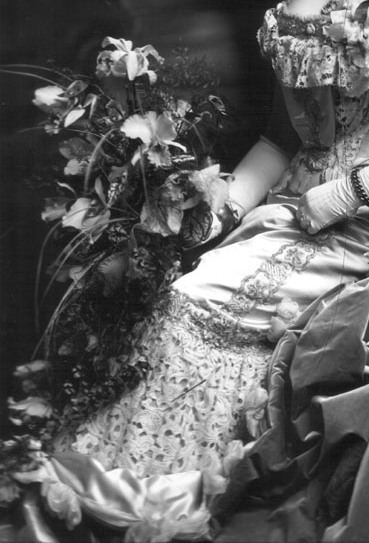
These firms supplied ladies with often floor-length bouquets comprising sprays of pungent gardenias, roses (damask, tea, briar), clove-scented malmaison carnations, nodding white eucharis, Belgian camellias, Japanese lilies, calla lilies, prong-like mignonettes, orange-blossom, jasmine, African tuberoses, giant narcissi, clematis, mimosa, Roman hyacinths, Dutch tulips, Chinese fuchsias, and above all rare orchidsthe longest possible sprays of the largest, spottiest, stripiest, frilliest, and most carnivorous-looking blooms. Arrangements of these could assume the dimensions, weight, and cumbersome clamminess of a mutant cabbage, from which also dangled a Portuguese man o war root system consisting of tendrils, vines, maidenhair fern, myrtle, ivy, wormwood, lady’s laces, and fragrant eucalyptus. Even as one entered one’s state coach, it was almost as if these were still trailing out the front door. Tied with a broad watered-silk ribbon, the raw materials for these crazy Edwardian floral effusions ultimately came from the twice-weekly wholesale auction sales in Covent Garden, and, once assembled by the Court florists, could easily cost more than twenty guineas, a third more than the Dowager Empress Marie Feodorovna of Russia paid in St. Petersburg for that fan. The journey to Buckingham Palace therefore involved carrying a bulky three-and-a-half to four yard train over one gloved arm; preventing it from getting crushed; holding the enormous bouquet in one hand, being careful not to squash the delicate fronds, and, in the other, a folded fan and a reticule or small purse and an entrée card, all the while balancing a diamond tiara and clutch of two or three bouncy ostrich feathers on your head. These were vulnerable to an unfortunate yank on the regulation white veil that descended from them. Once you reached the Palace, there ensued a crush in the vestibule. An army of ladies’ maids took wraps and cloaks in exchange for a numbered ticket (which had to be received and put away). You then proceeded up staircases and through packed corridors under hot new electric lights. Yet by convention ladies approaching the King and Queen were not permitted to open their fan, and nor could they let go of their train or their bouquet or their card:
Now the moment of all moments arrives: the presence of Royalty is entered. Each lady has her card in her hand (and each gentleman has his); she delivers it to the functionary nearest the barrier after it has been passed; and at the moment she is inside the [Ball-]room is conscious that her train is being gently taken from her arm, where she has up to that moment jealously and lovingly borne it, by one of the Gentlemen-at-arms, and cleverly spread by two of them upon the floor. As she glides onwards her card is passed from hand to hand until it is taken by the Lord Chamberlain himself. Lord Clarendon stands at the King’s left hand. Deliberately he reads the card, deliberately scans the donor of it over his spectacles, as if to satisfy himself that all is absolutely to his judgment, ripe and right for the important procedure of announcement, and then in a clear voice he speaks the name, or, should the case be that of a debutante, announces her chaperon’s first, adding that of the lady she is presenting. When her name is uttered the lady is face to face with her King; she curtseys very, very low to him. The King bows, bestowing upon her that most gracious smile which seems to convey to her a direct message of hospitable welcome. Then a few steps further she moves: she is face to face with her Queen. Again she curtseys very, very low. Her Majesty inclines her head and sweetly smiles. Onward she goes, her obeisances all made. At the portal on the other side, as if by magic, her train is returned to her arm and she passes out…
...by which Miss Howarth surely meant “leaves the room,” and not “loses consciousness”—although it is inconceivable that these rituals did not from time to time claim at least a few victims of fainting, or even heart attack. Meanwhile, bearing in mind all the encumbrances, how was one supposed to tackle the supper room afterwards, viz. “the most delicately delightful ‘little’ dishes, and superlatively charming cakes and creams...[which forms of refreshment were] taken standing”? How, indeed, did one contrive simply to keep one’s balance when either the floors were polished up to the smooth slipperiness of plate glass, or else the deep pile of silk carpets tugged powerfully at one’s various layers of hem?