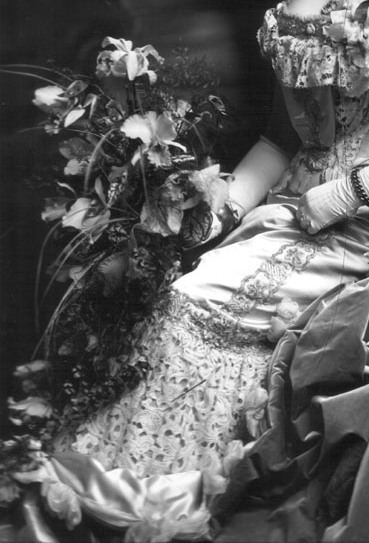
In chapter 20 of Moths (1880), the curious
novel by “Ouida,” the self-styled Marie Louise de la Ramée, a great singer,
Monsieur de Corrèze, presents “to the Princess Zouroff, an English girl who has
been sacrificed to a barbarously rich Russian, a special memento...: ‘He brought
her a great bouquet of Alpine roses, and in the midst of the roses was the rare
dark-blue Wolfinia Carinthiana [sic]
which grows upon the slops [sic] of the Gärtnerkögel [sic], and
nowhere else in the world, they say.’” (Notes and Queries, June 26,
1937, p. 459.) Wulfenia carinthiaca was indeed native to the slopes of
the Gartnerkofel, close to what is now the Austrian border with Italy, but by
1880 it obviously also formed part of the vast smorgasbord of ingredients at the disposal of the better London
florists—though Ouida herself by then lived at Bellosguardo, above Florence. As far as I can tell from my researches, which have been hampered by
the fact that I can locate not a single history of society fleuristes operating
in any market or era, late Victorian and Edwardian practitioners were prepared
to insert absolutely anything into “shower and châtelaine” floral bouquets (for
presentation at Court) so long as they were (a) large, (b) rare, and therefore (c)
incredibly expensive. In the case of various species of red-hot-poker (Kniphofia)
the more adventurous were obviously prepared to set to one side the basic
principle of beauty, the better to create what strikes me as a more than vaguely
menacing effect. Imagine coming face to face with a lady armed with a large
bouquet composed of Strelitzia reginae and red-hot-pokers.
In chapter 20 of Moths (1880), the curious
novel by “Ouida,” the self-styled Marie Louise de la Ramée, a great singer,
Monsieur de Corrèze, presents “to the Princess Zouroff, an English girl who has
been sacrificed to a barbarously rich Russian, a special memento...: ‘He brought
her a great bouquet of Alpine roses, and in the midst of the roses was the rare
dark-blue Wolfinia Carinthiana [sic]
which grows upon the slops [sic] of the Gärtnerkögel [sic], and
nowhere else in the world, they say.’” (Notes and Queries, June 26,
1937, p. 459.) Wulfenia carinthiaca was indeed native to the slopes of
the Gartnerkofel, close to what is now the Austrian border with Italy, but by
1880 it obviously also formed part of the vast smorgasbord of ingredients at the disposal of the better London
florists—though Ouida herself by then lived at Bellosguardo, above Florence. As far as I can tell from my researches, which have been hampered by
the fact that I can locate not a single history of society fleuristes operating
in any market or era, late Victorian and Edwardian practitioners were prepared
to insert absolutely anything into “shower and châtelaine” floral bouquets (for
presentation at Court) so long as they were (a) large, (b) rare, and therefore (c)
incredibly expensive. In the case of various species of red-hot-poker (Kniphofia)
the more adventurous were obviously prepared to set to one side the basic
principle of beauty, the better to create what strikes me as a more than vaguely
menacing effect. Imagine coming face to face with a lady armed with a large
bouquet composed of Strelitzia reginae and red-hot-pokers.
Those of my readers who have stayed with me up to
this point will understand why I am curious to hear directly from the society fleuristes
of London during the Edwardian era, for their voices have fallen almost completely silent, if
ever they were heard at all. However, two rare utterances will get us started. Both
were printed in the gossip pages of The
London Journal, and although separated by more than a decade each sheds a little
light on the florist’s workroom and salon.
The first is a “Chat with a Fashionable Florist”
(Vol. 29, No. 756, June 11, 1898, page 526).
On my books I have scores of people whom I supply daily throughout the season with the most exquisite flowers within reach…I supply many young aristocrats every morning with choice buttonholes, the price of which amounts to twenty shillings a week, for you must remember that the flowers are often rare. Strangely enough, I rank many old men amongst my best customers, and they are more particular than anyone as regards their buttonholes. Of course numbers of sprays are ordered by young men for their sweethearts, and even ancient dandies express their sentiment in this tasteful manner.
Who is this speaking? There are some clues. “On my books,” “young
aristocrats,” “many old men,” “sweethearts,” “ancient dandies,” and, of course, being more than willing to discuss money—these point to a solidly middle-class proprietor, alert to the advantages of publicity, where the shrewdest
high-end florist would almost certainly avoid any such disclosures to the
press, in the interests of discretion. There is also a sense in which the
speaker builds a head of steam:
I remember receiving an order from an old gentleman, who must have reached the allotted span of three score years and ten, to supply a young and pretty titled lady with a spray every morning she happened to be in the metropolis. The flowers were always sent according to the injunctions given, and just as regularly returned, the lady evidently not appreciating the attentions of the old beau. This state of things was duly reported to the gentleman, but without the slightest hesitation he instructed us to continue delivering the flowers, together with an occasional bouquet, which we did until the lady came personally to request us to desist. I have had many cases similar to this. Men frequently order flowers to be sent to ladies—beautiful, of course—with whom they are not acquainted, and the recipients often come round to ascertain the name of the donor, or to say that no more flowers are to be sent to them from such and such a person.
The phrase “three score years and ten” suggests to me that our florist was then middle aged,
and that distinct air of advertorial—combined with gossip that, in Edwardian
terms, verges on the positively risqué—suggest to me that we are dealing with,
at best, a second-tier retailer, maybe a garrulous bachelor (though this is not entirely clear), but evidently also relatively
successful, probably occupying premises in Mayfair, Knightsbridge, or Kensington.
The second piece (“The West End Florist Girl,”
March 11, 1911, page 468) is far more detailed and interesting. It is a
condescending account of a conversation between the writer and the “pretty
young lady” who sold him his buttonhole.
The fair florist seemed inclined to take a pessimistic view of things in general, and did not display that enthusiasm for her business which he had imagined so pleasant an occupation would inspire.“It is certainly not the most charming work in the world,” she said, “though I believe lots of girls envy us florists’ assistants, believing that we have a very easy time of it. There are so many drawbacks in the business, you see. In the first place, our hands are constantly in water, and that makes them red and hard. Then, again, the thin wires which we have to use cut our fingers terribly, and if you look at my hands you will see the marks now.“Yes, we are fairly well remunerated; but the hours are rather long in most West End shops. We are supposed to be here at eight a.m., when we get the shop ready for the day, make up the ‘display’ board for the window, and so on. We get half an hour for lunch, and ten minutes for tea, finishing work as a rule at eight or half-past, though, of course, at busy times—say at the height of the season, when weddings and balls are in full swing—we are often here till midnight.“We get some curious customers sometimes, of course. What shop doesn’t? Old ladies are the most annoying. We have any amount of them in here during the week, and the amount of cut flowers which they expect, say, for half a crown or three shillings is simply past comprehension. You would hardly believe how grasping some of them are. One old lady, though, proved a notable exception, for she made very large purchases, and when she was leaving she insisted on my accepting half a sovereign to reward me, as she said, for the attention I had shown her. Such customers are rare, however.“A young coster chap [a street seller usually of fruit], who evidently had just come in for a stroke of luck, slouched in here this morning and asked for a buttonhole. He was not content with one flower, but had three separate buttonholes wired together and fastened in his coat. Then he left the place looking as conceited as a peacock.“We have our regular people naturally. There is one old gentleman, a banker, I believe, who comes in here regularly every morning at ten o’clock for a bunch of violets, winter and summer, and we always have a bunch ready for him, no matter how scarce the flowers may be. Curiously enough he never speaks a word, either on entering or leaving. I do not think I know the sound of his voice. He walks in quietly, nods to us all, and calmly waits for the violets, whereupon he enters his motor and takes his departure. We send him a bill quarterly, to save him the trouble of paying every day.The writer then proceeded to put a somewhat delicate question. He asked whether any of the young men customers ever tended in the direction of flirtation while ostensibly in the pursuit of buttonholes. The young lady answered, with asperity:“No. Do you want to class us with barmaids or teashop girls?”The writer humbly begged her pardon, and pleaded his want of experience in such matters.“On the contrary,” she continued, “it sometimes quite astonishes me to see how reticent and almost nervous the majority of the gentlemen who come in here are. Many of them ask for their flowers in a whisper, as though they were in a church, and I may honestly affirm that nothing in this way of your suggestion ever occurs in this establishment. Of course,” she added, with an arch glance, “the other girls may have different opinions; but that is mine.“Do we have to serve an apprenticeship to the business? Oh, yes. That is quite indispensible. I myself was apprenticed for six months to a suburban florist, where I learned the rudiments of the work. Then I became what is called an ‘improver,’ that is to say, I gave my services gratuitously, after which I was promoted to the position of third hand, then second, and now,” she concluded with a smile, “I am a first hand, and no higher rank can be mine until I satisfy the dream of my life, which is—”“What?” queried the writer.“To have a shop of my own.”The writer assured the fair damsel that when this event came off he would be the first to patronize the new establishment, and then reluctantly took his way out of the sweet-scented realm into the land of noise and bustle, motor smells and grimy smoke.
As journalism, of course, this is cloying
rubbish, apparently trivial and certainly determined to be trivializing, but for any social historian or chronicler of the luxury goods business it is gold dust. Here we have valuable
hints at how a society florist really operated in Edwardian London.
There were at least three ranks of “shop-girls” with sufficiently specialist skills as to
require basic training. There must have been plenty of unskilled labor also: porters and errand boys, someone to light the fires, sweep the workroom floor, and naturally at least one person in charge who dealt with the agents and suppliers at the wholesale end. A working
knowledge of botany might have been useful up to a point, if only to avoid
combinations that were then regarded as mutually destructive, for example roses
and mignonettes, or roses and carnations—apparently each was believed to cause the other to
wilt—or to isolate certain flowers such as violets and pansies that lasted
far longer on their own, or similarly to extend the life of daffodils and jonquils
by adding plenty of fresh green leaves. (Notes and Queries, March 22,
1913, p. 231.) Yet, in a far broader sense, this young woman represents the
aspirational dimension of the Edwardian lower middle class. Our florist was almost painfully aware of
nuances of rank. She was contemptuous of vulgar counter-jumping. She laid claim to respectability. She was realistic about the hardship
of manual work, yet quite aware of the value of her skills, and of money in general. She was quite possibly
also equipped with basic accounting skills (because of the gentleman banker’s
quarterly bill). Above all she was possessed of the ambition to open her own shop. All of
this is good to know, and to parse with care. But what about her proprietor, who might well have been mortified (as indeed the young woman would have been shocked) to discover that her conversation had been scribbled down, filed as copy, and the identity of an all too readily identifiable customer unwittingly disclosed in one of the lesser weeklies? What, after all, did the gentleman do with his daily supply of violets? They were almost certainly not intended for the chief cashier at his bank. The young woman managed to disclose her own identity, too, and with considerable pride, as the first hand. Could this disaster have cost them the gentleman banker’s account, or even lost her her job?