Showing posts with label Queen Elizabeth II. Show all posts

Thursday, March 14, 2013

The message


Every now and then one is reminded of British imperial swagger, mostly symbolical but invariably sentimental, even nostalgic. Yesterday, for example, from Buckingham Palace the Queen transmitted the following message to the International Space Station—naturally in French as well as in English:

Le 13 mars 2013

Je suis heureuse de transmettre mes vœux les plus chaleureux ainsi que ceux de tous les Canadiens et Canadiennes au Colonel Christopher Hadfield, qui prend aujourd’hui le commandement de la Station spatiale internationale. Nos pensées et nos meilleurs souhaits accompagnent le Colonel Hadfield et tout son équipage, et nous prions pour qu’ils rentrent en toute sécurité auprès de leurs familles, amis et concitoyens.

ELIZABETH R.

No doubt we would be foolish to allow ourselves too readily to think of Scott, Shackleton, Mawson, or Hillary, but the gallant imagery is plainly there for those of us who choose to take note of it.

Friday, January 18, 2013

Edwardian or Edwardian?

Last year our distinguished colleague Professor Sir Christopher Ricks suggested to me that the correct pronunciation—or perhaps the most socially ambitious (not necessarily the same thing)—of the term Edwardian is not, in fact, like “accordion” but like “guardian” instead. Deeply skeptical, I hastened to check the first edition of the OED, itself a glorious monument to the Edwardian age, and found that they unequivocally gave the pronunciation of Edwardian like accordion. However, in the second edition and the current online entry (because they have a slightly worrying habit of revising and altering these from time to time) they are wavering, and now give Edwardian like accordion, but “also” like guardian. This seems to me irritatingly non-committal. I am not quite sure what it means, except that Edwardian like guardian was apparently unknown to the OED in its heyday, so I wonder where, when, or with whom the slightly affected later pronunciation originated. It has a vaguely Bertie Wooster-ish, Elsa Maxwell-ish, Wallis Simpson-ish, Duke-of-Windsor-ish quality, but who would know for certain? And what would The Queen say?

Tuesday, December 18, 2012

Queen Elizabeth Land

To mark The Queen’s diamond jubilee it is announced by the Foreign and Commonwealth Office in Whitehall today that henceforth the southern-most portion of the British Antarctic Territory will be named Queen Elizabeth Land. This large, wedge-shaped chunk of Antarctica extends from latitude 60°00’ S to 90°00’ S, and from 20° W to 80° W. No doubt Her Majesty will be pleased, but she may perhaps chuckle inwardly at the thought that she already has a sizable foothold on Antarctica, and has had it moreover for the past eighty-one years. Princess Elizabeth Land is a portion of the vast Australian Antarctic Territory stretching between 64°56’ S and 90°00’ S and between 73°35’ E and 87°43’ E. It was discovered in February 1931 by the British, Australian and New Zealand Antarctic Research Expedition, and named after Her then Royal Highness Princess Elizabeth of York (aged four) by the late Sir Douglas Mawson. It is, of course, given to few to have huge territories named after them, but it is surely a unique achievement, well into the second decade of the twenty-first century, to be able to add to one’s portfolio in this impressive manner—and that, thanks to the fulcrum of the South Pole, those territories may even abut. How splendid!

Saturday, August 11, 2012

The Coronation


Last month in London I snatched up a DVD, newly issued to mark the Diamond Jubilee, of the J. Arthur Rank Organization’s cinematic record of The Queen’s coronation, narrated by Sir Laurence Olivier, in startling Technicolor. It has taken me a little while to make time to sit down and watch the whole thing. Having been for so many months immured in the Edwardian age, it is astounding to grasp how much closer in mood and complexion to that compact moment than one might otherwise imagine was the London of Coronation day, 1953, at least in the form devised by J. Arthur Rank. Many things stand out: the sumptuous spectacle of such a concentration of diamond jewellery—the Queen Mother’s crown without its arches; the Duchess of Devonshire’s sensational tiara; the prominence, indeed assertiveness, of the Church of England bishops’ role in the coronation rite; the grayness and total absence of what we usually call “diversity” through the huge crowds on the streets of London; the residues of empire (mostly in the form of contingents of colonial and dominion troops, and their respective prime ministers); the skill with which so many great officers of state routinely walked backwards down steps, many with trains (though H.R.H. The Duke of Gloucester had a slight wobble); the careful distinction in scale and design between the coronets worn by different ranks of peers and peeresses; the alien hairdressing—in the relatively few instances of guests in the Abbey who can have availed themselves of hairdressers at all; the fact that so many dignitaries, not just Queen Sālote of Tonga and the Sultan of Kelantan, traveled through the pouring rain in open landaus; the leanness of the English physique in 1953, the product of a decade and a half of food rationing. And there, at the center of the whole thing, is that young woman of twenty-seven—subscribing to an oath of almost inconceivable gravity, and evidently absorbing the impact of prayers such as “Receive this kingly Sword, brought now from the Altar of God, and delivered to you by the hands of us the Bishops and servants of God, though unworthy. With this sword do justice, stop the growth of iniquity, protect the holy Church of God, help and defend widows and orphans, restore the things that are gone to decay, maintain the things that are restored, punish and reform what is amiss, and confirm what is in good order: that doing these things you may be glorious in all virtue; and so faithfully serve our Lord Jesus Christ in this life, that you may reign for ever with him in the life which is to come. Amen.” How, I wonder, would you feel having that one lobbed at you in front of an audience of millions, and by a fairly starchy Archbishop Geoffrey Fisher? Only one person knows the answer to that.

Saturday, July 28, 2012

Bond


I loved the little film that was made by the BBC and slotted into the beginning of last evening’s opening ceremony for the Games of London, celebrating the thirtieth Olympiad of the modern era. The conceit is simple enough, and therein, I suppose, lies its charm—two British icons, one fictitious and the other real, brought together in a flight of whimsy, yet at the same time with a measure of inherent logic. Of course, in an ideal world, Ian Fleming’s unassailable Bond, James Bond, would be entrusted with the task of escorting The Queen from Her Majesty’s Private Audience Room at Buckingham Palace to a waiting helicopter, and delivering the sovereign safely to that massive event, she who for longer than any other person has received and read weekly reports prepared for successive governments in Whitehall by the once secret British intelligence services. The exquisite note is one of slight tension, even a hint of urgency, on the part of Bond, as the clock strikes half past eight, and a corresponding determination on the part of Her Majesty not to be hurried (but, equally, not to delay). “Good evening, Mr. Bond,” says The Queen, with a suggestion of sprightliness, and, incidentally, effortless authority—and not the sort to which clever actors resort. “Good evening...Your Majesty,” replies Bond, who then follows The Queen out of the room, past Thomas Gainsborough’s magnificent 1777 full-length portrait of Anne, Duchess of Cumberland. Surely it must have been a glitch in the editing suite, but am I the only person who noticed the unfortunate exclusion of that moment in which Commander Bond surely bowed—correctly, and immediately upon entering the room: a clean, crisp motion of the head and neck only, and not the flamboyant deep waist-and/or-shoulders version that one occasionally observes among ill-briefed ambassadors, middle-European royalty, and on stage for curtain calls?

Wednesday, June 6, 2012

The flotilla

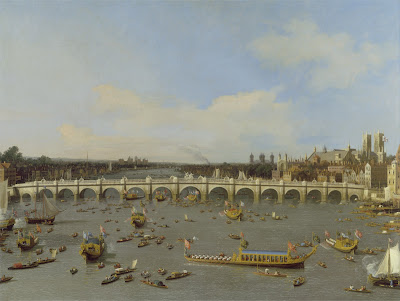
Perhaps no other object in our collection has lately received such immense media coverage than our splendid 1747 Westminster Bridge, with the Lord Mayors Procession on the Thames by Canaletto, yet few if any media outlets, including the New York Times, which spoke of it at considerable length, bothered to mention that the painting belongs to us and lives in New Haven, Connecticut. As regards proper or even cursory acknowledgment the media are most definitely a one-way street. Try posting something of theirs on YouTube, and one finds that it is generally removed in a matter of hours. Still, it was pleasing that our picture attracted such a lot of attention in connection with The Queen’s Diamond Jubilee flotilla last Sunday, and the resonances were indeed mighty powerful, especially when those plucky rowers fought a chill breeze on the same long, straight reach of the Thames that stretches between Millbank and the Palace of Westminster.
In Canaletto’s case, many of the little boats belonged to the watermen, whose closed-shop practices and stranglehold upon river traffic prompted the government of King George II to build only the second bridge over the Thames. The watermen appear to have resisted this unwelcome interference by sabotaging the first couple of spans, which duly collapsed, but the creation of this short-cut to the City of London via Southwark and London Bridge went ahead and was eventually successful. Indeed the task of painting it seems to have been the reason why Canaletto came to London in the first place. Interestingly, Canaletto painted the bridge as it was initially projected and not as it eventually looked. The elaborate personifications of the Thames were never installed in the middle, and nothing I think came of those useful cockle-shell niches for rainy weather. However much else last Sunday made you feel as if nothing much had changed on the Thames in the intervening 265 years.

Thursday, March 22, 2012

Diamond Jubilee


Watching The Queen’s Diamond Jubilee address to both Houses of Parliament in Westminster Hall the day before yesterday, I was struck by the extraordinary constitutional gulf that separates the present sovereign, in her stoical conscientiousness, from Queen Victoria, with whom she alone now shares the distinction of having reigned over the United Kingdom for more than sixty years. It was Queen Victoria, after all, who, towards the end of her life, facing the gloomy prospect of yet another (final) dose of Mr. Gladstone, confided to her daughter, the Empress Frederick: “These are trying moments, and it seems to me a defect in our much-famed constitution to have to part with an admirable gov[ernmen]t like L[or]d Salisbury’s for no question of any importance or any particular reason but merely on account of the number of votes.” To her credit, Queen Victoria did part with governments on these grounds, if only reluctantly, and one would be naïve to suppose that Queen Elizabeth II did not from time to time privately like some governments better than others—though we are never likely to learn which ones they were. Yet it is an awesome exercise of imagination to attempt to grasp the magnitude of the changes to her peoples and realms that have taken place during this remarkable reign, and to appreciate the calm resolution and strength with which, at the age of eighty-four, Her Majesty now publicly re-dedicates herself to their service.

Tuesday, October 18, 2011

Britannia


This week The Queen is visiting Australia for the sixteenth time since 1954. I have a vivid memory of the third of those official visits in 1970, to mark the bicentenary of the arrival of James Cook aboard H.M.S. Endeavour. I was five, and in the first grade at Grimwade House. Every schoolchild received a little medal to commemorate the event, and mine is somewhere. I must find it. Dad and Mum took me down to Port Melbourne to witness the arrival in Hobson’s Bay of the Royal Yacht Britannia. Not too far from Station Pier I waved my small Union flag with tremendous vigor, and was in every other respect beside myself with excitement. I have no recollection of seeing anything or anyone larger than a couple of brightly colored specks, descending the gangplank, and transferring to the snappy little tender that brought the sovereign, the Duke, Prince Charles (aged 21) and Princess Anne (19) all the way up the River Yarra, not I suspect an experience in those days that was ever likely to become etched upon their collective memory. Nevertheless, the drama created by the gradual approach of an ocean-going vessel as big, as sleek, and as glamorous as Britannia, and the certain knowledge that The Queen was definitely on board, these outshone anything that is now ever remotely feasible in the conveyor-belt desolation of a modern airport, even the patch of cement that is from time to time with pluck designated as the V.I.P. Apron. So to some extent when I think of The Queen, as I quite often do, I think also of that childhood vision of Britannia steaming up Port Phillip Bay. I think of the immense crowds, too, Maie Casey, Mr. Gorton, Jumbo Delacombe, Miss Mountain, Mrs. Woods, and the huge black Rolls Royce Phantom VI that I gather still lives in Canberra, and by no means in semi-retirement.

Wednesday, August 19, 2009

Sound


Assisted by the vastly learned Richard Warren, I have been systematically working through the extraordinarily rich collection of rare early sound recordings in the collection of the Sterling Memorial Library here at Yale, gradually assembling a representative program to offer through headphones to visitors to our forthcoming Edwardian Opulence exhibition. I wish the relevant laws of copyright would allow us to make this program more widely accessible on CD, possibly even include it in the catalogue, but outside the university I am afraid this will be prohibitively expensive, and administratively unachievable thanks to the relevant provisions of the Sonny Bono Copyright Term Extension Act 1998 (U.S. Public Law 105–298). Nevertheless, it has been a fascinating task, not least because of those moments of genuine surprise when an occasional tic or habit of British speech or pronunciation stands out as completely different not merely from “received pronunciation,” as it is now known, but from any other even vaguely recognizable variant. I do not speak of those relatively familiar locutions that were discernable at least until fairly recently in the voice of H.M. The Queen, e.g. gawn awf for “gone off,” crawss for “cross,” lawst for “lost,” Awstralia for “Australia,” or sawft for “soft,” though these are plentiful and charming. When Somerset Maugham said petrol he laid exactly equal, seesaw emphasis on both syllables, of which the second was pronounced exactly like “doll”—with an especially short, clipped “o.” E. M. Forster, meanwhile, said articulayte for “articulate” (the adjective); motionliss, useliss, chickin, and Athins (Greece), for “motionless, useless, chicken, and Athens,” as well as sincewity, weeweeniss, mystewiousniss, and murmewing—though naturally these were caused by a slight speech impediment. He also enunciated very carefully the “p” at the beginning of “psychology.” Describing an Ethiopian dignitary at the coronation of King George V and Queen Mary in Westminster Abbey in 1911, Vita Sackville-West later recalled watching this person with “rurl fescinairtion,” more particularly his “high yepple green hyet” with a “lahrn’s mane wined a-rind it” because, she said, every time he turned his head, the lion’s mane tickled “the neauze of his next-daw nebba.” And in a broadcast recorded in 1935, Max Beerbohm makes the perplexing aside: “Mayfair and Westminster and St. James’s were grand, of course, very urban, in a proudly unostentatious way...They were places of leisure—of leesure, one might almost have said, in the old-fashioned way.” Old-fashioned? Presumably he meant late Victorian, or even earlier. And in the scratchy old phonograph recordings Nellie Melba made for the Gramophone and Typewriter Company in the comfort of her drawing-room in Cumberland Terrace (ca. 1904), you can clearly hear the voice of the sound engineer from behind a screen give the diva her cue by shouting “Go!” when the clunky recording apparatus was successfully set in slightly arduous motion. Incidentally, the purpose of the screen was to enclose the equipment, and keep the wax of the cylinder well heated and comparatively soft, to avoid creating a harsh whistle in the track. Some engineers were evidently better at doing this than others. At any rate, the knack here is to demonstrate what, if any difference the extraordinary proliferation of sound recording (and motion pictures, for that matter) made to the visual culture of Edwardian Britain, and why we should care. However, I am working on it.

Wednesday, December 24, 2008

A Touch of the Vice-Regals


There is a point early in vice-regal terms of office when, at times, either separately or in tandem, the incumbent and his or her spouse may be temporarily affected by certain vibrations arising from their elevated standing. The shorthand term used by household staffs of several generations to describe this disorder is “having or getting a touch of the vice-regals.”

At worst, in rare instances, the sufferer may for brief periods behave like Middle European royalty.

Davis and Jean McCaughey were unusual in that so far as I am aware they never once suffered from this inconvenient vice-regal syndrome. Indeed, at times they were inclined instead to travel in the opposite direction.

Certainly they seemed never to notice when the organizers of huge events like the V.F.L. Grand Final paid far more attention to starlets and political hacks than the sovereign’s representative.

At times it was incumbent on their staff to attempt to stand on ceremony on their behalf, when clearly they would never themselves voluntarily choose to do so.

On Grand Final Day in 1988, for example, at the enormous, chaotic lunch put on by the V.F.L., one sensed that few people in the room even knew who Davis was. But on that occasion it so happened that Olivia Newton-John was present in the room, swamped by admirers and Les Patterson lookalikes – she was to sing the National Anthem.

A generalized sense of astonishment overcame the entire gathering when Miss Newton-John beat a path through the throng, and inexplicably threw her arms around Davis – whom, of course, she knew well because her father, Bryn Newton-John, was Davis’s predecessor as Master of Ormond, and both families grew up as neighbors.

As a result of this charming gesture, proffered so spontaneously by such a famous woman, one sensed in respect of Davis and Jean in all corners of the room, a not too subtle retraction of the jib of familiarity and offhandedness, and in its place the hoisting of effulgent spinnakers of respect.

Here I am at the age of twenty-three: evidently not doing my job properly - which is always to keep out of press photographs.

This is The Queen and The Duke of Edinburgh, accompanied by the Governor and Mrs. McCaughey, and the Premier, the Hon. John Cain, M.P., and Mrs. Nancye Cain (obscured), on what used to be called the V.I.P. apron at
Melbourne International Airport, Tullamarine, about to board an R.A.A.F. flight bound for Brisbane, Friday, April 29, 1988.

The Rolls still lives with the Governor-General, at Yarralumla in Canberra.