Showing posts with label prehistory. Show all posts

Friday, December 28, 2012

Who we are, part 3 (cousins)


When our most distant ancestors first staggered, scampered, or, in the case of the Trumbles, strolled amiably out of Africa about 60,000 years ago, we were not alone. At least two other species of distant hominid cousins walked the Eurasian landmass when Homo sapiens first arrived there, the Neanderthals and the Denisovans. The DNA of all non-Africans is between 1 and 4% Neanderthal in composition, and most of us are approximately 2%. Thanks to Mum, however, my brothers and I are 2.7% Neanderthal, a figure that in my case the exquisite Lyolik reckons is far too low—cheeky! Most indigenous sub-Saharan Africans have no Neanderthal component to their DNA because their ancestors never migrated through Eurasia. Only those whose people left Africa but then turned around and came back again carry any amount of Neanderthal DNA, and they are mostly confined to North Africa, along the southern shores of the Mediterranean Sea.

According to one fairly plausible theory, Neanderthals, Denisovans, and modern humans are all descended from the ancient humanoid Homo heidelbergensis, the original Trumble of us all. Between 300 to 400,000 years ago, an ancestral group of H. heidelbergensis tottered or scurried out of Africa and then split in two shortly thereafter. One branch ventured northwestward into West Asia and Europe and in due course evolved into the Neanderthals. The other branch moved east, becoming Denisovans. By 130,000 years ago, meanwhile, H. heidelbergensis in Africa had evolved into Homo sapiens.

The discovery that our ancient ancestor “cousins” mated with one another could help explain one of the great mysteries in paleoanthropology: Why did the Neanderthals vanish? After first venturing out of Africa long before H. sapiens, Neanderthals thrived in Europe for several hundred thousand years. But about 30,000 years ago somewhat mysteriously they died out, effectively became extinct, in other words at roughly the same moment when we modern Trumbles arrived in Europe. Some scientists have suggested that our H. sapiens ancestors outcompeted or actually clubbed the Neanderthals to death in a colossal struggle for dominance. But new genetic evidence that is enclosed in our own living bodies supports a different and in many ways kinder, better theory: We Trumbles made love and not war with our Neanderthal cousins. The older lineage vanished simply because it was absorbed into the much larger Trumble population through the processes of, at the very least, deep and evidently successful paleolithic flirtation. This comes as no surprise to us; Trumbles are not much given to storms of violence, and indeed we appear to have inherited a genetic predisposition, not always helpful, towards gentleness, even good-natured acquiescence—the better to avoid rocking boats. How charming that this therefore appears to have produced significant evolutionary results, even if, at times, it would not appear to serve us so well in the dog-eat-dog environment of modern life.

Although Neanderthals and Denisovans are both extinct, modern Trumbles may also owe them a mighty large debt of gratitude. A recent study by scientists based at Stanford University concluded that many of us carry ancient variants of immune system genes whose task is to direct our infection-fighting white blood cells to destroy pathogens. Certain of these arose after we left Africa. One very real possibility is that these gene variants entered our DNA as a direct result of mating with our archaic hominid cousins.

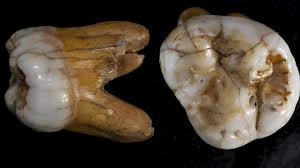
Unlike the Neanderthals, the Denisovans are a brand new addition to the human family tree. As recently as 2008, paleoanthropologists digging in a cave in southern Siberia unearthed a 40,000-year-old adult tooth and an exquisitely preserved fossilized finger bone (D5) that once belonged to a young Denisovan girl who was between five and seven years old when she died. Scientists successfully extracted nuclear DNA from that finger bone and compared it with the genomes of modern humans and of Neanderthals. That comparison proved that the girl was closely related to Neanderthals, yet distinct and distant enough from them to merit classification as a new species of archaic human. Scientists named her kin “Denisovan” after the cave where the finger bone was excavated. The Denisovan genome also suggests that this young girl had brown hair, brown eyes, and brown skin.

Surprisingly, these scientists discovered a measure of genetic overlap between the Denisovan genome and that of some present-day east Asians, and, in particular, Melanesians and the peoples of Papua and New Guinea. It appears the Denisovans contributed between 3 to 5 percent of their genetic material to the genomes of Melanesians. It is thought that the most likely explanation for this is that Denisovans living in eastern Eurasia interbred with the direct ancestors of Melanesians. When those humans crossed the ocean to reach Papua New Guinea around 45,000 years ago, they carried their Denisovan DNA with them.

If this genetic mixing did occur, the fact that Denisovans were discovered in Siberia but contributed to the genomes of modern humans living in Southeast Asia suggests the species ranged widely across Asia, although their low genetic diversity also indicates their numbers were never very high.

By comparing the genomes of apes, Denisovans, Neanderthals, and modern humans, scientists hope to identify DNA segments unique to the different groups. Early results already suggest modern humans underwent genetic changes involved with brain function and nervous system development, including ones involved with the evolution of language, after splitting from, or, more likely (in genetic terms) mopping up the Neanderthals and the Denisovans. Identifying and understanding these genetic mutations could help explain why our species survived and thrived while our close relatives died out. But was there something in the character of that process of interbreeding that in fact triggered the quantum leap in brain function, and led in turn to the development of language and all the other remarkable attainments of modern man? We may learn more about this in due course.

The Denisovan component of my Geno 2.0 result is the most experimental, as geneticists are still working to determine the best way to assess the percentage of Denisovan ancestry that we carry. If, as I suspect, the figure of 2.7% Neanderthal would have caused Mum a measure of vexation, she might well have balked at the current estimate of 4.5% Denisovan, though we are told that this figure may well change upward or down as a consequence of further research into many other subpopulations of distant Trumble cousins. Still, all of this is a sobering but delightful reminder that all living people are our kith and kin, and that race is but a mirage of difference. Personally, I am thrilled by the idea that we Trumbles have more in common with those gentle Melanesians than ever we thought possible, for they too are island people.

Who we are, part 2 (Dad)

Our grandfather, T. C. Trumble, a descendant of the Trumble hunter-gatherers of Northern India and the Levant.

Thanks to the National Geographic Society’s Geno 2.0 Project, I can now dilate further upon the distant origins of us Trumbles. All such genetic studies begin with the identification of the “marker” for our oldest male ancestor, and walk forward thence to more recent times, showing at each step the line of his descendants.

What is a marker? Each of us carries DNA in every cell of our body, a hugely complex combination of genes passed from both Mum and Dad. This combination endows us with traits that range from eye color, height, and bone structure (fabulous, if I do say so), to athleticism or otherwise, creativity, intelligence, and even susceptibility to certain diseases. As part of this process of combination and re-combination, the Y-chromosome is passed directly from father to son down a purely male line, in our case the Trumble line, unchanged from generation to generation. Mitochondrial DNA, on the other hand, is passed from mothers to their children, but only their daughters pass Mitochondrial DNA to the following generations. In other words it traces a purely maternal line. We have already dealt with this, and, with it, our exciting dalliance with Neanderthal and Denisovan man.

Now, parts of the DNA are passed on unchanged, unless a mutation occurs—a random, spontaneous, natural and usually harmless change. The mutation, known as a marker, acts as a beacon; it can be mapped through generations because it, too, is passed down through the generations for thousands of years. When geneticists identify such a marker, they try to determine when it first occurred, and in which region of the world: in Ethiopia, or Manchuria, or the Yukon, or Borneo, or Tierra del Fuego. Each marker is essentially the beginning of a new lineage on the human family tree.

Branch M42: ca. 75,000 years ago

The common direct paternal ancestor of all men alive today was born in Africa around 140,000 years ago. Naturally he was a Trumble. He was neither the first human male nor the only man alive in his time. He was, however, the only male whose Y-chromosome lineage has survived until now. All men, including our direct paternal ancestors, trace their ancestry to one of this man’s descendants. The oldest Y-chromosome lineages in existence, belonging to the “A” branch of the tree, are found only in African populations.

Around 75,000 years ago, the “BT” branch of the Y-chromosome tree was born, defined by many genetic markers, including M42. The common ancestor of most men living today, some of this proto-Trumble’s descendants began the journey out of Africa, to India (!) and to the Middle East. Small groups would eventually reach the Americas. Others would settle in Europe, and some from this line remained near their ancestral homeland in Africa.

Individuals from this line in Africa often practice cultural traditions that resemble those of their distant ancestors. For example, they often live in traditional hunter-gatherer societies. These include the Mbuti and Biaka Pygmies of central Africa, as well as the Hadza of Tanzania (formerly Tanganyika), a range of possibilities that I feel quite sure would have tickled my late father, and filled my mother with deep skepticism and, perhaps, a wry or mischievous chuckle. She was modestly proud of her own ancestors.

Now, as M42-bearing populations migrated around the globe, they picked up additional markers on their Y-chromosomes. Today, there are no known BT individuals without these additional markers.

Branch M168: Africa/Asia, ca. 70,000 years ago

As the proto-Trumbles left Africa, they migrated across the globe in a network of pathways that spread out like the branches of a tree, each limb of migration identifiable by a marker in our DNA. For male lineages, the M168 branch was one of the first to leave the African homeland.

Moving outward from Africa and along the coastline, members of this lineage were some of the earliest settlers in Asia, Southeast Asia, and, significantly, Australia, the Aboriginal Trumbles. Some from this line would even travel over the land bridge to reach the Americas. The Trumble who gave rise to the first genetic marker in our lineage probably lived in northeast Africa in the region of the Rift Valley, perhaps in present-day Ethiopia, Kenya, or Tanzania. My preference would be for Kenya, a distant premonition, as I have already put it, of gins-and-tonic on the verandahs of suburban Nairobi or in Happy Valley. The descendants of this rather blasé Trumble became the only lineage to survive outside of Africa, making him the common ancestor of every non-African man living now.

Why did this Trumble and/or his descendants leave Africa? The first migrants probably ventured across the Bab-al Mandeb strait, a narrow body of water at the southern end of the Red Sea, crossing into the Arabian Peninsula soon after M168 originated—perhaps 65,000 years ago. These beachcombing Trumbles made their way quite rapidly to northern India and Southeast Asia, following the coastline in a gradual march eastward. One can see it, I think, in the satisfactorily Brahmin Trumble eyebrows. By 50,000 years ago, they had also reached Australia. These were the ancestors of today’s Australian Aborigines.

It is also likely that a fluctuation in climate may have contributed to our ancestors’ exodus out of Africa. The African ice age, as we have already seen, was characterized by drought rather than by cold. Around 50,000 years ago, parts of the inhospitable Sahara briefly became habitable. As the drought-ridden desert changed to a savanna, the animals hunted by our ancestors expanded their range and began moving through the newly emerging green corridor of grasslands. Our nomadic Trumble ancestors therefore followed the good weather and the animals they hunted, although the exact route they followed remains to be determined. In addition to a favorable change in climate, around this same time there was a great leap forward in modern Trumbles’ intellectual capacity. Many scientists believe that the emergence of language gave we Trumbles a huge advantage over other early human species. Improved tools and weapons, the ability to plan ahead and cooperate with one another, and an increased capacity to exploit resources in ways we hadn’t been able to earlier: all these allowed ancient Trumbles rapidly to migrate into new territories, exploit new resources, and replace or subsume other hominids such as the Neanderthals.

Branch M89: South Asia (hmmm) or West Asia, ca. 50,000 years ago

The next male ancestor in our ancestral lineage is the man who gave rise to M89, a marker found in 90 to 95 percent of all non-Africans. This Trumble was born around 50,000 years ago in northern Africa or the Middle East. The first Trumbles to leave Africa probably followed a coastal route that eventually ended, satisfactorily, in Australia. Our ancestors followed the expanding grasslands and plentiful game to the Middle East and beyond, and were part of the second great wave of migration out of Africa.

Beginning about 40,000 years ago, the climate shifted once again and became colder and more arid. Drought bore down upon Africa and the grasslands reverted to desert, and for the next 20,000 years, the Saharan Gateway was effectively closed. With the desert impassable, our Trumbles had but two options: to remain in the Middle East, or to press on. Retreat to the home continent was no longer an option. While many of the descendants of M89 remained in the Middle East, others continued to follow the great herds of wild game through what is now modern-day Iran into the vast steppes of Central Asia.

These semi-arid grass-covered plains formed an ancient “super-highway” stretching from eastern France to Korea. Our Trumbles, having migrated north out of Africa into the Middle East, then traveled both east and west along this Central Asian superhighway. A smaller group continued moving north from the Middle East to Anatolia and the Balkans, trading familiar grasslands for forests and high country.

Today, geneticists have found the lineage in 1% to 2% of Pakistani and Indian populations. However, it is about 4% of some Austro-Asiatic-language-family-speaking groups in India. It is about 9% of some Dravidian-language-family-speaking groups in India, and it is 9% to 10% of male lineages in Sri Lanka. In Borneo, Borneo!, it is about 5% of the population. In Malaysia, it is about 6% of the population.

Branch P128: South Asia, ca. 45,000 years ago

The next male ancestor in our ancestral lineage is the Trumble who gave rise to P128, a marker found in more than half of all non-Africans alive today. This man was born around 45,000 years ago in the Middle East or Central Asia. The descendants of P128 migrated to the east and north, picking up additional markers on their Y-chromosomes. This lineage is the parent of several major branches on the Y-chromosome tree: O, the most common lineage in East Asia; R, the major European Y-chromosome lineage; and Q, the major Y-chromosome lineage in the Americas. These Trumbles went on to settle the rest of Asia, the Americas, and Europe; many others traveled to Southeast Asia. Today, P128 individuals lacking these additional markers are rare in most populations, and are most commonly seen in Oceanian and Australian Aboriginal populations.

Branch M45: Central Asia or South Asia, ca. 35,000 years ago

This Trumble traveled with groups in the open savannas between Central and South Asia during the Paleolithic era. These were big game hunters, and parents to two of the most widespread male lineages in modern populations, one that is responsible for the majority of pre-Columbian lineages in the Americas (haplogroup Q) and many others from Asia and Europe. Another one that spread farther into Asia produced the highest frequency lineages in European populations (haplogroup R). Today, Trumbles of this lineage who do not belong to a descendant branch are rare, and geneticists have found them most often, again, in India. These populations include such diverse groups as the Saora (23%), the Bhumij (13%), and Muslims from Manipur (33%).

Branch M207: Central Asia, ca. 30,000 years ago

Trumble M207 was born in Central Asia around 30,000 years ago. His descendants went on to settle in Europe, South Asia, and the Middle East over the following 20,000 years. Today, most western European men belong to one branch—R–M342—all descended from this glorious Trumble lineage. While it appears to have been one of the earliest to settle in Europe more than 25,000 years ago, more recent population expansions associated with the post-glacial re-population of northern Europe after the end of the last ice age, as well as the spread of agriculture during the Neolithic, also contributed to its high frequency in Ireland, Britain, France and Spain. One descendant lineage—R–L62—is common in Eastern Europe and India (again; are we detecting a pattern?), and was probably spread in part through the migration of Indo-European steppe nomad Trumbles over the previous 5,000 years.

Branch P231: Central Asia, ca. 25–30,000 years ago

The Paleolithic Trumble who founded this lineage was also a nomad. His descendants include two major branches that today account for most European men and many others from Central Asia, West Asia, and South Asia.

Branch M343: South Asia or West Asia, 17–22,000 years ago

The first Trumbles of this lineage lived as hunter-gatherers on the open savannas that stretched from Korea to Central Europe. They took part in the advances in hunting technology that allowed for population growth and expansions. When the Earth entered a cooling phase, most Trumbles from this line sheltered in the southeast of Europe and in West Asia. It was from these regions that their progeny rapidly expanded when the ice receded once more. Some of these Trumbles migrated west across Europe. Other Trumbles moved back toward their distant ancestors’ homelands in Africa, passing through the Levant (!). Through these movements and the population boom triggered by the Neolithic Revolution, these Trumbles and their descendants came to dominate Europe. Today, it has a wide distribution. In Africa, geneticists have found this lineage in Northern Africa (6%) and central Sahel (23%). Its frequency in Europe is at times high and at other times moderate. It represents about 7% of Russian male lineages, about 13% of male lineages in the Balkans, about 21% of Eastern European male lineages, 55% to 58% of Western European lineages, and about 43% of Central European male lineages. In Asia, most men of this lineage are found in West Asia (6%) and South Asia (5%). However, trace frequencies of around one half of a percent from this lineage are present in East Asia, our very distant Han Chinese Trumble cousins.

Branch L278: West Asia, date yet to be determined

While some Trumbles from this group traveled west into Central Asia, others moved south toward the Levant. Today, they are present in trace frequencies of less than 1% in Italy, the Ukraine, and the region of the Pannonian Basin, pottering about in their characteristically Trumblish way.

Branch P310: West Asia, date yet to be determined

Trumbles of this lineage strolled into Central Asia, Europe, and the Levant (!). One such Trumble branch has the highest frequency of any male line in Western Europe. However, rather than a single movement across Europe, this lineage’s branches may represent many simultaneous and successive waves of migration. Today, it is 48% to 52% of male lineages in Ireland. This comes as no surprise to us, for we already knew that our Irish great-great-grandfather William Trumble (1828–1908) emigrated to Australia from Ballymote, Co. Sligo, in 1841, aged fourteen. The family also had connections to the little town of Castlerock, near Lough Foyle in Co. Londonderry, Northern Ireland. Their father, John Trumble, was evidently a freeholder, and their mothers name was Ann (née Knott). John Trumble survives in the land records for two parishes in the neighborhood of Ballymote, Co. Sligo. It seems he paid a church tithe or tax for arable and bottom land, and what is unsentimentally described as reclaimed bog at Feenaghroe in the parish of Toomour, to the tune of £1/10/10½.

However, looking at the much farther distant horizon, we are now sure that Branch P310 also represents 45% of those in France—Les Trumbles. It is about 38% of the male population in Spain—Los Trumbles. It is about 8% of male lineages in Italy—i Trumble. It is about 5% of male lineages in Oman. It is 1% to 2% of the male population in Iraq and Lebanon—the Lebanese Trumbles. It is also 1% to 2% of the male population in Kazakhstan, the sturdy Kazakh Trumbles. Today, members of this lineage are even more widely distributed across Europe and West Asia. Yet they reached their highest frequency in Ireland where we and our descendant branches contribute to between 35% and 38% of the male population. It is between 1% and 2% of male lineages in Germany—Die Trumbln. It is about 2% of the male population in Croatia. It is also present in some paternal lineages from the Ashkenazi population of eastern Europe. Can this perhaps mean that certain Trumbles were in fact once Jewish, or, at any rate, proto-Jewish—because this almost certainly predated Abraham and Sarah by several millennia? Quite possibly, and, if so, how very wonderful!
Who we are, part 1 (Mum)


At last I am able to dilate upon my remote ancestry, thanks to the National Geographic Society’s Geno 2.0 project, which I described earlier. The results of their analysis of my mitochondrial DNA and my Y-chromosome arrived when I was in London a few weeks ago, and I have been gradually absorbing the implications ever since, most of which are simply awe-inspiring. On the whole I am thankful that my mother never lived to be vexed by the idea that it is thanks to her, and her distant relations, that my brothers and I are 2.7% Neanderthal, although my beloved Lyolik says with firmness that he reckons that this figure is far too low. Whichever way you look at it, however, there can be no doubt that approximately 60,000 years ago one or quite possibly more of my mother’s female ancestors turned the head of Hairy Slobodan of the Caucasus, some no doubt fetching Neanderthal, and that this was far more than a brief dalliance; evidently it involved a sustained period of gleefully horizontal folk-dancing in the flickering light of a fire, perhaps in a cave or escarpment, or in the lea of some convenient, mossy bank (for privacy). Intriguing.

Let us go back to the beginning, however. The common direct maternal ancestor to all people living today was born in East Africa around 180,000 years ago. Obviously she was not the only female hominid alive at that remote time, but hers is the only line of posterity that has survived into current generations. This woman represents the deepest root of the human family tree. She gave rise to two descendant lineages known as L0 and L1’2’3’4’5’6, each of which is characterized by a different set of genetic mutations carried by their respective members. Current genetic data indicate that indigenous people belonging to these groups are found exclusively in Africa. This means that, because all humans have in a common this female ancestor, and because Africans are the oldest groups on the planet, we know our species—each and every one of us, the entire human family—originated there. The more historically-minded might choose to think of this as a distant but satisfactory premonition of gins-and-tonic on the verandahs of suburban Nairobi or the polo fields of Happy Valley, but in truth we are looking at hairy hominids busying themselves over tens of thousands of years with the task of basic survival, and the quest for controllable flame—fire! the earliest glimmer of the pre-dawn of human civilization—at around the same vital moment as the earliest discovery, or evolution, or invention of language itself, those guttural love cries with which in due course Mum’s people evidently beguiled certain Neanderthals of the Caucasus.

L3

Eventually, by a process of gradual genetic mutation, L1’2’3’4’5’6 gave rise to L3 in East Africa. While L3 individuals are found all over Africa, L3 is important because of its movements north. Our L3 maternal ancestors were the first party of Homo sapiens to leave Africa, and therefore represent the deepest branches of the tree found outside that continent. Thenceforth, members of this group went in different directions. Many stayed on in Africa, dispersing to the west and south. Some L3 lineages are predominant in many Bantu-speaking groups who originated in west-central Africa, later scattering throughout the continent and spreading this L3 lineage from Mali to South Africa. Today, L3 is also found in many African-Americans. Other L3 individuals, however, our ancestors, kept moving northward, eventually leaving the African continent completely. These people gave rise to two important haplogroups that went on to populate the rest of the world.

It is likely that a fluctuation in climate may have prompted our ancestors’ departure from Africa. The African Ice Age was characterized by drought rather than by cold. Around 60 to 50,000 years ago the ice sheets of northern Europe began to melt, introducing a period of warmer temperatures and moister climate in Africa. Parts of the inhospitable Sahara briefly became habitable. As the drought-ridden desert changed to savanna, the animals our ancestors hunted expanded their range and began moving through the newly emerging green corridor of grasslands. Our nomadic ancestors followed the good weather and plentiful game northward across this Saharan avenue, although the exact route they followed remains to be determined. Whatever the cause of the exodus, it is also clear that when it occurred (a) there were barely 2,000 individuals of the species Homo sapiens left alive, so we very nearly became extinct before the long human migrations even began. We survived only by the skin of our teeth; our civilization might never have developed at all. (b) Those 2,000 shivering, frightened, increasingly desperate specimens were evidently huddled in and around an area of Ethiopia known as the Asaf Depression. And that was the point of departure for many tiny groups of the survivors, of whom a handful actually stayed put.

N

Our next crucial maternal ancestor is the woman whose descendants formed haplogroup N. Haplogroup N comprises one of two groups that were created by the descendants of L3. One of these two groups of individuals moved north rather than east and left the African continent across the Sinai Peninsula, in what is now Egypt. Also faced with the harsh desert conditions of the Sahara, these people apparently followed the Nile basin, which yielded a reliable supply of food and water in spite of the surrounding desert and its frequent sandstorms. Descendants of these migrants eventually formed haplogroup N. Early members of this group lived in the eastern Mediterranean region and western Asia, where they apparently co-existed for a time with other hominids such as Neanderthals. Excavations in the Kebara Cave (Mount Carmel) in Israel have unearthed Neanderthal skeletons as recent as 60,000 years old, indicating that there was both ample geographical and chronological overlap between us and them. This accounts for the presence of Neanderthal DNA in those of us who live outside Africa—between 1% and 4% of the whole of our DNA is Neanderthal.

Be that as it may, after several thousand years in the Near East, members of our group began moving into unexplored neighboring territories, following large herds of migrating game across vast plains. These groups broke into several directions and made their way into territories surrounding the Near East. Today, haplogroup N individuals who headed west are prevalent in Turkey and the eastern Mediterranean. They are found farther east in parts of Central Asia and the Indus Valley of Pakistan and India. And members of our haplogroup who headed north out of the Levant across the Caucasus Mountains have remained in southeastern Europe and the Balkans. Importantly, descendants of these people eventually went on to populate the rest of Europe, and today comprise the most frequent mitochondrial lineages found there.

R

After several thousand years in the Near East, individuals belonging to a new group called haplogroup R began to move out and explore the surrounding areas. Some moved south, migrating back into northern Africa. Others went west across Anatolia (roughly corresponding with modern Turkey) and north across the Caucasus Mountains of Georgia and southern Russia. Still others headed east into the Middle East, and on to Central Asia. All of these individuals had one thing in common: they shared a female ancestor from the N clan, a recent descendant of the migration out of Africa.

The story of haplogroup R is complicated, however, because these individuals can be found almost everywhere, and because their origin is quite ancient. In fact, the ancestor of haplogroup R lived relatively soon after humans moved out of Africa during the second wave, and her descendants undertook many of the same migrations as her own group, N. Because the two groups lived side by side for thousands of years, it is likely that the migrations radiating out from the Near East comprised individuals from both of these groups. They simply moved together, bringing their N and R lineages to the same places around the same times. The tapestry of genetic lines became quickly entangled, and geneticists are currently working to unravel the different stories of haplogroups N and R, since they are found in many of the same far-flung regions.

U

Descending from the R group, a woman gave rise to people who now constitute haplogroup U. Because of the great genetic diversity found in haplogroup U, it is likely that this woman lived around 47,000 years ago. Let us call her Granny Ugh! Her descendants gave rise to several different subgroups, some of which exhibit very specific geographic homelands. The very old age of these subgroups has led to a wide distribution; today they harbor numerous particular European, northern African, and Indian components, and are to be found in Arabia, the northern Caucasus Mountains, and throughout the Middle and Near East.

One interesting subgroup is U6, which branched off from haplogroup R while still in the Middle East, moved southward, and today is found in parts of northern Africa. Today, U6 individuals are found in around 10% of people living in North Africa. However, other members of the larger haplogroup U descend from a group that moved northward out of the Near East. These women crossed the rugged Caucasus Mountains in southern Russia, and moved on to the steppes of the Black Sea. These individuals represent movements from the Black Sea steppes west into regions that comprise the present-day Baltic States and western Eurasia. This grassland then served as the springboard for subsequent movements north and west.

Today, this line is part of populations in Europe, West Asia (including Arabia), North Africa, India, and the North Caucasus Mountains. In Europe, this lineage averages 7% of the population. In Scandinavian countries (Norway, Sweden, the Netherlands, etc.) it is between 9% and 16% of the population. In England, it is about 12% of the population. Toward the Mediterranean, this line is between 10% and 12% of the population in Croatia and Greece.

U5

The most recent common ancestor for all of us U5 individuals broke off from the rest of the group and headed north into Scandinavia. Even though U5 is descended from an ancestor in haplogroup U, it is also exceedingly ancient, and thought to be around 30,000 years old.

U5 is quite restricted in its variation to Scandinavia, and particularly to Finland. This is probably the result of the significant geographical, linguistic, and cultural isolation of the Finnish populations, which restricted geographic distribution of this subgroup and kept it genetically isolated. The Saami, reindeer hunters who follow the herds from Siberia to Scandinavia each season, have the U5 lineage at a very high frequency of around 50%, indicating that it may have been introduced during their movements into these northern territories.

The U5 lineage is found outside Scandinavia, though at much lower frequencies and at lower genetic diversity. Interestingly, the U5 lineage found in the Saami has also been found in some North African Berber populations in Morocco, Senegal, and Algeria. Finding similar genetic lineages in populations living thousands of miles apart is certainly unexpected, and is likely the result of re-expansions that occurred after the last glacial maximum around 15,000 years ago. Humans who had been confined to narrow patches in southern Europe began to move outward again, re-colonizing ancient territories and bringing new genetic lineages with them.

In addition to being present in some parts of North Africa, U5 individuals also live sporadically in the Near East at 2%—about one-fifth as frequent as in parts of Europe—and are completely absent from Arabia. Their distribution in the Near East is largely confined to surrounding populations, such as Turks, Kurds, Armenians, and Egyptians. Because these individuals contain lineages that first evolved in Europe, their presence in the Near East is the result of a back-migration of people who left northern Europe and headed south, as though retracing the migratory paths of their own ancestors.

U5B

Today, this line is present most often in Finland (15%) and Latvia (12%). It is between 6% and 9% of maternal lineages in Luxembourg, Northern Ireland, Spain, and Slovenia. It is widespread in western Eurasia, particularly to the north. This spread began with the expansion of haplogroup U5B-bearing populations out of West Asia during the Upper Paleolithic, prior to 12,000 years ago, and like other branches of U it reached Europe during the Paleolithic. Despite later waves of migrants from other lineages, it remains common there.

Insomma, we can now conclude (not very surprisingly) that Mum’s distant relations down to approximately 10,000 years ago were only 45% Northern European, and that that component of our ancestry is found at the highest frequency in Britain, Denmark, Finland, Russia and Germany (oh!). While not limited to these groups, it is found at significantly lower frequencies throughout the rest of Europe. This component is probably the signal of the earliest hunter-gatherer inhabitants of Europe, who were the last to make the transition to agriculture as it moved in from the Middle East during the Neolithic period around 8,000 years ago—Hairy Grandmother Margaret on her wee Shetland pony, as Hamish rightly predicted, galloping headlong across the land bridge into the vastnesses of the Scottish highlands at almost the very earliest time that this was possible. Is it any wonder therefore that on my first visit to Edinburgh some years ago I had the strongest feeling that I had been there before?

On the other hand we of the line of U5B are also 37% Mediterranean, a component to be found at the highest frequencies in southern Europe and the Levant—people from Sardinia, Italy, Greece, Lebanon, Egypt and Tunisia. While not limited to these groups, it is found at lower frequencies throughout the rest of Europe, the Middle East, Central and South Asia. This component is also probably a sign of the Neolithic population expansion from the Middle East, beginning around 8,000 years ago, likely from the western part of the Fertile Crescent.

We are also 17% Southwest Asian. This component of our ancestry is found at highest frequencies in India and neighboring populations, including Tajikistan and Iran—and it is probably just as well that Mum never lived to learn this, although I am quite sure that she would have looked askance with her customary pursed-lip skepticism. Nevertheless this component is an undeniable fact of our mitochondrial DNA, and it is also found at significantly lower frequencies in Europe and North Africa. As with our Mediterranean component, it was most probably spread during the Neolithic expansion, perhaps from the eastern part of the Fertile Crescent. Individuals with heavy European influence in their ancestry will show traces of this because all Europeans have mixed with people from Southwest Asia over tens of thousands of years, something that was not lost on Grandfather Borthwick and his slightly crude allegation that there was, at least in the Borthwick line, a “touch of the tar-brush.” Putting it in a slightly more positive light, Mum carried a modicum of the culture of primitive near-eastern philosophy, mathematics, jurisprudence, and the root of writing itself, and no doubt this expressed itself in the skills she duly brought to The Times cryptic crossword puzzle, and to the bridge table. 

For all of this we must be grateful, and now to Dad and the Y-chromosome.