Among the numerous bronze and
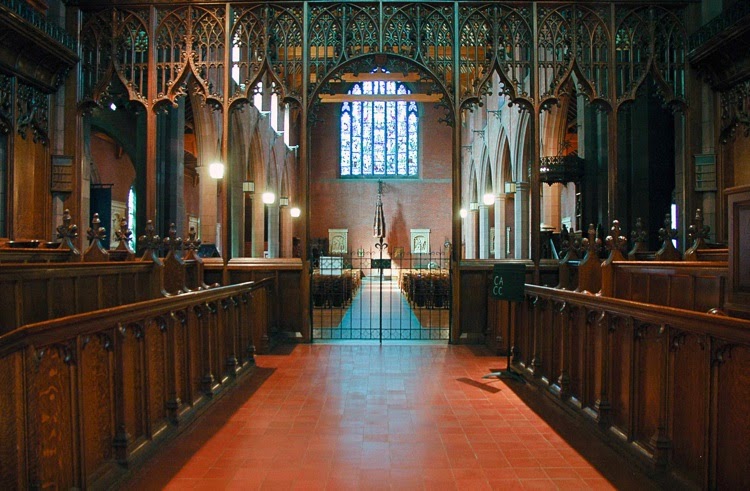
brass commemorative wall plaques in Christ Church, New Haven, my favourite
reads: “ELEVEN / STATIONS OF THE CROSS / WERE PLACED IN THIS CHURCH / BY THE
MUNIFICENCE OF / GRACE M. FOGG / IN MEMORY OF HER FATHER / EZRA D. FOGG / AND
HERSELF.” I have never felt compelled learn more about the munificent Miss
Fogg, I suppose because so much is hinted at in the inscription. The stations
themselves are impressively large, and carved in fine-grained sandstone,
possibly Portland. Miss Fogg paid for all but three. Which three? Did she have
some objection to certain of them on scriptural grounds (or lack of
these—although several more than three stations of the cross are absent from
the Gospels), or was this simply a question of firmness in the face of an unfortunate
budgetary overrun? The specificity of “eleven,” and not ten or twelve or some
other tally is so very intriguing, and I cannot imagine it may be attributed to
a pedantic executor. One senses that these are the words of Miss Fogg herself.
She was certainly not given to false modesty; the stations commemorate not only
her late father but herself too, hardly an afterthought. The desire to be
remembered after we are gone is natural and widespread, but few people take
steps to erect a church monument for that express purpose. I imagine Miss Fogg
was a doughty New Englander who did not hesitate to call a spade a spade. She
was evidently an only child. Perhaps in later years she concluded that nobody
would do her the honors if Miss Fogg did not see to it herself. I see that Ezra
D. Fogg was in 1899 president and treasurer of The Ezra D. Fogg Company at 87
Church Street, New Haven, wholesale lumber merchants (“SPECIALTY—Pine and
Spruce Boxes and Shooks, and Brick Pallets”). Shooks are lengths of wood sufficient
for one hogshead or barrel, prepared for use and bound up in a portable packet,
a sort of kit. At this date Mr. Fogg resided at 389 Edgewood Avenue in
Westville, not too far from me. I imagine Miss Fogg stayed there until she
died, interesting herself up to a point in the affairs of the parish—and
perhaps inadvertently terrorizing successive curates and churchwardens.
Sunday, November 17, 2013
Saturday, November 9, 2013
On the road
North American motorists
are among the worst I have ever encountered—over nearly 30 years driving
on both sides of the road in many countries spread across four continents as
well as on numerous islands. I am not sure
why this is so. Perhaps Americans learn to drive far too early—often at the age
of fifteen or sixteen—and are held to a breathtakingly low standard, mostly using
vehicles with automatic transmission. Many people
freely admit that they could not possibly operate a “stick-shift,” or manual. Parallel
parking is an almost complete mystery to them, for it is not part of the
test. All you have to do in Connecticut is to steer your nose through 90 degrees into a vacant spot in a parking lot, and finish up
somewhere between the two solid white lines. By contrast in downtown New Haven one
often witnesses the comic spectacle of people making five, six attempts to
parallel park, such that the end result is not parking so much as abandonment—four
or five impressionistically unaligned feet from the curb, sometimes more, having
for several minutes prior swooped, bumped, and zig-zagged, earnestly and
longingly, in the hope of attaining eventual success. In heavily built-up urban
environments they wander aimlessly between lanes, much encouraged
by the extra space provided by one-way streets with three or more wide lanes, divided by lines mostly ancient but occasionally still visible. They hesitate, or suddenly change their mind in the middle of busy intersections. They ignore pedestrian crossings completely and often run red lights,
as if these were merely advisory. They turn left from the right without indicating,
tracing a wobbling arc that delivers them in the end to an inside
lane at right angles, often against oncoming traffic, which is frequently ignored on the
assumption that those of us with the right of way will intuitively, even gladly
yield by braking sharply. On the interstate highway system, meanwhile, people steer their creaking
old bedpans, many the epitome of un-roadworthiness—hubcaps and bodywork
scraped, dented, battered, or missing; lights often broken or defunct—at 70
miles per hour and upwards when the speed limit is 55—aggressively tailgating, passing
on the wrong side (a much cherished and particularly dangerous habit here in Connecticut), safe in the knowledge that they will almost certainly not be
ticketed by any state troopers attempting to impose order. Motorists treat
huge lorries as if they are as maneuverable and responsive as a Corvette. You see many yelling illegally into their mobile phones, and sometimes even texting at the wheel. Motorcyclists
are free from any obligation to wear helmets. These lethal habits know no distinction as to race, age, or gender; they
are universal. And every Saturday morning on National Public Radio a succession
of callers to Car Talk (a program
that runs of out of Boston), seek guidance about some 1983 Corolla that has
clocked up 280,000 miles and is emitting smoke, or making an alarming noise, or
conking out suddenly and inexplicably on the open road. The roads themselves,
meanwhile, are pockmarked, bumpy, and shored up with dribbling lines of bitumen and stray gravel, or else clobbered and patched up in so ad hoc a manner that you wonder how the entire system can survive the punishment of another winter. The contrast between all this and the wilderness of late-model Mercedes
Benzes, BMWs, and Renaults one encounters nowadays in the eastern suburbs of
Sydney and Melbourne, or the velvety smoothness of our freeways, could not be
more stark, and provides an apt metaphor for the sluggishness and
malaise in which the United States’ economy is in many
sectors and many regions still immured—despite reassuring but mostly misleading noises from Washington and Wall
Street. It is equally if not more worrying that many people think, in the face
of all possible reason, that American drivers are, on the whole, pretty good,
and that American streets, roads, and highways are as safe as can be!
Tuesday, October 29, 2013
Too early to say
A journalist asked Premier Chou En-lai (Zhou Enlai) what, in his
opinion, had been the full impact of the French Revolution? Chou’s answer,
after a long and thoughtful pause, was: “It is too early to say.” A good one, no? Perhaps too good. Obviously this
anecdote gained traction in the wake of Vietnam, and ever since, as a measure
of the sage Chinese “long view,” but because it is repeated so regularly, and
with a suspicious array of variations—occasionally also attributed to Ho Chi
Minh, and even to Mao—I have become increasingly skeptical about its
authenticity. There is a whiff of orientalist fantasy, after all, to say nothing of plain condescension in the
broad historical conceit. Add to these a suggestion of facetiousness on Chou’s part and the whole thing strikes a
false note. No doubt it held some appeal, too, for student radicals in the west to whom Chou was most appealing in the guise of Confucius, and not so much as master of the Party Congress. At last I think I have cracked it. According to Charles W.
Freeman, Jr., a retired American diplomat who acted as the official interpreter
for President Richard M. Nixon during his famous visit to China in February 1972, Chou made
his remark to Nixon over lunch or dinner in Peking (as
it was then still known), during a rather delicate political discussion about
revolutions that had succeeded, and ones that had failed. These included the
Hungarian uprising of 1956 and the Prague Spring of 1968. According to Freeman it
was quite clear from the context that in saying it was “too early to say” Chou
was referring specifically to the upheaval that took place in Paris in May
1968, and not to 1789. There are other theories, for example that Chou made his remark to a French journalist at the Geneva conference in 1954, but I suppose this simply demonstrates the tendency of enjoyable snippets to take on a life of their own, and powerfully to resist clarification, correction, or debunking. I think we can safely predict that Chou will continue indefinitely to say “it is too early to say,” without any fear of contradiction.
Monday, October 28, 2013
The medallion
I have
been doing a lot of work lately on the material culture of Sydney in the first
decades of European settlement, about which there is a great deal to be learned
from lengthy advertisements placed in the earliest colonial newspapers.
However, I have also become wholly preoccupied with the so-called Sydney Cove Medallion—a work of art that
bridges the 10,000-mile gap between the brand new penal settlement and the beating heart
of Enlightenment England. Others have written at length about this object and
its variants, above all the late L. Richard Smith of the Wedgwood Society of New South Wales, but there is, I think, still much more to be said.
The “First
Fleet” of eleven ships, under the command of Captain Arthur Phillip, R.N.,
arrived in Botany Bay on January 18, 1788. The very next day two French ships, La Boussolle and L’Astrolabe, commanded by Admiral Jean-François de la Pérouse, were
spotted out to sea. Eight days later, on January 26, as Phillip raised the
Union Flag at Sydney Cove in Port Jackson, and his officers did their best to hurry the rest of
the feet out of Botany Bay, the French dropped anchor there and received from
John Hunter a cautious but cordial welcome. The coincidence must have seemed
utterly astonishing, and probably not a coincidence at all—although it was indeed purely a chance encounter. Through February and early March Phillip set about establishing his
settlement. The most rudimentary wattle-and-daub shelters were built, for which
deposits of local clay proved useful but in due course, once the rain set in,
depressingly impermanent. However, before the French party
set sail on March 10—never to be heard of again—one of La Pérouse’s naturalists,
the Abbé Jean-André Mongez, a mineralogist, ornithologist, entomologist and chemist,
casually remarked to Phillip that this Sydney Cove clay might in due course be used to produce excellent pottery, or
even bone china.
In due
course, on November 16, 1788, Phillip despatched aboard H.M.S. Fishburn a sample of this clay to Sir
Joseph Banks—repeating the Abbé’s positive assessment; stressing that it was
also used by the local Aborigines to decorate their bodies, and mentioning that
he would not have thought it worth sending except that Banks himself had
mentioned the substance in his account of Captain James Cook’s first circumnavigation (1768–71)—an intriguing but maddening reference because it cannot now be
traced. Since many of Banks’s positive assessments of the potential of Botany Bay had
proven so depressingly inaccurate, Phillip must have been relieved to be able
to furnish some confirmation of his account in the form of the clay, together
with samples of an unusual black mineral that had been discovered whilst digging a well.
This turned out to be “a species of plumbago, or black-lead.” The parcels
reached London in May 1789, and Banks immediately forwarded them to his
friend Josiah Wedgwood, a fellow member of the Royal Society. Wedgwood’s Staffordshire
pottery, “Etruria,” near Stoke-on-Trent, was well accustomed to testing the properties of batches of
clay sent from all over England, Europe, and much farther afield—for example from China
and North America.
Wedgwood
soon found the Sydney Cove clay to be “an excellent material for pottery,” and
set about producing from it a small edition of commemorative medallions. The design was created
by Wedgwood’s in-house draughtsman Henry Webber, brother of the artist John
Webber who had sailed with Cook aboard the Endeavour, and the moulds were created by Wedgwood’s
principal modeler William Hackwood. The heavily classicizing bas-relief composition
was entitled “Hope encouraging Art and Labour, under the influence of Peace, to
pursue the employments necessary to give security and happiness to an infant
settlement.” This figure group on the recto carried the inscription “ETRURIA
1789,” and on the otherwise unadorned verso “MADE BY IOSIAH WEDGWOOD OF CLAY FROM SYDNEY COVE.” Thus
the Sydney Cove Medallion is evidently the only work ever signed and dated by
Wedgwood himself, a measure of the seriousness with which he undertook its manufacture.
The first
batch of finished medallions were sent to Phillip aboard the second fleet, which set
sail on January 19, 1790, but Wedgwood also sent a specimen to his friend the
midlands physician and intellectual Erasmus Darwin. Responding to Wedgwood’s
invitation to compose some suitable accompanying verses, Darwin supplied thirteen
couplets in iambic pentameter entitled “Visit of Hope to Sydney-Cove, near Botany-Bay.” These were in
fact a slightly leaden pastiche of “Liberty,” by the Scottish poet James
Thomson (who also wrote the lyrics to Thomas Arne’s “Rule Britannia!”). Together with
an engraved vignette of Webber’s design, these appeared on the
title page of final part of The Voyage of
Governor Phillip to Botany Bay, with an account of the establishment of the
colonies of Port Jackson and Norfolk Island, printed in London at the end
of November 1789 by John Stockdale, sometime publisher to Dr. Samuel Johnson).
Any one of
these stout warp threads of Enlightenment England—Banks, Wedgwood, the Webbers,
Hackwood, Darwin, Thomson, Stockdale and, admittedly by very indirect association, Johnson—would be sufficient cause to
celebrate this, the first British fabrication of a work of art using Australian
raw materials. Being a set of multiples produced in the west midlands, moreover, it carries strong
associations with the Industrial Revolution. However, the additional
Anglo-French, and even Aboriginal dimensions of the episode, to say nothing of the fact that in Sydney Cove dire necessity had been the
mother of invention—all these converge on the medallion, and allow
it to make the case, however illusory, that the first British settlement in New
South Wales was indeed a project of the Enlightenment, and not merely the by-product of a cruel, corrupt and unwieldy eighteenth-century British criminal justice system, obsessed above all with relatively minor offenses against property.
Subscribe to:
Posts (Atom)


