Saturday, March 17, 2012

Margaret Whitlam

Margaret Whitlam has died at the great age of 92, only a few weeks before she and her husband, the former prime minister Gough Whitlam, would have celebrated their seventieth wedding anniversary. At times it can seem as if national stalwarts will go on forever, and I cannot remember a time when I was not mightily aware of Mrs. Whitlam, though I met her only once. In the depths of retirement, Mr. Whitlam asked me for a little help with an almost inconceivably arcane point of clarification relating to the Italian noble origins of the family of Diamantina, Lady Bowen—her husband, Sir George, was chief secretary of the Ionian Islands (where the Bowens married), then successively Governor of Queensland, New Zealand, Victoria, Mauritius, and Hong Kong. It was shortly after this that Mr. and Mrs. Whitlam came to some event at Government House, when I must have been in attendance upon Davis. What was so striking was that their physical presence was almost as commanding as the other sort, but, being very tall myself (6’5”)—and having long shared the joys and travails of most if not all other tall people, never more so than aboard commercial jet aircraft—it was as if, coming face to face, one was treated almost like an old friend, purely because for the time being one was relieved of having thoughtfully to crane downwards to compensate for the urgent needs of any stray Napoleon who might for the time being require our reassurance, or some other kind of special treatment. Short people often think that tall people are haughty, but this is not usually the case. It is simply that they so often fly under one’s radar. Anyhow, Mrs. Whitlam was delightful, and dilated on that occasion about her fond memories of Melbourne when she came to swim in the intervarsity competitions; this must have been in the mid- to late 1930s. True, I noted with considerable amusement that Mrs. Whitlam made no mention of any good impression created by Melbourne that was more recent than those. However, I was also struck by how very direct, plain-speaking, and kind she was—and fun, especially when deposited for the time being with someone as young and decidedly callow as I was then. It is no secret that Mr. Whitlam was on occasion inclined to stray towards self-parody, as when for example he added the word “Statesman” to his signature in the Governor’s visitors’ book. But Mrs. Whitlam tended to go in the opposite direction; she was a no-nonsense woman with good sense, ample friendliness, and an unrestrained, hearty laugh. Somewhere in there one also detected a certain patrician quality that must have come from being the well-educated daughter of Mr. Justice Dovey of the New South Wales Supreme Court. In other words, you felt that she was the perfect adjunct, well able to keep the prime minister’s feet firmly planted on the ground. That she did not manage to keep them planted in Canberra for more than a single term was no fault of hers. Indeed, as Mr. Whitlam has famously remarked, she was by far and away his best appointment. May she rest in peace.

Friday, March 16, 2012

George Beare


Little more is known about the provincial Hampshire portrait painter George Beare than what appeared in his brief obituary in the Salisbury Journal on May 22, 1749: “Last week died near Andover, Hants., Mr. Beare, lately an eminent Face Painter in this City.” Judging from the relatively small number of portraits that have yet been identified, a little shy of fifty, none predating 1743, this double portrait is his masterpiece, exploiting to the fullest extent the sympathetic contrast in age between a grandmother, elaborately dressed in gray damask and lace, and the freshness and simplicity of the granddaughter on whose shoulder the old woman rests her right hand. Together with that telling gesture, the double portrait of a grandmother and granddaughter, in which a degree of emphasis is placed upon family likeness, may imply here the role of guardian in lieu of a conspicuously absent mother, presumably dead. Beare’s painting here at Yale, which must date from 1747, represents a subtle shift in taste from the English Rococo idiom, as practiced by Francis Hayman, Philippe Mercier and others, toward the more robust English style of forthright naturalism we associate with Joseph Highmore and William Hogarth. The sitters may have been members of the Grove family of Ferne House, at Berwick St. John in Wiltshire, but no securely verifiable identification has yet been possible.


One of the things we do know about George Beare was that in 1746 he wrote a letter to one of his sitters, Sir Alexander Powell, politely asking to borrow that gentleman’s claret-colored waistcoat so that he could paint it accurately, and without unnecessarily detaining him with an unnecessarily tedious string of follow-up sittings. He also offered Sir Alexander his choice of top coat to harmonize, and sought his approval of the work already done. This tells us quite a lot. Beare evidently could not afford to keep a convenient wardrobe in his Salisbury studio with which to tackle this problem. Successful metropolitan portrait painters such as Sir Joshua Reynolds did, and indeed we see the same dresses, in other words certain extravagant studio props, recurring slightly indelicately in many of his portraits of middling gentlewomen and actresses. But Beare’s request sheds still more light on the immediate set of circumstances. This was evidently not an issue of color. Artists can be very good at replicating hue, or at least coping without direct access to a waistcoat of this or that particular plum, yellow, or crimson. Yet this garment must have been an especially impressive one, made either from some richly woven silk brocade, not unlike the material we see in this old lady’s dress, or else elaborately embroidered. So Beare needed to have it in front of him. And this may well have been dictated by the wishes of his gentleman-sitter, who might not have owned very many such aspirational garments with which to present himself in splendor. (In the end, according to Nigel Surry in the ODNB, he decided upon a plain, stone grey-colored coat, a conservative but by no means unfortunate choice.) The same may have been true of the delicious oyster-colored gown we see here; this was a precious garment worn only for the most important occasions, and cared for during the gradually lengthening periods in between with much of the tenacity, zeal, good sense, and prudence that are chiseled into the contour of the lady’s chin, and also sparkle in her eyes, as yet undimmed by old age (a particularly engaging quality in the very old of which those of us in the grip of middle age become increasingly aware and respectful). I like to imagine that this gown was made from a precious bolt of Italian silk brocade that the old lady brought as a significant portion of her dowry when fifty years before, early in the reign of Queen Anne, she married (for the first time?). And when that happened she cannot have been much more than a few years older than her granddaughter was when Beare painted this marvelous picture. It seems fatuous to say it, but to me there are few Georgian women more vividly alive in our collection than this old lady; how I would love to have been able to pay a call, take tea, and learn what shrewd things she had to say about goings on in the village, and the county. Though necessarily such observations were most probably in miniature, yet I suspect she missed very little, and in doing so exercised considerable powers of observation, and surely accumulated much wisdom.

Inscriptions


Inscriptions such as the one at the bottom left hand corner of this fine painting by Cornelius Johnson were often added to Elizabethan and Jacobean family portraits long after they were finished, spelling out the name or title (and often the age) of sitters for the benefit of descendants who at length could quite reasonably be expected to become vague about their forebears’ correct identity. The higher up the portraits hung in the gloomy staircase or in the recesses of the long gallery, the more likely it was that following generations would quickly lose track of who it was they were actually meant to portray. More often than not, such well-meaning interventions were made at the behest of some self-appointed dynastic chronicler, a ferocious spinster aunt, say, with time on her hands, or a youthful bachelor cousin in Holy Orders with an antiquarian frame of mind, and were implemented under his or her cursory supervision by an artist-limner engaged by the factor, librarian, or keeper of the muniments. It is hardly surprising therefore that such bona fide inscriptions regularly perpetuated the very mistakes they were intended to prevent. Self-appointed chroniclers of noble houses are almost always sure that they are right, especially when they are in fact secretly or even unconsciously doubtful, and given the complexities of premature deaths, multiple titles and re-marriages, huge families of children, half-siblings, and whole tribes of cousins once or twice removed, there was plenty of scope for unremitting parades of error. To this species of dodgy inscription one may add another with far more deceitful intent—in other words the work of unscrupulous picture dealers and framemakers who were determined to sweeten a freshened-up Elizabethan or Jacobean picture by association with a famous sitter, or else as a way of hooking a specifically targeted client. This one, however, was almost certainly bona fide and added in the first quarter of the eighteenth century, and while it is not exactly wrong it is evidently only right for a brace of the wrong reasons. This lady looks nothing like other surviving portraits of Alathea Talbot, who was Countess of Arundel in 1619—Johnson dated the work in the lower right. Instead, the subject was more probably Lady Elizabeth Stuart, who became Countess of Arundel many years later in 1646 when her husband, Lord Maltravers (1608–1652), succeeded the fourteenth Earl. Clearing up small matters of this kind often requires many hours’ consultation of Burke and Debrett, and of course relies on the accuracy of such seventeenth-century pedigrees as are set out in successive editions of both. No guarantees there, because pedigrees can be just as vulnerable to cheerful optimism, crossed wires, and other points of confusion as the inscriptions added to those portraits we hope they will elucidate. Still, it can be rewarding work.

Wednesday, March 14, 2012

Sir Alfred Munnings


Last Saturday, whilst strolling down Glebe Place in Chelsea en route for Cheyne Walk, I was astonished to come across this blue plaque, which looks to me as if it does not enjoy the sanction of English Heritage but is perhaps home-made. This would partly explain the impressionistic, not to say loose, copy-editing. But wouldn’t you think that someone would let them know, or that they might get around to replacing it with a corrected one, or that some passer-by might possibly even take matters into his own hands by fetching a ladder and inserting the missing “S” à la Lynn Truss? There is an alternative possibility, which is that a person who rejoiced in the name of Alfred Munning did indeed live there, but was in due course understandably confused with the fourteenth President of the Royal Academy of Arts. However, the question would then arise as to whether that lesser known gentleman, if he existed, warrants the blue plaque treatment at all. Either way, it is a problem.

Tuesday, March 13, 2012

Suffolk dreaming


Intimate friends and acquaintances may well be surprised to learn that last Sunday I traveled the 220 miles from Central London to Orford Ness and back riding pillion on an extremely glamorous BMW GS 1200 motorcycle. It was Heaven. Getting out of London other than by rail is always tedious, but on a motorcycle it is rather less so. Once free of the metropolis, however, the ride through Epping Forest with its ancient trees, so gnarled, so reminiscent of Shoreham-period Samuel Palmer, then onward through rural Essex, past Chelmsford, Colchester, and through the gentle countryside of Suffolk past Ipswich to the sea was simply marvelous, made more so by the benign warm spring sunshine, the rush of fresh air, and the smooth zippiness of the bike. I had previously been concerned lest every muscle in my body end up in spasm as a result of holding on, but a little more than forty-eight hours later I am feeling no ill effect whatsoever. In fact, my comparatively elevated position and unobstructed view gave rise to a number of those unforgettable experiences of the English landscape when you go round a corner and feel as if, all of a sudden, you have entered almost physically into the margin or past the frame of a familiar view of some almost identical spot by (in this instance) John Constable, and that nothing much could separate your experience of it from his, aside from the fact that 200 years later you are traveling at 70 miles per hour, so it is admittedly rather more fleeting. All of which obviously makes regular and unrestricted access to his superb and unpretentious painting, now that I am back here in New Haven, Conn., a luxury even greater than the precision engineering afforded by the firm of BMW.

Thursday, March 8, 2012

Patsy

One of my most cherished possessions is this simple painting, Three Bush Birds, 2000, by the late Patsy Lulpunda (Anguburra) (Worrora culture) (c. 1898–November 2000), who lived her whole life in the Kimberley region of Western Australia. I bought it from an exhibition of Patsy’s work at the Kintolai Gallery in Hindley Street, Adelaide, in May 2001, when at around the same date my friend Philip Fimmano purchased another bush-bird painting, admittedly the better of the two. He and it are now in Paris. According to the Gallery, it was upon attaining the great age of 100, when shortly afterwards in 1999 she received from The Queen an official letter of congratulations, that the artist was stirred into taking up painting for the first time in her life. Thereafter she produced a body of about fifty paintings before Patsy died soon afterwards in November 2000. Immediately after I bought the picture I wrote to The Queen, explaining this remarkable turn of events, and in due course received a kind acknowledgement from the Hon. Mary Morrison, Lady-in-Waiting, dated Buckingham Palace, May 25, 2001. As far as I can recall, Patsy’s work consists mostly of sprightly bush birds and camp dogs, about which she obviously knew plenty, and in this case I was and remain tickled by the lively interaction of the two on the right: surprised, possibly, quizzical certainly, and I imagine definitely rowdy in the cool of the early evening. A polished draftswoman Patsy was not, but anyone who has encountered these noisy creatures in the Great Outback cannot fail to recognize them here. Patsy painted straight onto unstretched canvases laid flat on the ground, using water-soluble synthetic polymer paint, and I possess a photograph of her painting this one, a satisfactory hedge against any future suggestion that it might be a forgery. May she rest in peace.

New


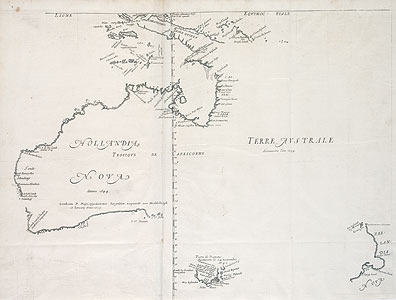
Among historical anomalies none is more curious than the English habit of naming distant places “new,” then waiting long enough to discover with some measure of satisfaction that they have become exceedingly old. That practice did not begin with Christopher Columbus and Giovanni da Verrazzano with whom we associate orbo novo, the “new world,” because New College was established early in the reign of King Richard II in 1379, and is therefore one of the earliest Oxford colleges. Perhaps stimulated by the early successes of Nuevo España, Nouvelle-France, and Nieuw Amsterdam, the habit reached its peak in the seventeenth and eighteenth centuries—with Nova Guinea (1600); New England (1614); New Haven (1640); Nieuw Holland (1644); Nieuw Zeeland (c. 1645); New London (1658); New York (1664); New Britain (1754); New South Wales, the New Hebrides, and New Caledonia (1770). Nieuw Oranje died on the vine, and few other names have fallen by the wayside, but the majority have endured, especially in the United States, and still proclaim a novelty that is impressively historical.

Wednesday, March 7, 2012

Louie


Between 1859 and 1891 her four sons and four of her five daughters produced for Queen Victoria no fewer than forty grandchildren. Of these six died in early childhood, and a further four died comparatively young. Of the surviving thirty, twenty-one were princesses and no fewer than six of these were christened Victoria. Princess Marie Louise (Louie), and her elder sister Princess Helena Victoria (Thora), were the daughters of Queen Victoria’s slightly difficult third daughter and fifth child Princess Helena and her husband Prince Christian of Schleswig-Holstein-Sonderburg-Augustenberg, and were born in 1872 and 1870 respectively. This places them right in the middle of the sequence of granddaughters, in the tenth and eleventh spots. Their female first cousins fall into four principle categories: German and Russian princesses by birth or marriage who found themselves cut off from their British cousins after the outbreak of World War I and whose official rank evaporated when the Kaiser abdicated in 1918; British and German princesses who went on to become crown princesses or queens consort and empresses of other European countries—namely of Greece, Norway, Rumania, Spain, Sweden, and Russia; British princesses who remained British, but whose public role gradually diminished in prominence and importance following the accession of King Edward VII, and the following three generations: King George V (1910), King George VI (1936), and the present Queen Elizabeth (1952); and, finally, those few who, through marriage, spent long periods in vice-regal service abroad, invariably in Canada and South Africa.

Louie is interesting because although she evolved through several of the lesser of these categories, she did not fit comfortably or permanently into any of them. Her early marriage to Prince Aribert of Anhalt was the bright idea of Cousin Willie—but was perhaps more accurately an outstanding example of the Kaiser’s astounding lack of judgment. The marriage was dissolved in 1900, almost certainly because the prince was caught in flagrante with a young male servant. Thenceforth Louie’s status was somewhat problematic. She regarded her marriage vows as permanently binding, and never considered remarriage. She returned to the household of her parents, and, in 1917, when, bowing to immense public pressure, King George V converted those German titles held by members of the extended royal family to English ones, Louie became known, somewhat ambiguously, as Her Highness Princess Marie Louise. In the 1920s and 1930s Louie spent long periods traveling abroad, inviting herself to stay for several high-maintenance months at a time in Government Houses all over the Empire, or else in the palaces of her crowned cousins. In between, Louie interested herself in various charities, girls’ clubs, nursing homes, and other worthy causes, mostly those established and sustained for decades by her mother Princess Helena. Louie lived comfortably with her sister Thora and a succession of long-suffering ladies-in-waiting for whom the arduousness of these honorary appointments was not necessarily rewarded by close proximity to court; indeed the rate of attrition appears to have been quite high. Nevertheless as an increasingly eccentric old lady, the families of George V and George VI kept an affectionate eye on Louie and Thora, and evidently enjoyed their company. Most importantly in the present context, not unlike her aunt Princess Louise, Duchess of Argyll, Louie gravitated towards artists and designers and musicians and writers. It was partly through her intervention that the young Cecil Beaton gained access to the royal circle, and for two solid years between 1921 and 1923 practically all of Louie’s time was spent organizing and mustering the increasingly granular contributions to Queen Mary’s Doll’s House.

Further scarlet heels


Here we see The Queen and The Duke of Edinburgh arriving at St. Paul’s Cathedral in London only this morning, where Her Majesty has led a service of thanksgiving as Sovereign of the Most Excellent Order of the British Empire. But look carefully at The Queen’s page, and note the delightful aspect of his buckled shoes: scarlet heels, alive and well, and evidently still flourishing at Court. Splendid!

Tuesday, March 6, 2012

Counting sheep


Last night, whilst being softly serenaded by my owl, I reflected upon the sheer range and number of different forms of transportation that I have been lucky enough to experience in the course of a busy life of almost constant travel. I have flown in everything from a rusty old Douglas DC-3 at uncomfortably low altitudes through shocking turbulence and dense tropical cloud all the way across the Owen Stanley Ranges in Papua New Guinea to a luxurious private jet from Adelaide to Birdsville, Moomba, Innamincka, and back; from a tiny four-seat Helicopter at Cooper Creek to an Airbus A380 (alas downstairs); from a six-seat Cessna fragilely circling over what remains of the Franz Josef Glacier in New Zealand to sundry clapped-out Fokker Friendships, and innumerable trusty Boeing 747s, beginning in 1975—when our first stop was the old Kai Tak in Hong Kong. The sensory residues of that childhood experience will remain with me until the day I die. Air bridges were then still an exciting novelty, and far more often one descended the stairs in the re-invigorating open air: on that occasion a unique combination of tropical heat, wetness, and the fragrance of jet fuel, dung, coca-cola, sea air, and frying food. I have sailed in everything from a home-made Sabot to the Empress of Tasmania (when, in a ridiculous instance of Australian prudery, the menu for the first sitting featured “chicken chest”; this was at Eastertide in 1971—how vividly I recall my grandmother’s unrestrained laughter on that occasion); from Bangkok riverboats to gondolas and traghettos in Venice, the shotover jet near Queenstown in New Zealand, the family Jubilee, Uncle David’s Top Hat, a channel hovercraft, the Sydney to Manly hydrofoil, a banana boat, an outrigger canoe in Fiji, and innumerable ferries, large and very small. I have taken rickshaws, tuks-tuks, funicular and narrow-gauge railways, cable-cars (several of them revolving), chair-lifts, and, of course, conventional trains on four continents, including several steam trains, the Shinkansen from Tokyo to Kyoto, and the fabled Blue Train from Cape Town to Pretoria. For years I have driven so often on the left and right hand sides of the road (as required), in other words on all five, that I am now completely ambidextrous. For several years I had the privilege of learning by example the various tricks deployed by two lovable professional chauffeurs in vice-regal service, both of whom had taken advanced military instruction in crisis and anti-terrorist driving. I have been aboard a submarine, and several tall ships, though admittedly I never sailed in any. I have ridden several horses and ponies, innumerable bicycles, and on the back of a zippy little Suzuki motorbike in Rome. Many different sorts of bus, tram, underground railway, Ferris wheel, golf buggy, punt, pod, and horse- and ox-drawn vehicle further diversify the picture. I have never been in a hot-air balloon, but I have driven a Victorian Railways diesel locomotive (between Ararat and Stawell), and a clapped-out Vespa in Naples. I have been on an elephant, a dromedary, and in the front cabin of many different trucks with air-bag suspension, usually accompanying shipments of works of art—with one of which I passed through the Mont Blanc tunnel; and more often than I care to remember all the way across the Hay Plain, in both directions. And I have flown in numerous freight aircraft, more often than not with horses and other livestock, tended by a qualified vet with a loaded rifle (should any beast take fright and need to be destroyed; I am told that a horse is easily capable of kicking a hole in the side of a Boeing 747). Going on the big dipper as a child at Luna Park in St. Kilda proved to me that once was definitely enough: never again. Nor do hang-gliding, bungy-jumping, white-water rafting, sky-diving, nor any form of motor-racing, hold any appeal. However, I have lately been inspired to take lessons for my motorcycle license—the better to explore the pretty country roads of New England in late spring, summer, and the fall, ever mindful of the danger and, of course, carefully attending to the various risks—none greater than Connecticut motorists.