Tuesday, January 24, 2012

Finger-twirlers


Lately an excellent colleague of mine, an enormously learned young man, has directed my attention to Mrs. Piozzi [Hester, previously Mrs. Thrale], specifically to her diary entry for March 29, 1794 (ii. 874f.), in which she coined the term “finger-twirler,” not one that I had previously come across. “[Ann,] Mrs. [Bertie] Greatheed & I call those Fellows Finger-twirlers,” wrote Mrs. Piozzi, “meaning a decent word for Sodomites: Old Sir Horace Mann [first baronet] & Mr. [George] James the Painter had such an odd way of twirling their Fingers in Discourse;―& I see Suetonius tells the same thing of one of the Roman Emperors ‘nec sine molli quadam digitorum gesticulatione.’ [Life of Tiberius, 68].” Finger-twirler does not yet appear in the O.E.D. among the many compounds listed in the article on finger, n., so at first I wondered if the nearest viable approximation was the citation for finger-work—“(a) work executed with the fingers; (b) the play of, or manipulation by, the fingers”—viz., 1849 D. Rock, Church of Our Fathers, III. x. 354: “A rich pall of silk, the finger-work of some queen,” but I am sure this is far too literal a reading. No doubt Mrs. Piozzi knew what she was doing, but I do wonder about the leap from digitorum gesticulatione to twirl. In any event, it seems that she was consistently preoccupied by matters of sexual orientation, perhaps to the point of obsession, though Mrs. Piozzi was certainly right about Sir Horace Mann and Mr. James, and I am sure she would have extended the same compliment to their friends Thomas Patch and Lord Tylney, who were also, by all accounts, fully paid-up, card-carrying finger-twirlers.

Saturday, January 21, 2012

South 2

The following day we approached the chalk cliffs between Seaford and Beachy Head. The most extraordinary aspect of this stretch of south coast is that cuddly old rural England just rolls picturesquely along, up hill and down, peacefully navigating soft rises and little gullies, until.... Straight down into the sea, a sheer and entirely unimpeded drop. It’s eroding steadily, of course, which means that sometimes important listed farmhouses of inconceivable antiquity that just happen to find themselves closest to the precipiceeven a quarter of a mile or so from it, are absolutely uninsurable, so I imagine whoever is the unhappy person most recently left holding the deed has no choice but to abandon ship, and leave the place to its eventual fate. Contented livestock, meanwhile, graze contentedly in the teeth of southerly gales, almost perversely ignoring the dizzy spectacle of dwelling at the abrupt margin of England. If Dungeness is the sine qua non of horizontality, the Seven Sisters, here, are the epitome of vertical. During the First World War, incidentally, depending on the direction of the wind, the incessant bombardment of trench warfare in northern France was clearly audible in the locality.

South

Last weekend we stayed in a little cottage on the South Downs, hard by the ancient smuggling village of Alfriston, East Sussex. Two places, barely fifty miles apart, attest to the extraordinary variety of the English landscape. Dungeness (above), where we went on Saturday, is a flat promontory composed entirely of shingle, one of the largest such aggregations in existence. Here all things are in a state of gradual reclamation: metal, driftwood, stone. The elemental powers simply grind them all to dust. Though barely twenty-seven miles away, just across the horizon, France might as well not exist; the place screams isolation and insularity, notwithstanding the twinkling lights of the nuclear power station that squats with a measure of contingency on the western edge. Fishing boats perch atop the vertiginous beach of loose, salt-encrusted stones, waiting stoically for their working life to expire; cottages cling to the ground as best they can. Dungeness makes David Copperfield’s Yarmouth feel positively cosy; it could easily be the farthest extremity of the world.

Saturday, January 7, 2012

Callas

Among the assortment of old gramophone records that lived in Dad’s study at number 18 Denham Place was “Callas à Paris,” a collection of French operatic arias sung by Maria Callas, and conducted by the youthful Georges Prêtre. Thank God I listened to that record a lot as a teenager, but it took me a long time to discover the early recordings made by Callas when she was at the height of her vocal powers, and in every respect in her prime. Among those the one I now listen to most is the 1953 Teatro alla Scala recording of Pietro Mascagni’s Cavalleria Rusticana, conducted by Maestro Tullio Serafin. For what operatic confrontation is as painful or affecting as the scene in which Santuzza begs her lover (sung by Giuseppe di Stefano): “No, no, Turiddu, rimani rimani ancora” (“Turiddu, Stay with me, stay”)? And what fury when, at length, high-handedly he doesn’t, was ever better expressed in music than by Maria Callas here? No doubt Christoph Willibald von Gluck was a more soothing presence in the front room at Denham Place than Mascagni, whom I think probably Dad would have disliked, but there can be no doubt that Mascagni was the better fit for Callas. At the end of her career, when her voice was in shreds, Callas performed the same duet in concert with Giuseppe di Stefano in the Royal Festival Hall in London—the sparks flew there, too, but the pain of the drama itself was overshadowed by the greater anguish of a once matchless star who must have been aware that her own voice had abandoned her. You can see it in her eyes.

Thursday, January 5, 2012

Princess Marie Louise again


This rather beautiful drawing by Dame Laura Knight is coming up for sale late this month at Lawrences in Dorset, for next to no money. It shows Princess Marie Louise as a rather wistful old lady, having just completed her very engaging volume of memoirs, My Memories of Six Reigns. The lot contains two further drawings by Knight, showing the hands of the sitter and sheets of writing (“To all those whose friendship and affection have made my long life so full of interest and happiness―Marie Louise; I have told you that my religion and faith have been the anchor to which I have clung all through my life with its many joys and sorrows. There is no other anchor, and with that assurance I say ‘Farewell’―Marie Louise.” The drawings and manuscript were apparently acquired by the vendor’s mother from Princess Marie Louise’s last Lady-in-Waiting. According to the catalogue notes, the Princess died at her home off Berkeley Square on December 8, 1956, aged 84, only a matter of months after Dame Laura executed this portrait. The ones of her hands formed the frontispiece and endpapers of the Princess’s book, which was published earlier in the same year, so the group carries more than a hint of valedictory repose, or, as Lawrences rightly put it, “an unusual farewell to the nation” by one of Queen Victoria’s last surviving granddaughters.

Wednesday, January 4, 2012

Ronald Searle


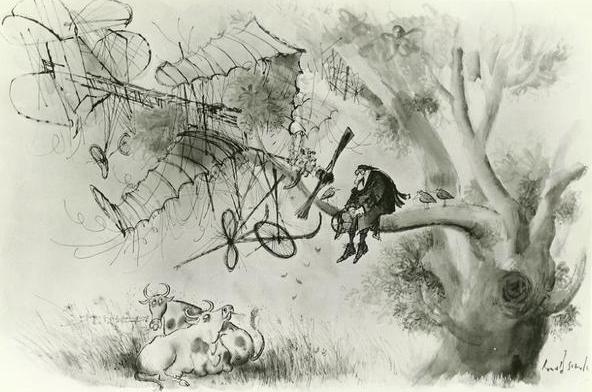
Ronald Searle has died at the great age of 91. By all accounts he felt oppressed by his enduring association with the Belles of St. Trinian’s, with Molesworth, and with all the other broadly revealing postwar English stereotypes which decades ago he skewered so exactly with his pen. His reportage and more serious later work he felt were consistently underappreciated at home; he settled in France. Yet those early, writhing symphonies of line were the works with which I grew up, and in early childhood obviously did my very best to imitate. This was my father’s taste, though interestingly in his own graphic work Dad leaned farther towards Daumier’s gens de justice. Anyway, a mere cartoonist or illustrator Searle was most definitely not, but rather, as his obituary in the Daily Telegraph rightly states, “one of the world’s greatest satirical artists.” Indeed, Ronald Searle belonged in the same category of genius as that of Saul Steinberg or Hilary Knight. His personal collection now goes to the Wilhelm Busch Museum (Deutsches Museum für Karikatur und Zeichenkunst) in Hanover.

Sunday, January 1, 2012

Happy New Year!

New Year’s Day? It’s incredible. The accelerating rate at which it arrives! I suppose the reason for that is that each passing year forms an incrementally smaller proportion of one’s entire lifespan, and no doubt that must make it feel as if they fly past faster. I’m not quite sure why New Year’s Day always puts me in mind of the Radetzky March and An der schönen blauen Donau because when I was growing up in Australia invariably we spent it at Metung, messing around on the shores of Bancroft Bay and Lake King, often in sweltering midsummer heat. In his heyday, Dad would join the sail-past in the old Jubilee, and we would give three hearty cheers to the commodore of the Metung Yacht Club—which event is just about as far from the New Year’s Concert in the Wiener Musikverein as it is possible to stray, yet now I am pottering around the house thinking of both: Metung and the Strausses (Elder and Younger), which evidently produce more than the hint of a spring in my step. And somehow this New Year’s Day, I have more of one—being filled with hope and energy and excitement about what this particular year will bring. I wish you, dear readers, as much of the same as anyone can reasonably expect, all the luck in the world, and I send you, wherever you may be, and for what they are worth, my warm greetings for a happy and prosperous 2012.

Friday, December 30, 2011

Vezdye, vezdye, on predo mnoyu!

When I was a rather shy and extremely inexperienced undergraduate in the early 1980s, I indulged an immoderate enthusiasm for grand opera. That interest has never entirely gone away, but thirty years later I am struck by how inadequately I ever grasped the convergence of poetry and music and emotion in the great love scenes especially—which I was then singularly ill-equipped to appreciate. True, Giuseppe Verdi managed to fire up a certain amount of adolescent passion, never more so than in the love scene in Act I of Otello, but it has taken me half a life-time to learn to listen with the heart, and discover in music drama the expression of real emotions, and not some exciting approximation of something big that might be waiting around the corner, or not. Who has not looked back with a wry half-smile, and said to himself, “I was just too young”?

So it is that I have been listening lately to a crackly old recording of the remarkable Bulgarian soprano Ljuba Welitsch, a star who shone as brightly in the decade between 1942 and 1952 as indeed she shone briefly, and whose glorious voice, alas, faded much too soon. Here is her publicity photograph; talk about star power in living black-and-white! In May 1948, at the height of her powers, Miss Welitsch recorded in London the famous letter scene from Piotr Ilyich Tchaikovsky’s Eugen Onegin, with the Philharmonia Orchestra conducted with exemplary finesse (and an admirably retrained tempo) by Walter Süsskind. Everyone knows, or ought to know the story: Tatiana Larina exchanges only a few words with the coolly detached Onegin when his friend Lensky, a neighbour, brings him to visit her sister Olga and their parents, but that encounter, in her own home, unleashes a torrent of emotion in Tatiana’s mind, and, in the privacy of her bedroom later that night, overwhelmed by a fever of passion, and of doubt, she sits down to write Onegin a letter—pouring out her very soul, with predictable consequences upon which the rest of the story hinge.

What is so remarkable about this particular recording (alas not yet propelled onto Youtube; though Renee Fleming is superb here), with all its technical limitations, and the further disadvantage that the piece was sung in a rather leaden German translation from which the richness of those marvelous Russian consonants was eliminated, is the apparent recklessness with which from the very opening Ljuba Welitsch hurls herself into the performance, as if from an exposed cliff-top: “Everywhere, everywhere I look, I see my fatal tempter! Wherever I look, I see him!” The quality of her voice, moreover—which is also what made her such a sensational Salome, and maybe also conspired at length to ruin it—combines bell-like clarity, urgency, unguarded girlishness, and a visceral unrestraint, which are all, of course, exactly right for Tatiana. You feel she gives it 250%, with all the breathtaking risk that that must have involved. Again, this is somehow right for Tatiana, though no voice teacher would ever these days responsibly recommend it. The internal shifts between torrential passion to doubt and fear and back again are written into the score, with its restive drive and accelerating heartbeat, but the job of making it all hang together is really the soprano’s. Hers is the startling vocal line, and Welitsch is never more believable or moving than in the moment of climax, when, about to sign and seal her letter to Onegin, Tatiana impores him: “I wait for you, I wait for you! Speak the word to revive my heart’s fondest hopes or shatter this oppressive dream with, alas, the scorn, alas, the scorn I have deserved!” I challenge anyone who has ever fallen deeply in love not to recognize at least something of the feeling—though for most of us it is couched in prosaic language: Will he or won’t he? Does he or doesn’t he? What are these feelings, whose sheer intensity I can barely understand? As usual, great artists hold up the mirror, and it is up to us—whether we are in the theatre with Tchaikovsky, in an art museum maybe with Tilman Riemenschneider (I wish), or just listening to the late, great Ljuba Welitsch on the radioto peer into that mirror, and discover there an emotional experience, real and true. Then, with luck, we may shed tears of understanding. Vezdye, vezdye, on predo mnoyu! Everywhere, everywhere I look, I see him!

Wednesday, December 28, 2011

What did Thomas Woolner see?

Just before Christmas I sent the following message to the editor of the Paris Review, hoping it might be included in the advice column in the online daily, then promptly forgot all about it:

Dear Lorin, May I once more avail myself of the generous hospitality of your advice column to help solve another of my small mysteries? I am currently editing the 1852–54 journal kept on the Australian goldfields by the Pre-Raphaelite sculptor Thomas Woolner. It is a fascinating document, from which most of the best bits were ruthlessly excised prior to publication in 1917 by his industrious daughter, à la Cassandra Austen, though fortunately they survive in the manuscript. On November 8, 1852, Woolner and his two traveling companions strayed from the main road north from Melbourne toward the diggings, became separated, and got lost in the bush: “I went on and saw—what produced this observation, ‘That [he] who wants to avoid strange sights must shun byways.’ A brutal, worse than brutal sight.” So far I have not been able to identify the quotation, if indeed it actually was one. It seems possible that the inverted commas were merely added for emphasis; it’s a rather clunky aperçu, yet I wonder if any of your readers recognize it? Elsewhere in the journal Woolner recorded without hesitation, and in detail, even a measure of cold detachment, scenes of drunkenness and violence, shady characters, the accidental drowning of a friend, and several murders in and around the goldfields. On this occasion, though, whatever Woolner saw so shocked him that he was obviously not prepared to note any particulars. Bodily, I presume, but what on earth was it? On that gothic note, may I also add my sincere compliments of the season? Angus Trumble.

This minor editorial problem has been rattling around in a quiet corner of my head for many months, and I thought it would be rather satisfactory if someone might come up with a plausible answer, or indeed an implausible one provided it was correct. Yesterday my attention was drawn to Lorin Stein’s extremely generous, flattering and, above all, helpful response:

Dear Angus, When you say jump, The Paris Review does not ask how high. We put our best people on this one. The results—while inconclusive—were revealing. Within minutes, our Southern editor, John Jeremiah Sullivan, wrote in from North Carolina with a passage from Tommaso Grossi’s Marco Visconti in an 1849 translation. This looked promising at first, only it had nothing to do with Woolner’s text, and was rejected. (Sullivan: “Could it have been this? My gut says no [and so does mine].) Next our associate editor, Stephen Andrew Hiltner, proposed a line from the Tao Te Ching, but admitted that Woolner was unlikely to have known Chinese [correct]. Our deputy editor, Sadie Stein, claimed—impressively, and with some vehemence—to recognize the sententia from Horace [much warmer]. The poem has not been found. Our Latin consultant, Brian FitzGerald of Lincoln College, Oxford, doubted a classical provenance. He directed us to some chapters from Proverbs, in which, however, there is no mention of strange sights. Our managing and Web editors, Nicole Rudick and Deirdre Foley-Mendelssohn, came out strong for Dante. So far we are unable to supply the relevant verse. One of Sadie’s contacts, a professor of Greek, suggested Oedipus Rex, either the messenger reporting Laius’s death or else a speech by Oedipus himself. Our close readings have not produced a match. On the other hand, we have now figured out what Woolner saw. (Private letter to follow.)

This last communication I am most eager and anxious to read. Beyond this small army of enthusiastic in-house helpers, a generous reader, who self-identifies as “J. A. Zugot,” submitted the following comment…twice!:

Reading Woolner’s quotation, “That [he] who wants to avoid strange sights must shun byways,” I too was reminded of bad translations from the Chinese or Japanese, or of some clunky re-doings of Sophocles and Horace. Dante, Milton—who not? Your staff isn’t—literarily—alone for the holidays…But that mention of Proverbs, by your guy from Oxford (surely he was thinking of those strange warnings against “strange women”), set me down another, um, “byway.” The Talmud, specifically its section called Avot, is often read separately under the title Pirke Avot, “Ethics of the Fathers.” These fathers are called the tannaim, or “repeaters,” and they, repeating mostly in Jerusalem, essentially committed the Oral Law—the Jewish oral tradition—to parchment, roundabout the first two centuries of the previous millennium. This could go on and on. Better you should search the internet. Anyway, from Avot: “He [their teacher, Rabbi Yochanan ben Zakkai] said to them, Go and see which is the good way that a man should cleave to. Rabbi Eliezer said, A good eye: R. Yehoshua said, A good friend: and R. Yose said, A good neighbor: and R. Shimon said, He that foresees what is to be: R. Eleazar said, A good heart. He said to them, I approve the words of Eleazar ben Arak rather than your words, for his words include your words. He said to them, Go and see which is the evil way that a man should shun. R. Eliezer said, An evil eye: and R. Yehoshua said, An evil companion: and R. Yose said, An evil neighbor: and R. Shimon said, He that borroweth and repayeth not—he that borrows from man is the same as if he borrowed from God (blessed is He)—for it is said, The wicked borroweth, and payeth not again, but the righteous is merciful and giveth: R. Eleazar said, An evil heart. He said to them, I approve the words of Eleazar ben Arak rather than your words, for your words are included in his words.” Now here’s where I’m going to lose you:
Freemasonry. “The Constitutions of Free Masons,” ca. 17something and so among the oldest surviving documents of the Brotherhood, states that God Himself, the Great Architect, is the primeval Grand Master. Fellow lodge members include Adam, the three Patriarchs, Moses, the various Israelite kings and high priests, Jesus and his dozen apostles. And obviously the entire Masonic temple model, symbology to rituals, was based solidly on the two Temples of Jerusalem.
Now, after the Roman destruction of the Second Temple in 70 C.E., Judaism lost its geographic center and became wholly bookish. The rabbis of the Talmud kept the secret, at least selective, traditions alive. It was natural that they, and their two local lodges—those of Grand Master Rabbis Hillel and Shammai—would be Masonically adapted/adopted. Freemasonry from the Talmud, a very stupid, stupidly fascinating book from 1905, written by A. (no further clarification) Posman, makes this explicit. Here, R. Eliezer ben Hyrcanus’ responses have been altered to: “A good eye is the right path for man to adhere to.” “An evil eye is to shun the path.” Again, here’s Woolner’s: “[He] who wants to avoid strange sights must shun byways.” Of course, the Pre-Raphaelite Brotherhood was itself a type of lodge, and indeed its original members, including Rossetti, Millais, Holman Hunt, and Thomas Woolner, were all Masons. As Albert Boime, in the final volume of his magisterial A Social History of Modern Art, notes: “‘Brotherhood’ carried unmistakable allusions to a Freemason-like fraternity. Significantly, when the group agreed to use the monogram P.R.B., each member had to swear an oath to keep its meaning secret.” So, another year over, another hour wasted. From the Oral Tradition to the Written Tradition (the Talmud), to an English Masonic traducing, to oral Masonic lore—that’s my guess. Strange.

I never knew that Rossetti & Co. were Freemasons, and will—with all due respect, and many thanks to J. A. Zugot for his efforts on my behalf—check in with Barringer and Prettejohn for confirmation. If so, it seems a rather plausible explanation, which nevertheless leaves unanswered the larger and definitely more baffling question as to what on earth was the brutal, worse than brutal sight Thomas Woolner glimpsed in the Australian bush that shook him so.

Sunday, December 18, 2011

Brownie


We go the whole way back, my bear and I.
His name is “Brownie,” though I’m not sure why:
The threads are dappled grey, not brown, with which
Aunt Anne contrived and made him, stitch by stitch,
Before my birth, love’s labour unremitting:
She never shone more brightly than when knitting.
I miss her still, my thrilling, clever aunt,
Her many skills she never wished to vaunt:
The semaphore she learned and trained to guide
Our ships past Rottnest Island, served with pride
In wartime—Russia was our ally then;
Her letters, and the sharpness of her pen,
But funny too; she taught me how to swim.
Her work was therapy, not mind but limb,
A physio, and “farmer’s wife” as well,
Admittedly far better in that shell
Than Uncle Henry handled sheep or cattle,
Through flood and drought with courage she did battle;
Like Mum, she built in winter massive fires,
Dispatched whole trees, killed snakes with fencing wires.
In town from time to time Aunt Anne would see
A play or concert, kindly taking me:
That’s how aged six or seven at the Palais
I saw Nureyev leap in my first ballet!
To Paris and l’Étoile she took me straight,
And climbed the arc, then let me stay up late.
Though shy, dear Brownie knows these things by heart,
Reminds me, too, how well she learned the art
Of complex origami from Japan.
How lucky that our smashing lives began,
My bear and me, not part of any plan,
But soon enough to know and love Aunt Anne!