Sunday, October 10, 2010

Wednesday, October 6, 2010

Friday, October 1, 2010
Ten years

It is ten years to the day since my father died in Melbourne. I can hardly believe it. I have his photograph on my desk at home, and another one hangs in my office. And I have any number of others in my head. The photo in the office is a head-and-shoulders portrait that was commissioned when he was elected president of the Australian Club. It’s complicated, because although it certainly looks like him, and moreover at the peak of his professional life when my memories of Dad are the vividest, it doesn’t really capture his gentleness and good humor. It’s rather over-formal. Still, it is a fine thing to have Dad watching over my shoulder at all times. I miss him very much.
Saturday, September 25, 2010
Tuesday, September 21, 2010
Tiffany

I was terribly shocked this morning to learn that Tiffany McNab has died. Somewhere along the line the bush telegraph has broken down.
This is the first occasion I can remember on which a direct contemporary of mine has died—something of a Rubicon experience.
Tiffany was a dear person, and a considerable artist. I have an early etching of hers, full of vigor and life. It is an attenuated figure, clambering in mid-air, with lots of plate tone, burr, bite, and velvety ink-black emphasis—a work of early maturity. As a young art student she was the embodiment of fun, but the sort of fun that was built on kindness. She embodied all the best qualities of a country upbringing, near Lismore I think. Her laugh was a bell; her hair a luminous red in Depeche Mode. She was magnificently tall; her legs came up to here. When I first knew her at the beginning of 1983 she wore skirts made of unprimed canvas, but decorated with hand-painted neo-constructivist post-De Stijl motifs, a good-humored riff on the color-field aesthetic. She also wore—according to Charles Gillies—an ammunition belt for the Harraway tennis tournament. I remember being deeply impressed by learning that Ned Brew had sat for Tiffany in the ad hoc art room, not merely nude but adopting the pose of the Barberini faun. It has taken me more than twenty-five years to pluck up the courage to follow suit, though of course in my case the pose is that of the Louvre odalisque brune by Boucher, quite a different proposition. I’m not sure I would ever have had the courage to pose for Tiffany, whose visual assessments were sharper and more accurate than suits the current state of my love portions. She was a wonderful friend to Margaret Kirby and, especially, to dear David Harley. I seem to recall Bohemian evenings spent with all of them, and Tim Klingender, and Julian Mitchell, and so many others. In a very real way they taught me all about letting go, and having fun. I regret very much that for most of the past twenty-three years we lived on different continents, and that I didn’t make a far better effort to keep in touch.
Vale dear Tiffany.
This is the first occasion I can remember on which a direct contemporary of mine has died—something of a Rubicon experience.
Tiffany was a dear person, and a considerable artist. I have an early etching of hers, full of vigor and life. It is an attenuated figure, clambering in mid-air, with lots of plate tone, burr, bite, and velvety ink-black emphasis—a work of early maturity. As a young art student she was the embodiment of fun, but the sort of fun that was built on kindness. She embodied all the best qualities of a country upbringing, near Lismore I think. Her laugh was a bell; her hair a luminous red in Depeche Mode. She was magnificently tall; her legs came up to here. When I first knew her at the beginning of 1983 she wore skirts made of unprimed canvas, but decorated with hand-painted neo-constructivist post-De Stijl motifs, a good-humored riff on the color-field aesthetic. She also wore—according to Charles Gillies—an ammunition belt for the Harraway tennis tournament. I remember being deeply impressed by learning that Ned Brew had sat for Tiffany in the ad hoc art room, not merely nude but adopting the pose of the Barberini faun. It has taken me more than twenty-five years to pluck up the courage to follow suit, though of course in my case the pose is that of the Louvre odalisque brune by Boucher, quite a different proposition. I’m not sure I would ever have had the courage to pose for Tiffany, whose visual assessments were sharper and more accurate than suits the current state of my love portions. She was a wonderful friend to Margaret Kirby and, especially, to dear David Harley. I seem to recall Bohemian evenings spent with all of them, and Tim Klingender, and Julian Mitchell, and so many others. In a very real way they taught me all about letting go, and having fun. I regret very much that for most of the past twenty-three years we lived on different continents, and that I didn’t make a far better effort to keep in touch.
Vale dear Tiffany.
Saturday, September 11, 2010
Pat
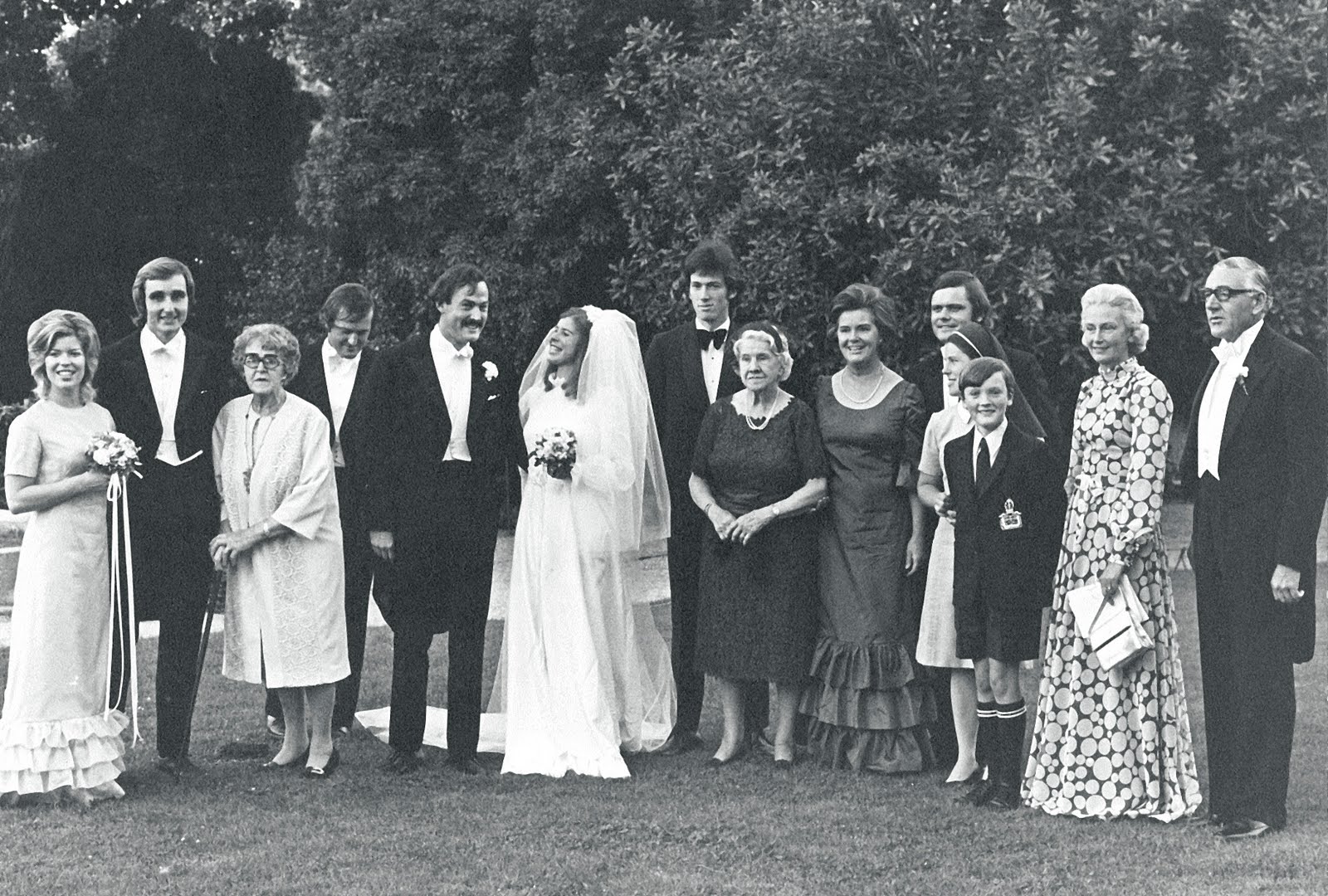
Patricia Rofe has died. She was remarkable. I first met Pat when I was ten years old, and I have a vivid recollection of that occasion. It was after a game of football in Adelaide—surely Simon must have been playing; we were visiting him there. In the lengthening shadows, with the rich fragrance of clods of mud and football boots hanging in the damp, chilly early evening air, both teams, with corresponding girlfriends, families, friends, coaches, umpires, spectators, and hangers-on, repaired to the warmth and light of the old weatherboard pavilion for cocktails, and there, sitting in a fur coat at an ancient upright piano, Pat was good-naturedly accompanying everyone in a rousing set of sporting and other songs. She played with flair, and a sunny smile. Quite obviously everybody loved her. I had never seen anything remotely like this, and actually that pattern has continued in the thirty-five years since. Here she is, our hostess, at the wedding of my brother Simon to my sister-in-law Mary Ann. Pat wore red, and is sixth from the right. When at length I returned to Adelaide to work at the Art Gallery of South Australia, Pat was infinitely kind to me, and also did me the honor of attending some of my talks and lectures. In the middle of one of these, I referred to the English custom that continued long into the Edwardian period of letting the hair of little boys grow long until they attained the age of seven or eight, and of putting them into smocked dresses. When you lecture with slides, your audience is usually invisible—but out of the gloom came the welcome sound of dear Pat in the front row, laughing like a drain. She raised two sons and three daughters pretty much on her own—her husband, a pioneering rocket scientist, died far too young—and Pat dwelt in a world (she really created it) in which every single person except Don Dunstan was interesting, or fun, including the ambulance man who attended her when a few days ago she left her beautiful house in Kensington, knowing full well that it was for the last time. Pat was the grandmother of second helpings and, I suspect, contraband. She detested flying; the Overland has lost its principal income stream. Her politics were robustly conservative, but she loved the Jesuits. And they loved her. Pat played an occasionally flamboyant game of bridge, and also fibbed outrageously about her age. No document, however official, may ever be regarded as a sound measure of it. She was a stalwart of the Adelaide archdiocese, and has, I assume, gone straight to Heaven. May light perpetual shine upon her.
Monday, September 6, 2010
Lasting relationships II

It breaks your heart. At the end of first term in 1979, in the grand tradition of total denial, Messrs. Hallo and Smith wrote: “I have been pleased to see that he has improved his relationships with his fellows and now appears to be enjoying school life more.” Mr. Creese, the headmaster, then piped up: “He seems to be happier.” At that point I had never even met Mr. Creese, so one wonders upon what basis he conjured this rosy, and totally inaccurate picture. At the end of first term in 1980, Mr. Nethercote (economics) wrote: “He could do very well but it would be pleasing to see him ‘free up’ and become more relaxed towards his learning and class involvement.” In his form master’s report at the end of that year, Mr. Brumley wrote: “Despite his difficulty with human relations he remains polite and cheerful.” He was right about being polite and cheerful; I got very good at that, but there it is again: “difficulty with human relations,” as if that were a matter of incapacity, or lack of focus, and not aggravated sexual assault! Mr. Rosenhain (mathematics) chimed in with “He lacks a little confidence but he does have ability.” Major Morton (French), meanwhile: “He lacks confidence however in speaking the language, and this seems to worry him; which it need not do.” Mr. O’Brian (music) broke into intimate typescript with “This student needs to work on his snare drum rudiments. His work on the timpani could also do with more control in the roll area.” Quite. What on earth did any of them really think was going on? Who read these reports in their entirety, and wondered if perhaps a little further investigation might be warranted—beginning with a quiet word to me? By the end of 1980 that would have yielded much evidence of criminal misconduct, so maybe they just thought it safer not to ask. And what should one now do with these bleak, mostly handwritten documents? Shred them, burn them, or send them back to whichever of the authors are still alive, together with an icy covering note?
Subscribe to:
Posts (Atom)