Saturday, September 25, 2010

Tuesday, September 21, 2010
Tiffany

This is the first occasion I can remember on which a direct contemporary of mine has died—something of a Rubicon experience.
Tiffany was a dear person, and a considerable artist. I have an early etching of hers, full of vigor and life. It is an attenuated figure, clambering in mid-air, with lots of plate tone, burr, bite, and velvety ink-black emphasis—a work of early maturity. As a young art student she was the embodiment of fun, but the sort of fun that was built on kindness. She embodied all the best qualities of a country upbringing, near Lismore I think. Her laugh was a bell; her hair a luminous red in Depeche Mode. She was magnificently tall; her legs came up to here. When I first knew her at the beginning of 1983 she wore skirts made of unprimed canvas, but decorated with hand-painted neo-constructivist post-De Stijl motifs, a good-humored riff on the color-field aesthetic. She also wore—according to Charles Gillies—an ammunition belt for the Harraway tennis tournament. I remember being deeply impressed by learning that Ned Brew had sat for Tiffany in the ad hoc art room, not merely nude but adopting the pose of the Barberini faun. It has taken me more than twenty-five years to pluck up the courage to follow suit, though of course in my case the pose is that of the Louvre odalisque brune by Boucher, quite a different proposition. I’m not sure I would ever have had the courage to pose for Tiffany, whose visual assessments were sharper and more accurate than suits the current state of my love portions. She was a wonderful friend to Margaret Kirby and, especially, to dear David Harley. I seem to recall Bohemian evenings spent with all of them, and Tim Klingender, and Julian Mitchell, and so many others. In a very real way they taught me all about letting go, and having fun. I regret very much that for most of the past twenty-three years we lived on different continents, and that I didn’t make a far better effort to keep in touch.
Vale dear Tiffany.
Saturday, September 11, 2010
Pat
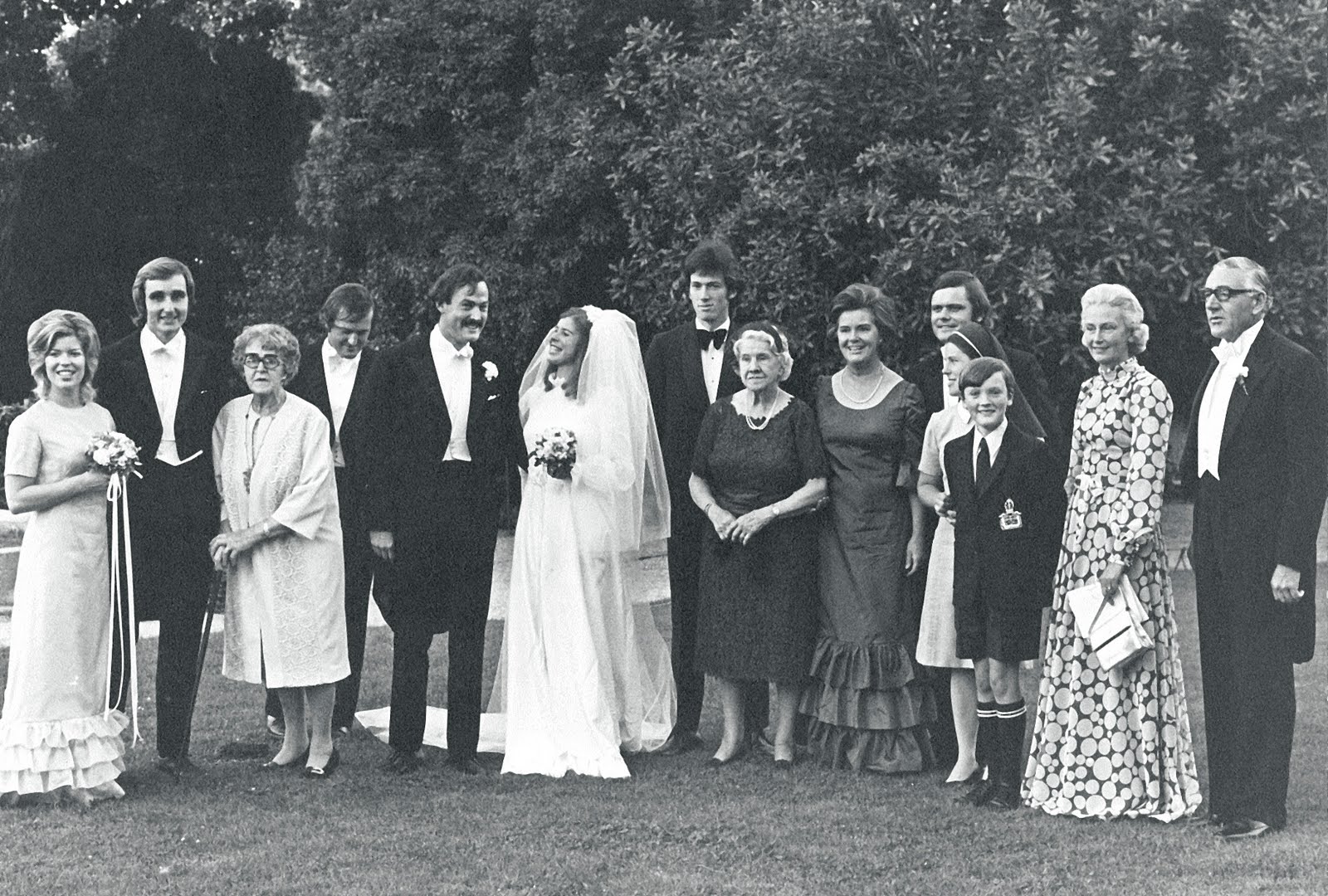
Patricia Rofe has died. She was remarkable. I first met Pat when I was ten years old, and I have a vivid recollection of that occasion. It was after a game of football in Adelaide—surely Simon must have been playing; we were visiting him there. In the lengthening shadows, with the rich fragrance of clods of mud and football boots hanging in the damp, chilly early evening air, both teams, with corresponding girlfriends, families, friends, coaches, umpires, spectators, and hangers-on, repaired to the warmth and light of the old weatherboard pavilion for cocktails, and there, sitting in a fur coat at an ancient upright piano, Pat was good-naturedly accompanying everyone in a rousing set of sporting and other songs. She played with flair, and a sunny smile. Quite obviously everybody loved her. I had never seen anything remotely like this, and actually that pattern has continued in the thirty-five years since. Here she is, our hostess, at the wedding of my brother Simon to my sister-in-law Mary Ann. Pat wore red, and is sixth from the right. When at length I returned to Adelaide to work at the Art Gallery of South Australia, Pat was infinitely kind to me, and also did me the honor of attending some of my talks and lectures. In the middle of one of these, I referred to the English custom that continued long into the Edwardian period of letting the hair of little boys grow long until they attained the age of seven or eight, and of putting them into smocked dresses. When you lecture with slides, your audience is usually invisible—but out of the gloom came the welcome sound of dear Pat in the front row, laughing like a drain. She raised two sons and three daughters pretty much on her own—her husband, a pioneering rocket scientist, died far too young—and Pat dwelt in a world (she really created it) in which every single person except Don Dunstan was interesting, or fun, including the ambulance man who attended her when a few days ago she left her beautiful house in Kensington, knowing full well that it was for the last time. Pat was the grandmother of second helpings and, I suspect, contraband. She detested flying; the Overland has lost its principal income stream. Her politics were robustly conservative, but she loved the Jesuits. And they loved her. Pat played an occasionally flamboyant game of bridge, and also fibbed outrageously about her age. No document, however official, may ever be regarded as a sound measure of it. She was a stalwart of the Adelaide archdiocese, and has, I assume, gone straight to Heaven. May light perpetual shine upon her.
Monday, September 6, 2010
Lasting relationships II

It breaks your heart. At the end of first term in 1979, in the grand tradition of total denial, Messrs. Hallo and Smith wrote: “I have been pleased to see that he has improved his relationships with his fellows and now appears to be enjoying school life more.” Mr. Creese, the headmaster, then piped up: “He seems to be happier.” At that point I had never even met Mr. Creese, so one wonders upon what basis he conjured this rosy, and totally inaccurate picture. At the end of first term in 1980, Mr. Nethercote (economics) wrote: “He could do very well but it would be pleasing to see him ‘free up’ and become more relaxed towards his learning and class involvement.” In his form master’s report at the end of that year, Mr. Brumley wrote: “Despite his difficulty with human relations he remains polite and cheerful.” He was right about being polite and cheerful; I got very good at that, but there it is again: “difficulty with human relations,” as if that were a matter of incapacity, or lack of focus, and not aggravated sexual assault! Mr. Rosenhain (mathematics) chimed in with “He lacks a little confidence but he does have ability.” Major Morton (French), meanwhile: “He lacks confidence however in speaking the language, and this seems to worry him; which it need not do.” Mr. O’Brian (music) broke into intimate typescript with “This student needs to work on his snare drum rudiments. His work on the timpani could also do with more control in the roll area.” Quite. What on earth did any of them really think was going on? Who read these reports in their entirety, and wondered if perhaps a little further investigation might be warranted—beginning with a quiet word to me? By the end of 1980 that would have yielded much evidence of criminal misconduct, so maybe they just thought it safer not to ask. And what should one now do with these bleak, mostly handwritten documents? Shred them, burn them, or send them back to whichever of the authors are still alive, together with an icy covering note?
Lasting relationships
.jpg)
Not many things make me really angry, but this morning’s perusal of the old Melbourne Church of England Grammar School reports has brought me to the point of apoplexy, never a good thing. In the House Master’s Report for the third term of 1978, my first year at the senior school in Domain Road, South Yarra, the following relatively brief summary remarks were signed by “R. Hallo” and “A. J. Smith”: “An excellent academic start has been made which augurs well for the future. His hard work certainly deserves the success he has enjoyed. He has an obvious contribution to make to the library and music. However he must make a real effort with the main problem he has faced this year, that is, developing better and lasting relationships with boys of his own age.” At that time I was fourteen, and scarcely even beginning to go through puberty. Throughout the previous three terms I was subjected to physical and emotional abuse of almost unbelievable severity—including but not limited to sexual assault, battery, imprisonment, mental torture, and an orchestrated program of excoriation, belittlement, and ostracism, wherein one day the boy whom I then regarded as my closest friend casually announced to me in the school parking lot that upon the advice of his own father, a sometime lord mayor of St. Kilda, he had come to the conclusion that my friendship was so damaging to his own reputation that it must henceforth cease entirely, and cease it did. David never spoke to me again, and I do not know what has become of him. The lasting effect of all those things on an adolescent boy never quite go away, but I guess thirty-two years later I have built a viable sort of life despite them. Books, art, and music were my refuges at school, such as they were. But I do not know, and nor now can I ever know, what on earth my deeply worried parents ever made of these House Masters’ view that I “must make a real effort with…developing better and lasting relationships,” as if this were something over which I had any control, or for the lack of which any shy fourteen year-old might actually be blamed. On the whole, better and lasting relationships prosper when you are not being beaten, or having your head pushed down a lavatory in the tog-rooms, or being stuffed into a locker and left there for a good long while. These schoolmasters were in a far better position to stop the abuse and punish the bullies than I ever was. To be fair, schoolboys are as cunning as they are cruel and dangerous, and I would hazard a guess that Messrs. Hallo and Smith actually knew very little about what was going on right under their noses. If they did know, they chose to do nothing about it. I am not sure which is the more damning form of negligence. Poor Mum: She and Dad encouraged me to think seriously about moving to a different school, but such was my state of mind then that I recall thinking that if it was bad at this elite breeding ground of Australian peers, prime ministers, and bishops—I had no points of comparison—then how much worse might it end up being somewhere less distinguished? I suspect they may have felt the same, however misguided was their apparently infinite trust in the wisdom of the school authorities. Simply incredible, and regrettably that is where all of us left the matter. I soldiered on, and survived the ordeal. But how many other boys were not so lucky?
The Rusden Scripture Prize

I have come across my old Melbourne Church of England Grammar School reports. According to Miss Cameron, writing at Grimwade House in 1970, when I was six, “Angus brings many books for us to read. He is most responsive to the rhythm of words and can join in the saying of many poems. He writes down many stories for our enjoyment…His drawings and paintings are especially interesting, being both colourful and imaginative. He has some excellent ideas for creative work and he gets much pleasure from the things he makes.” In conclusion, Miss James remarked: “Angus now smiles much more readily, and seems much happier in a big and busy school.” Two years later, Miss James’s assessment continued to be upbeat: “Angus is a quiet, hardworking boy who always gives of his best. He has completed an excellent third form year.” In the same year Mrs. Fairbairn saw fit to write: “Angus’s work in divinity has been excellent throughout the year. He shows particularly good understanding of this subject and well deserves his Rusden Scripture prize.” Now, interestingly, my dear brother Hamish also won the Rusden Scripture Prize, nine years earlier, as did our beloved father some forty years before that. Not long ago Hamish told me that Dad was awarded the Rusden Scripture Prize for an impressive essay about his great uncle Harry, whose life was taken by heathen savages in New Caledonia whilst engaged upon missionary work—an outrage that apparently prompted the punitive expedition of H.M.S. Psyche. Alas, his account was not accurate, because it seems that Great Uncle Harry actually died of injuries sustained in a pub brawl somewhere in Queensland. The casus belli on that occasion was missionary work of an entirely different character, in connection with a married lady, and a heated discussion arising from that between Great Uncle Harry and the married lady’s cuckolded husband, a cane-cutter. Dad’s mistake was an honest one, and I do not know if Pa took any steps to clarify this delicate matter with the school authorities. Certainly the prize was never rescinded: I have it now, a fine hand-tooled edition of Weigall’s Nero.
The flat

It’s nobody’s fault, I suppose, except my own. I am now all packed up and ready to move house, except I haven’t got a house to move to. The dear little flat that I am trying to buy is waiting there, but owing to some curious historical preservation matter arising from the nature and construction of the windows my lawyer tells me that the City of New Haven has seen fit temporarily to decline a certificate of occupancy, without which it cannot be sold. There’s a meeting at city hall tomorrow at which this issue may be resolved, but if it is not—and I am not hopeful—I shall then have to wait until no sooner than October 12, quite possibly longer. This will require all the patience I can muster, but at least I may have the option of retrieving my deposit and starting again. I don’t especially want to do that, and to some extent it will be for the vendor to decide how much they want to conclude the sale upon which we have agreed. Perhaps they will decide that they have a good chance of selling it to someone else for more. Good luck to them. From my vantage point the local housing market has all the vim and vigor of an Ice-Age mastodon lumbering towards a snowdrift in which to die peacefully, or a sluggish coal-burning tramp steamer with an alarming list. I am repeatedly told that it is a buyer’s market, but it doesn’t really feel like that. Among the benighted markets of America the housing market is quite obviously still the sickest of men, not merely on life support, but with metastases à go-go. Apart from those many small anxieties of moving house, there is added to these that overarching, palm-moistening fear that if it is this hard to pay cash for a not inexpensive flat in New Haven, Conn., how much harder will it be in due course to sell the damned thing? The Labor Day weekend marks the psychic end of summer, but this year I am spending it immured in a canyon of cardboard boxes, tawdry cartons of atrocious take-away food, and nail-biting anxiety. But I have not been unproductive: In an effort to distract myself I been listening carefully to the three concerti for piano and orchestra by Nikolai Medtner, in the sensational recordings made for Chandos by the late Geoffrey Tozer (at the inspired suggestion of the Hon. Paul Keating) and the London Philharmonic conducted by Neeme Järvi. The tragically premature loss of Geoffrey Tozer a little more than a year ago is something that has diminished Australia, and the world. He was a great, great artist—of the stature of Arturo Benedetti Michelangeli, Artur Schnabel, and Sviatoslav Richter. So in the end, and in the larger scheme of life and art, you have to say: Who cares about a dear little flat?
Saturday, August 14, 2010
The figurine

About twelve years ago Uncle John gave me this beautiful object for my birthday. He acquired it in London in the early 1970s when he was a partner in Barling and Co., a small but highly respectable firm of antique dealers in Mount Street, just off Berkeley Square. Roy Barling, the principal, used to take Chinese antiquities and works of art on consignment from the distinguished New York dealer Robert Hatfield Ellsworth, and I presume that this was one of them. Eventually for a while after Roy Barling died, Robert Ellsworth owned the London firm, but I gather not for very long. Despite my best efforts to insure the figurine was expertly packed before I moved from Adelaide to New Haven, Conn., in May 2003, sadly she got broken in transit, and I have only lately got around to having her mended and conserved in New York by the excellent sculpture and objects conservator Susan Schussler. Happily, Susan is convinced that the breaks are actually old ones.
Uncle John loved the figurine, and never sold her—partly because he became convinced that she was a clever fake. At the time he acquired it in the mid-1970s, he engaged the Research Laboratory for Archaeology and the History of Art at Oxford, who took a sample from beneath the base, and subjected it to thermo-luminescence testing. The results were not encouraging. At least that was Uncle John’s decidedly vague recollection towards the end of his life. He told me that afterwards he filled the hole with a scrap of kleenex and spit, but I cannot now find it. It must have been tiny.
Now, the consensus of opinion among specialist objects conservators and laboratory technicians has since then shifted substantially. Samples are best taken from somewhere other than underneath the base for the simple reason that bases are more likely to have been restored, mended, consolidated, or otherwise interfered with, which obviously can make a big difference to the thermo-luminescence test results. The convenient aspect of the present situation is that Susan has been able to take a new sample from inside the head, from the broken part of the neck, in other words from a spot which will not be visible when she reattaches them, and which, when tested, will be far more likely to provide reliable evidence of my figurine’s antiquity, or not.
The question is of some moment, because if she turns out to be genuine, my little musician is almost certainly a Sui Dynasty (A.D. 580 to 618) temple musician, of which Chinese archaeologists have lately excavated a number from tombs. Indeed a complete female orchestra came from the tomb of Zhang Sheng and his wife; it is dated to A.D. 595. According to my generous colleague David Sensabaugh, Curator of Asian Art at the Yale University Art Gallery, the hairstyle here may be just a little later, perhaps early Tang (i.e. early to mid-seventh century). She is playing a four-stringed pipa, a fretted instrument obviously very like a lute or a modern guitar. David suspects that the figure was originally painted with cold colors that have now disappeared from the slightly powdery surface slip.
If the thermo-luminescence results turn out to be as discouraging as the previous set, it seems likely that the figure is indeed a forgery, but almost certainly made in the early to mid-twentieth century. David does not think there was much systematic forgery in China from the late 1940s through to the end of the Cultural Revolution (other than in Hong Kong) for the simple reason that there was too much upheaval. In the 1920s and 1930s, however, temple musician figurines of this kind were indeed forged for an almost exclusively western market. Chinese connoisseurs tended to avoid them because of their inauspicious associations with death and burial, and indeed the presumption that, if genuine, they must almost certainly have been swiped from the final resting place of someone eminent or at least respectable. Alas, western taste has proven altogether less scrupulous, and quite obviously remains so.
Anyhow, Susan’s preliminary assessment is that my figurine has been heavily restored on at least more than one occasion and presumably in radically different circumstances. This could mean (a) that what remains of her is indeed genuine, or else (b) she was assembled by forgers from a stock of “authentic” ancient broken fragments illicitly harvested from tombs, in other words as a sort of palimpsest-like assemblage whose claim to authenticity is uniquely Chinese, and characteristically complicated. Hence the importance of thermo-luminescence testing, though of course an encouraging result from the new sample would not rule out this second possibility. The main and overriding point is that my figurine now seems unlikely to have been forged from scratch.
And she is beautiful. To my untrained, non-specialist eye, there is a gentle subtlety and vivaciousness in her plump face, and an charmingly affectionate disposition of the little left hand, qualities in other words that are not usually generated in the otherwise coldly calculating mind of a brilliant professional forger. On the other hand, Chinese forgers are among the cleverest ever to have thrown a brace of spanners into the thrumming machinery of connoisseurship, and their best productions may well escape notice forever. Even so, it would be odd, though not impossible, for such a subtly beautiful object to be identified as an obvious fake, or a clumsy hybrid.
Part of me hopes that that is what she is, because therefore she was not stolen from some poor gentleman’s tomb. And even if she is not a terribly compromised, much-repaired antiquity from the Sui or early Tang dynasties, I love my little pipa player, as Uncle John did, and she will henceforth preside over my dining room, serenading his merry ghost, together with Jim Lawson, Aunt Anne, Uncle Henry, gusty old Uncle David, Gran, Nan and Pa, and of course Dad and Mum, all of whom are just now getting ready to move house with with me.
The table


Saturday, June 19, 2010
The chair

Through the combined efforts of Susan Holbrook, of the firm of Holbrook and Hawes in Bethany, Conn., and Benny Becker of Norton Upholstery in West Haven my chair may now be revealed in all its renovated splendor. I picked it up last Tuesday. Real horsehair has taken the place of clumps of coconut fiber (and a lot of other junk swept off the Melbourne upholsterer’s floor in the late summer of 1949). My excellent colleague Pat Kane should take credit for having recommended the most appropriate sort of fabric—indestructible mohair velvet—while, of course, the color was my bright idea, as was the inspired choice of gimp.