Wednesday, March 23, 2011

Josef Hochgürtel and August Saupé


There is a tendency in Australian heritage circles to set aside detached assessments of aesthetic quality in respect of the colonial built environment, and fill that void with bright jingo. A perfect example is Stonnington, which for the first few decades after Federation served as State Government House. It is generally described as a mansion, but Lady Talbot, who lived there, thought it was “a nasty little villa,” which is without question more accurate—Stonnington is old, comparatively large, and obviously “historic,” but it is not great architecture, nor probably even good.

In a similar vein, last week I was intrigued by the large fountain that stands in front of the south façade of the Royal Exhibition Building, and is actually an indispensible fulcrum for the principal arch, the forecourt, and the axial arrangement of the entire design of the Carlton Gardens on the Victoria Street side. According to the plaque, that fountain was designed and modeled in Portland cement by a man who rejoiced in the name of Josef Hochgürtel, and this is evidently the only work by him that was ever built in colonial Australia. Here is what the emelbourne website says about him, and it:

Josef Hochgurtel was born in Cologne and trained under Herr Fuels, who modeled the Cologne Cathedral. In creating the Exhibition Fountain, he was assisted by August Saupe, who had worked on similar pieces in Berlin, Dresden and Copenhagen. The colossal fountain stands some ten meters high on the south side of the Royal Exhibition Building, outside the Great Hall. It was constructed for the first of Melbourne’s two grand international world fairs. The fountain’s visual elements were designed to display the young colony’s confidence and advancement, simultaneously signaling the purpose of world fairs to display the produce and industry of nations. At the central level of the fountain, four youths (representing a young and vibrant colony) dance below symbols of the arts, science, commerce and industry; for example, musical instruments, a telescope, sailing ship, steam engine and globe of the world. Above this are images of Victoria’s indigenous flora and fauna, and a boy with a clamshell. Holding all of this aloft are four merpeople rising up from the waters of the lower pool. Built during Victoria’s boom years, the fountain’s spouting water, it was thought, would demonstrate the power and success of the recently established Yan Yean project, which brought potable water to the city. On opening day, however, the pressure was too poor to affect much more than a spurt from atop of the grand edifice. In 1994, Hochgurtel’s fountain underwent major restoration. It remains a great reminder of the glorious days of Marvelous Melbourne.

Hmmm, yes. Time for a little fact-checking.
 
The names of Josef Hochgurtel and August Saupe and Fuels do not appear in Saur (Allgemeines Künstlerlexikon Bio-Bibliographischer Index), nor in the revised Bénézit, nor in Thieme–Becker, which is very suspicious, but it turns out that whoever drafted this text gleaned most if not all of the pertinent facts from an article entitled “The Exhibition Fountain” that appeared in the Argus on Tuesday, May 18, 1880 (p. 7). There it is made clear that Messrs. Hochgürtel and Saupé were present in the colony, which partly explains why they flew under the radar screen of Thieme–Becker, and almost everybody else since then. Mr. Saupé may have come overland from Adelaide, where he is documented living slightly later. His name appears nowhere in the shipping lists. Mr. Hochgürtel, meanwhile, “a young German artist, who has recently arrived here with the intention of settling in Melbourne should sufficient inducement be offered,” in fact sailed into Hobson’s Bay aboard the Sultan in September 1879, aged 25. According to the Argus, “Mr. Hochgürtel, who is a native of Cologne, has enjoyed a wide continental experience, having received his preliminary training at the hands of Herr Fuels, of that city, modeler for the Cologne cathedral, the noblest Gothic structure in Germany…” I have used Australian colonial newspapers for so long that by now I can not only spot a misspelled name, but can usually correct it. Now, the Kolner Dom was begun on August 15, 1248. Construction ground to a halt in 1560 and did not recommence until 1842, when the work was directed by the Gothic Revival architect Ernst Friedrich Zwirner (1802–1861), liberally financed by the King of Prussia and the Zentral-Dombau-Verein. So Herr Fuels must have been a sculptor working on the site, and, sure enough, there he is, popping up in the records as Peter Fuchs (1829–1889), a churner out of hundreds of life- and over life-sized figures for the interior and exterior of the cathedral. Mr. Hochgürtel, the Argus went on, “was also associated with Professor Hasenphlug [sic], of Cassel [sic], and Professor Franz, of Berlin, and studied anatomy under Professor de la Halette St. George [sic], at Bonn, and Professor Lucea [sic], at Frankfort-on-Maine [sic]. Mr. Hochgürtel has with him another European artist of considerable experience—M. August Saupé, who has been engaged upon similar works at Berlin, Dresden, and Copenhagen.” Karl Hassenpflug (1824–1890) was from 1868 professor of sculpture at the Kasseler Akademie. Julius Franz (1824–1887), of the Berliner Akademie, specialized in portrait busts and rather wan genre groups in marble. Adolf Johann Hubert, Baron de la Valette St. George (1831–1910), director of the Anatomisches Institut at Bonn, was actually an ichthyologist, and alas I cannot trace Professor Lucea (obviously misspelled). M. Saupé may have belonged to a family of artists in Dresden, meanwhile, because Saur and Thieme–Becker record Johann Gottlob Sauppe, sculptor of capitals for the Church of the Holy Cross in that city (active 1764–1792), and also Louis Saupe, “Genremaler u[nd]. Lithograph um 1845/47, tätig in Cassel u[nd]. Dresden,” in other words just maybe our sculptor’s father, or else an uncle or cousin. August Saupé definitely crops up in the Class III (“Sculpture, Statuary, and Artistic Modelling”) section of the Official Catalogue of Exhibits in South Australian Court at the Colonial and Indian Exhibition which took place in London in 1886. The entry gives an excellent impression of the gentleman’s range, and also the general artistic company he kept in colonial Adelaide: “1. Commissioners for South Australia.—(1) Plaster cast of Mullaway fish. (2) Plaster cast of South Australian fish (painted, natural tints, by A. Saupe [sic]). (3) Wax models of Fruits grown in South Australia (made by Mrs. Gray, Melbourne-street, North Adelaide). (4) Plaster casts of Merino Ram, and one double cast of the same. 2. Kennedy, William, Noarlunga.—Carving on slate by a self-taught workman, “Old England and the New.” The exhibitor is an ostler [i.e. a stable-man, usually at an inn], and has executed this work with rude tools. 3. Saupe, August, Adelaide.—(1) Bust of Sir W. F. D. Jervois, G.C.M.G., C.B., ex-Governor of South Australia. (2) Medallion of the Hon. Sir Henry Ayers, K.C.M.G., President Legislative Council. (3) Medallion of late Rev. James Way, Bible Christian Minister. (4) Medallion of Dr. Way. (5) Medallion of the late Dr. Chas. Gosse. (6) Hoh-relief copy of [Bertil] Thorwaldsen’s ‘John the Baptist Preaching in the Wilderness [i.e. pediment of the Frue Kirke, now Copenhagen cathedral].’” Mr. Saupé is also mentioned in connection with an intriguing proposal to create an ambitious group of polychrome wax models of Australian Aborigines, and much later as a prospector for quicksilver and gold. Finally, in 1900 the Queensland branch of the Royal Geographical Society acquired a medallion of Ferdinand von Mueller by August Saupé, to whose name at least several papers (the Queenslander, the South Australian Register and the Advertiser) added the fictitious postnominals “R.A.” The Exhibition Fountain itself belongs to the so-called Renaissance Revival type, usually with various personifications, that was pioneered in France by Louis-Tullius-Joachim Visconti (1791–1853), and proliferated as a model for the modern city, to some extent imitated but also given a distinctly stodgy cast for German squares and terraces by the building inspector of Karlsruhe, Friedrich Weinbrenner (1766–1826). The Argus gives the best and most comprehensive reading of the artist’s scale model for the projected fountain, which was displayed in the window of Messrs. Nicholson and Ascherberg, music publishers, “importers of fortepianos, cabinet organs, and harmoniums,” along with a corresponding scale model of the Royal Exhibition Building (also made by Hochgürtel) :
The design, which is to be carried out by the artist himself, is for a fountain 34 ft. high, rising out of a basin 60 ft. in diameter. The material used in its construction will be the best Portland cement, on a strong framework of stone and iron, and when finished the fountain is expected to be the handsomest structure of its kind in the Australian colonies. The base of the fountain is an irregularly-shaped mass of rock, rising 2 ft. or 3 ft. above the level of the water, on which there are three colossal figures, half human and half fish, supporting the first ledge or basin, 48 ft. in diameter. The figures are each 9 ft. high, and in the bays formed by their tails are placed three boys, one deeply intent on fishing, another stooping down to dip up some water in a shell, while a third is represented in the ludicrous position of affright at the appearance of a turtle which is crawling up out of the water towards him. Above the first basin the central column is continued in the form of a hemisphere, around which four boys are dancing hand-in-hand. These figures will represent Commerce, Industry, Science, and Art, symbolical devices being shown over the heads of the dancers. The second basin has a circumference of 30 ft., and above this the fountain is continued in another form, the supporting pillar being fancifully embellished with birds and flowers, all of which are taken from species indigenous to Victoria. Twenty-nine feet above the level of the water, the third ledge or basin supports the figure of a boy bearing on his head a basket with four fishes, from the mouths of which streams of water will flow and from the basket itself will rise a strong jet, which may be forced up to a height of 70 ft., should the pressure be available. In addition to the figures described, 12 young crocodiles are shown in the act of crawling up from the water below, and simultaneously invading the first basin of the fountain. Their forepaws and heads are level with the water in the basin, and from the mouth of each a jet of water ascends, which, curling outwards, falls into the huge basin below—a clear descent of 22 ft. The upper basins are imperceptibly filled with water, which falls downward in sheets, and in addition to the crocodiles some 29 heads of marine animals spout water in all directions higher up the fountain. The closest attention has been paid by the artist to detail, and the fountain in play will be supplied with water from every tier or basin. The supply-pipe will be 4 in. in diameter, drawn direct from a 22 in. main, so that on special occasions the fountain may be worked up to 100 ft., though 70 ft. is likely to be the ordinary height attained…The total cost will be £800, the commissioners at their last monthly meeting having accepted this estimate.
The finished work differs only in minor details from this plan, although it is interesting to note how completely degenerated the action and effects of the water have become in recent times, presumably in an effort to save water. Goannas appear to have taken the place of crocodiles, and platypuses were introduced in amusing dialogue with them from a corresponding vantage point at the lip of the middle basin. The 29 marine animals seem to have been conflated, perhaps in the interests of increasing water pressure, and an engaging upper fretwork of ferns is the only feature that the Argus did not mention, possibly a refinement introduced during the process of construction. It is delightful, symphonically vulgar, and fabricated out of deeply unpromising materials, although I suppose we must be grateful that they did not carve it out of bluestone. It is hardly surprising that nothing else remains of the sculpture of Josef Hochgürtel and August Saupé, although given the impressive scale and ambition of the Exhibition Fountain it seems strange that neither artist has ever made it into McCulloch, or any other printed record other than Ken Scarlett, the Victoria Government Gazette, and the daily newspapers. Hochgürtel simply evaporated.

Tuesday, March 22, 2011

The enduring qualities of local stone


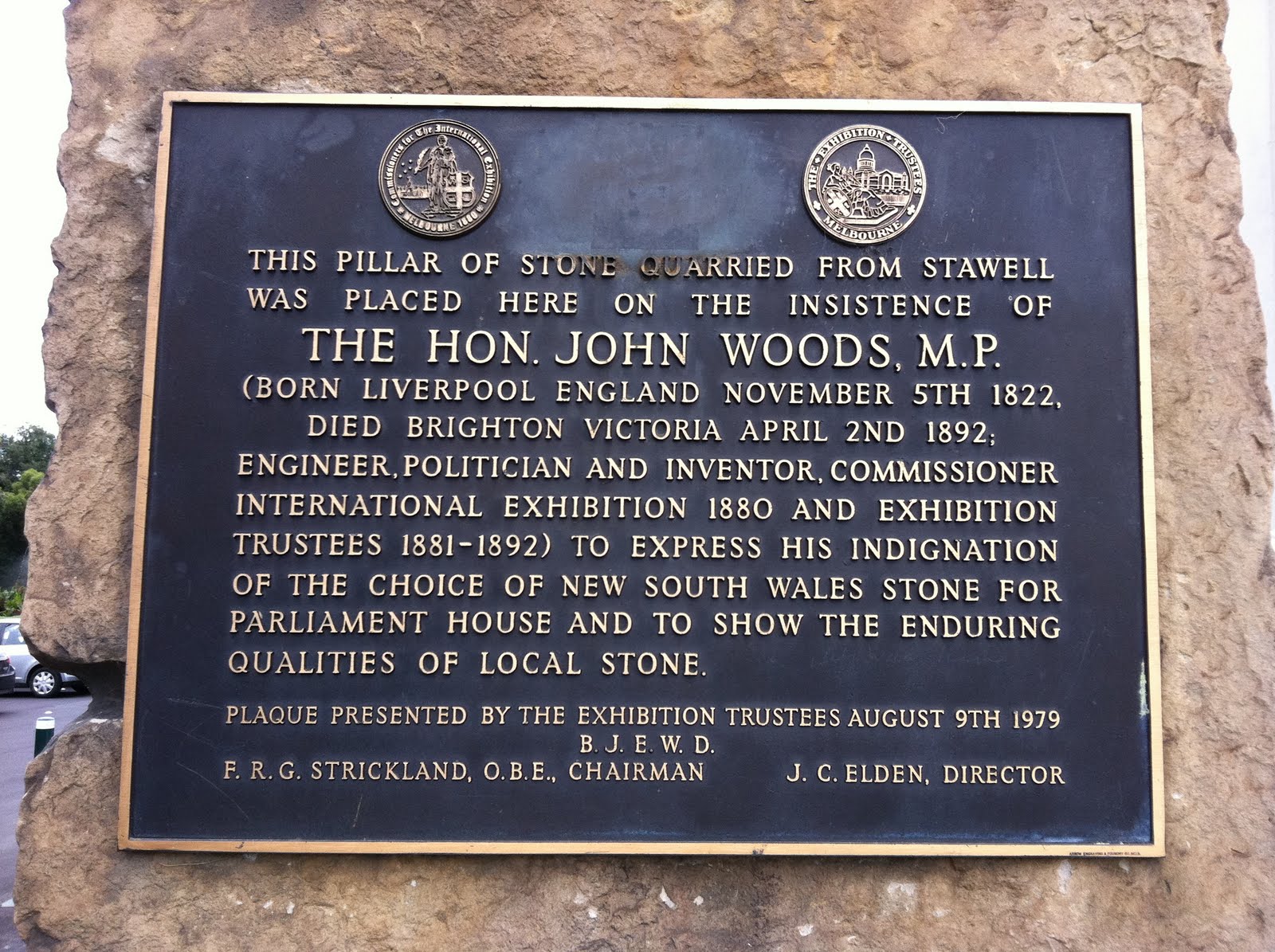
On my perambulation through the Carlton Gardens last week, I came across a little monument that captures perfectly the puffiness and pride of colonial Victoria. It is a tall, skinny, rough-hewn monolith discreetly placed near the north side of the eastern facade of the Royal Exhibition Building, to which is affixed a bronze plaque with the following, curiously drafted inscription: “This pillar of stone quarried from Stawell was placed here on [sic] the insistence of the Hon. John Woods, M.P. (born Liverpool, England, November 5th 1822; died Brighton, Victoria, April 2nd 1892; engineer, politician and inventor, commissioner International Exhibition 1880 and Exhibition Trustees 1881–1892) to express his indignation of [sic] the choice of New South Wales stone for Parliament House and to show the enduring qualities of local stone. Plaque presented by the Exhibition Trustees, August 9th 1979, B.J.E.W.D. F. R. G. Strickland, O.B.E., Chairman, J. C. Elden, Director.”

I wonder what “B.J.E.W.D.” stands for—that W.D. on the end could be something like “works department,” or maybe its the acronym for the architects, builder, or civil engineer who fixed it up in time for the centenary in 1980, and the visit of Princess Alexandra. I must find out.

Anyhow, there are many wonderful things about Victoria, and maybe even grounds for believing that certain of them compete successfully against the corresponding or rival claims of neighboring states. However, throughout our brief history such convictions have tended to give way to parochialism pure and simple, and in some respects they still do. I notice this for the simple reason that I have not lived in Victoria for seventeen years, and it has been a happy consequence of living elsewhere that I have come to know the rest of the country a little better, I suspect, than if I had stayed put. So, I am thinking to myself: Where else in the whole wide world would “the enduring qualities of local stone” trump those creamy, soft, fine-grained, honey-colored sandstones that are the glory of colonial architecture in New South Wales, Van Diemen’s Land, and South Australia? These would have offered Melbourne architects almost limitless possibilities had there been no overriding belief that the local product was superior, or that bluestone was ipso facto better—bluestone, the epitome of forlorn volcanic greyness, the geological equivalent of catarrh, scattered so plentifully across the high plains of Central Victoria. Sullen, lumpy boulders of it broke axles, maimed horses, and provided excellent cover for criminals during the Gold Rush, and in due course poured into stonemasons’ yards for crude, busy rustication (because it is both crumbly and hard, dense but full of bubbles, scratchy in texture but not crystalline, and innately dull) before being turned into prisons, cemetery out-buildings, storm drains, presbyteries, and Church of England boys’ schools. Admittedly, the Stawell product seems a little more promising, though it has not weathered very well. No, Mount Gambier or, better, Sydney and Hawkesbury sandstones are so much more beautiful, and, pace my beloved Melbourne, to point this out with particular emphasis does not constitute an act of treachery.

Sunday, March 20, 2011

In Pleasant Remembrance

When, I wonder, was the old Museum of Victoria turned into the rather different, definitely expedient, and colossally self-important “Melbourne Museum”? The name is not in any way an adequate descriptor of the spread and character of the collections, nor indeed the sources of its funding both now and in the past, but I suppose resistance is futile, as usual. Whilst waiting to enter the other morning, however, and ruminating upon the demise of the old-style natural history museum, I did a turn around the surrounding Carlton Gardens, and came across this extraordinarily curious lantern and drinking fountain, set back from Nicholson Street, right in front of the east facade of the Royal Exhibition Building.
This public amenity is a glorious hybrid—the lantern supported by a group of affectionate, overweight kangaroos, carved out of a single piece of pink Aberdeen granite...
with a supporting patch...

...of approximately Australian foliage.
These are in turn set upon a low, muscular plinth of similar material into the sides of which are introduced satisfactorily ovoid, protruding basins on Romanesque-izing half columns, above which are also set bronze high reliefs, each depicting the head, neck, and shoulders of an inquisitive, if slightly bad-tempered emu, presumably keeping watch over the basins.
There is also a bronze plaque on the front, which reads, delightfully: “TO / VICTORIA / FROM ONE OF / HER EARLIEST COLONISTS / IN PLEASANT REMEMBRANCE / 1840–88.”

I carefully noted this down, to the surprise of a couple of indolent junkies, and resolved to discover the identity of this discreet but public-spirited benefactor upon my return to New Haven, Conn. It didn’t take long. First thing this morning I found that the composer was William Westgarth (1815–1889) who arrived in Melbourne on December 13, 1840, and in due course became prominent in the Melbourne Mechanics Institute, the Benevolent Society, and most if not all of the fledgling institutions of civil society in the Port Phillip District, as it was before 1851. Westgarth entered the Legislative Council of New South Wales as a representative of the region, and was an early advocate of Separation. His Observations on the Present Commercial, Agricultural, and Civil Condition of the Australian Colonies, was published in Leith in 1844. A Report on the Condition, Capabilities and Prospects of the Australian Aborigines followed in 1846; then Australia Felix; or, a Historical and Descriptive Account of the Settlement of Port Phillip in 1848; Victoria: Late Australia Felix in 1853; a revision of James Bonwick’s Discovery and Settlement of Port Phillip in 1856, along with Commerce and Statistics of Victoria, From the Commencement of the Colony; Victoria and the Australian Gold Mines in 1857; Australia: Its Rise, Progress, and Present Condition in 1861; The Colony of Victoria … Down to the End of 1863 in 1864; at length, the entirely vivid and engaging and extraordinarily useful Personal Recollections of Early Melbourne and Victoria in 1888, and, finally, in 1889, the year he died suddenly of injuries sustained whilst attempting to open the attic window of his house in South Kensington, Half a Century of Australasian Progress, a Personal Retrospect. Mr. Westgarth’s keen interest in drinking fountains arose from his longstanding commitment to the temperance movement, and this one was created to coincide with the Centennial International Exhibition of 1888. Victoria’s founding fathers thought globally, not nationally or even inter-colonially, and certainly not within closely drawn metropolitan boundaries, so why on earth was the crazy decision made lately to recast one of their most ambitious intellectual and institutional legacies under the dismal rubric “Melbourne Museum”? Someone should reverse it, soon.

Loose ends

After she died nearly sixteen months ago, Mum left behind very few loose ends. Helen made a lifetime’s habit of throwing things away, and although it fell to Nick and Simon, mostly, to dispose of the contents of her house, when the time came to do that ghastly job it was reasonably straightforward. Yet anyone who has dealt with the estate of an elderly parent will know that matters small and large continue to crop up for many months, extending some considerable distance beyond the canonical executor’s year: the melancholy card or telephone call from a distant but affectionate country cousin who for some reason flew under the radar screen; Dad’s apparently missing Pacific campaign medals that eventually turned up in the bottom drawer of an old desk, raising the further question as to what on earth to do with them; a dry cleaners’ docket carefully tucked into Mum’s purse, behind her driver’s licence—still current but somehow overlooked. Last week we discovered that docket. It relates to two good quality woolen blankets, part of the last spring clean, which, only a matter of days before she died, Mum took up to the dry cleaner near the corner of High Street and Glenferrie Road. It must have taken some considerable physical effort, and that she carried on so heroically with such humdrum domestic chores is entirely characteristic of her sterling, undaunted personality. Anyhow, we decided we should probably inquire about the blankets, knowing that, having been unclaimed for so long, in all probability they would in all likelihood have been disposed of.

Mairse rang The Elegant Dry Cleaners (9509 3718), and to our amazement the proprietor still had them. Her name is Janine, and, it turns out that after Mum failed to collect them promptly, as was her habit, Janine sensed that something must have happened to her. Mum was a good customer for many years, businesslike and formal and well-organized. There was no small talk. There are dry cleaners that are nearer and cheaper, but they don’t do as good a job. Mum definitely preferred The Elegant Dry Cleaners. At the time, Janine started ringing selected Trumbles in the telephone directory, and even contacted Telstra, who declined to make further inquiries, but hers is a busy concern, the weeks sped by, and the matter drifted, as such matters do. Still, she held onto Mum’s blankets. Last Tuesday I went to collect and pay for them, and Janine leaped from behind the counter, gave me a hug, told me the whole story, decried the unhelpfulness of Telstra, and asked me to convey her condolences to the rest of the family. She fetched the blankets from somewhere distant, and told me how to peel the plastic off so as to protect them from the layer of sixteen months’ accumulation of dust, a good deal of which ended up down the front of her red sweater. Presently they’ll go to Metung, and replace a couple of the ancient, sixty, seventy, eighty year-old stained monstrosities in the middle bedroom. These days we hear a lot about customer loyalty, as if the concept is an exciting invention of the modern retail trade, but with Mum it was ingrained, just as for all those years and years she bought meat from nobody other than Mr. Matthewson the butcher. But what you don’t hear quite as much about is the corresponding loyalty the good customer earns from her hard-working local dry cleaners. I thanked Janine, and shook her hand. This felt strangely final, especially because only a few days earlier, the previous Sunday, after the 8 o’clock service, we deposited Mum’s ashes not fifty paces away, under a fine cherry tree in the Memorial Garden at St. George’s in Glenferrie Road. Final, yes, but what more could I do, except to commend to anyone who is prepared to listen the outstanding worth of The Elegant Dry Cleaners of 1274, High Street, Armadale?

Tuesday, February 22, 2011

More from Nick in Saigon


Inspecting the contents of the library in the old presidential palace in Saigon, this morning Nicko writes: “The palace was designed by a French trained Vietnamese architect Ngô Viet Thu, who somehow survived the war and its aftermath, and only died quite recently. It’s all very 1961, and untouched. Quite fashionable actually. It has a Monash University or Canberra feel. The evil President Diem was assassinated before it was finished, so I’m not sure whether these books were his, or those of his successor, but whoever it was was reading Airport, and had an interest in Henry James. I see a title by Graham Greene, but I don’t think it’s The Quiet American. The cafe in which some of the action takes place in that novel is now a Gloria Jeans coffee emporium. Depressing.”

Monday, February 21, 2011

GAY 900


In the 1950s and 1960s, indeed throughout the rest of his life, our father indulged an immoderate enthusiasm for French automobiles, many of them unreliable. At the funeral Hamish summoned an especially charming image of Dad’s Walter Mitty-like reverie behind the wheel of whichever Citroën was for the time being the object of his affection—“I hear the thrum of accordions, I savour the fragrance of Gauloises mingled with that of blanquette de veau or the bouquet of a good Côtes de Rhône, and, with my beret worn just comme ça, I coast along the grand corniche…” or something similar. In fact for many years, but long before I came along, the family vehicle was a model very similar if not identical to this one, and it provided excellent service on many long-haul family holidays, country picnics, skiing trips to the old Belmore Ski Club at Mount Buller, which Dad helped build with his own bare hands, etc. Its Victorian registration plate was the altogether delightful “GAY 900.” Indeed the vehicle continues to be fondly remembered by my brothers as “the GAY 900.” So imagine his surprise when last week in Ho Chi Minh City, formerly known as Saigon, where he is currently on vacation with Lesley, Nicko was astounded to come face to face with this relic of the French colonial period—think of what it must have survived: blanket bombing, napalm, the chaos of insurgencies, the American evacuation, the arrival of the Viet Cong, and the rest. In other words, without actually saying so, I suspect this chance encounter, of which he immediately notified us by email, powerfully removed Nick to Australian places of childhood and adolescence that must be about as different as it is possible to be from any aspect of life in Vietnam, then or since. I have an idea that through the immense number of automobiles Nick owned as a young man he may well have bought himself one of these jaunty black traction avant Citroëns 11CV (1934–1957), though alas it did not last.

Saturday, February 19, 2011

The hyacinthine colour of the distance

I am a sucker for Edwardian sentiment, and apparently so too was Margaret Wood, author of The English Mediaeval House (1964), which I have been re-reading lately. Something of her character is conveyed on the title page where, without false modesty but at the same time nodding toward old manners, she is “MARGARET WOOD, M.A., D.LIT., F.S.A. (MRS. E. G. KAINES-THOMAS),” while the hearty, public school-leaning dedication is simply “To K-T.” However, it was by the long epigraph that I was captivated in bed this morning—a passage from the novel Precious Bane (1924), by Mary Webb:

To conjure, even for a moment, the wistfulness which is the past is like trying to gather in one’s arms the hyacinthine colour of the distance. But if it is once achieved, what sweetness!—like the gentle, fugitive fragrance of spring flowers, dried with bergamot and bay. How the tears will spring in the reading of some old parchment—“to my dear child, my tablets and my ring”—or of yellow letters, with the love still fresh and fair in them though the ink is faded—“and so good night, my dearest heart, and God send you happy.” That vivid present of theirs, how faint it grows. The past is only the present become invisible and mute; and because it is invisible and mute, its memoried glances and its murmurs are infinitely precious. We are tomorrow’s past. Even now we slip away like those pictures painted on the moving dials of antique clocks—a ship, a cottage, sun and moon, a nosegay. The dial turns, the ship rides up and sinks again, the yellow painted sun has set, and we that were the new things, gather magic as we go.

Precious Bane is set in Shropshire shortly after the Napoleonic wars, and concerns two parallel love stories, that of Prue Sarn, the narrator, who because she has a disfiguring harelip cannot believe that she is worthy of the wholesome weaver Kester Woodseaves, who perceives the innate beauty of her character, and that of Prue’s brother Gideon whose determination to marry his sweetheart, Jancis, is fatally sabotaged by lust for money and power. The title comes from Milton: “... Let none admire / That riches grow in Hell; that Soyle may best / Deserve the pretious bane. ...” (Paradise Lost, I: 690–92, i.e. money is the root of all evil, viz. bane, or poison). Incidentally, “to my dear child, my tablets and my ring,” clearly evokes a mother’s last will and testament, but those tablets were old-fashioned items of jewellery, not medicine. Precious Bane earned Mary Webb the Prix Femina Vie Heureuse, and also the admiration of Prime Minister Stanley Baldwin, but it is also typical of the kind of post-War, primitive-England, “loam and lovechild” writing that Stella Gibbons parodied so brilliantly in her Cold Comfort Farm (1932)—I read that again too not long ago. But what about that passage to which Margaret Wood, a disciple of Sir Mortimer Wheeler, so extravagantly directed her readers at the beginning of The English Mediaeval House? Well, I think it’s rather simple. Surely you can only fully grasp what Mary Webb has to say about trying to gather in your arms the hyacinthine colour of the distance, or indeed measure the sweetness of the gentle fugitive fragrance of spring flowers dried with bergamot and bay, once you have arrived comfortably at middle age—or if, over the years, you have kept enough letters that were written in blue ink that is rapidly fading. And it all lines up perfectly with the Edwardian cult of paleness, which was surely what Yeats had in mind, or something very similar, when, in a review of the play Ubu Roi (1896) by Alfred Jarry, he remarked: “After Stéphane Mallarmé, after Paul Verlaine, after Gustave Moreau, after Puvis de Chavannes, after our own verse, after all our subtle colour and nervous rhythm, after the faint mixed tints of Conder, what more is possible? After us the Savage God.” In this world of unstoppable email and limitless terror, you can only conclude that he was onto something; Margaret Wood knew what Mary Webb was talking about, and for all their damaging imperial jingo the Edwardians had exactly the right idea about what really matters.

Friday, February 18, 2011

The snuff-box


For as long as I can remember Mum used this kidney-shaped Georgian brass snuff-box to store pins inside her sewing basket. I am not quite sure where it came from, except I have an inkling that Uncle John may have given it to her—simply because it so exactly reflects the monkish side of his taste. He could easily have picked it up for no money at all in the Portobello Road, or else on one of his sweeps through the junk shops and country auctions.

It is brass, with a lovely soft patina, and the hinge is rather fine. I have lately seen several others like it. These days the type is generally referred to as a Welsh miners’ snuff-box, though obviously the inscription provides a completely different point of reference. I doubt if we shall ever identify E. L. Bull, but I presume he was a sailor aboard H.M.S. Terrible, and also responsible for turning down the nose of the lid, presumably with a hammer or mallet, to create a sort of clasp. It is pretty effective. Was he, I wonder, the ship’s carpenter?

H.M.S. Terrible was a 1,660-ton, 170-foot, 74-gun Culloden-class ship of the line. She was ordered by their lordships of the Admiralty in December 1781; her keel was laid down on January 7, 1783, and she was launched on March 28, 1785. During the 1790s, she saw action in the Mediterranean under the command of he who rejoiced in the name and rank of Captain (later Admiral) Skeffington Lutwidge. The Terrible joined squadrons harrying the French, at different times under the direction of Rear-Admiral George Hotham and Admiral Viscount Hood, and a little later she transferred to the Channel fleet, then finally via Plymouth, Madeira and the Canaries, to the West Indian station—for essentially the same purpose. On October 15, 1800, a court martial was held aboard the Gladiator at Portsmouth at which James Keating, a Royal Marine, of the Terrible, was found guilty of disobedience, and of striking a serjeant. He was sentenced to 200 lashes. E. L. Bull may well have known the man, however this wobbling, but nevertheless reasonably well-spaced and carefully punctuated, stamped inscription on Mum’s snuff-box is his only surviving private statement. I fancy E. L. Bull was proud of his ship, as literate as he needed to be, and far cleverer than to be insubordinate.

Friday, February 11, 2011

Thomas Cornelius Trumble

Some time ago in these columns I remarked that Thomas Cornelius Trumble, the brother of our pioneering Irish great-great-grandfather William Trumble, sometime superintendent of the Kew Lunatic Asylum, “decided to continue on to New Zealand, and was never heard of again.” This is only partly true. Thanks to the diligence of Simon Trumble, our second cousin once removed, my attention has now been directed to the following obituary which appeared in the Southland Times on May 27, 1889, p. 2: “One by one the old identities who did service in the early colonization of Otago are passing away. Few figures were better known to old settlers than that of Mr. Thos. Trumble, who has for many years made Invercargill his chief residence. The deceased arrived in Dunedin on the second trip of the ship Mariner in August, 1850, and as an original settler under the New Zealand Company was allotted town and suburban sections. He settled on the latter, situated at Kuri Bush, near Dunedin, until March, 1856, when he took up the Otaraia run between Clinton and Mataura, at that time the advanced outpost of the settlement. In time he made a considerable portion of the property freehold with which he never parted. In 1866 he removed permanently to Invercargill for the sake of the educational advantage it offered for his family. The date of his settlement on his Otaria property was well fixed in his memory from the fact that in March of the same year what was then considered an alarming earthquake was felt in Dunedin, which destroyed a few weak chimneys, but from all accounts was not anything like as severe as some that have since been experienced. The deceased leaves a widow and a grown up family of two sons and seven daughters. Two boys pre-deceased him, one [William Henry, the youngest son] having been drowned in the Oreti many years ago [on March 30, 1873] near his Winton estate. Mr. Trumble was what is termed a strong politician, and was a firm supporter of the late Mr. James Macandrew. He took some part in the management of some local matters, having been for a time a member of the Invercargill District Road Board. He was an enthusiastic Mason, and a score of years ago held the office of treasurer of the Southern Cross Lodge. He died on Saturday evening, having nearly attained the age of 79 years.”

Friday, February 4, 2011

The token


Among the detritus floating at the bottom of an old deed box inscribed “Rutherford Trust,” that Dad kept for years in his study at home in Melbourne, I have this morning found an old copper coin, with the baffling inscription (obv.): “OIL & COLOR STORES • O. H. HEDBERG • ARGYLE ST. HOBART TO[W]N” (above) and (rev.) O. H. HEDBERG • HALF PENNY • SWEDISH HOUSE HOBART TO[W]N.” I have never before encountered artists’ colourmen who doubled as issuers of currency, let alone in Van Diemen’s Land, so in search of an answer to the vague question “huh?” I did some digging, and have just finished reading an entirely absorbing article in the Tasmanian Numismatist, vol. 9, no. 2 (2004), viz.: “Tasmanian Tradesmen’s Tokens Revisited,” by the estimable Graeme Petterwood.

It turns out that the explanation for the existence of this odd little private Tasmanian halfpenny is relatively simple, and what follows is merely a condensation or digest of Petterwood’s fuller, livelier, and more expert account.

Throughout the British Empire during the Regency period there was a persistent shortage of small change. Paper promissory notes and letters of credit were issued and circulated in many colonies, but there was also a host of different coins, not necessarily even British, that trickled in from passing ships, and circulated freely alongside them. When these coins grew scarce, a simple barter system evolved—often centering on rum and tobacco. In Australia rum, in particular, was controlled by the officers of the deeply corrupt New South Wales Corps until Governor William Bligh tried to put a stop to the nuisance, thereby precipitating the so-called “Rum Rebellion” of 1808, and his successor Governor Lachlan Macquarie finally disbanded the corps in the following year.

In September 1813, Macquarie ordered a large shipment of £10,000-worth of silver Spanish dollars from the East India Company in Madras, each valued at 5s, to be centre-punched to produce two coins from one, that is, a ring, and a smaller solid dump—this idea was not new; the same technique was earlier used to create small change at Prince Edward Island. The ring (thenceforth known as the “holey dollar”) would remain pegged at 5s, but the smaller dump would be re-struck, and circulated with a value of 15d. The colonial treasury obviously made a substantial profit, and, for a while, viable, small-denomination currency circulated in Sydney and elsewhere in the Australian colonies.

In 1824, the Bank of Van Diemen’s Land opened in Hobart, and issued sterling under licence from the London & Westminster Bank. Before this, Tasmania was awash with paper promissory notes of any and all values above 3d, and hardly any coins. The issuers of these notes—which could be purchased in bundles or booklets of 100 blank forms—promised to reimburse the bearer for the amount stated on the note. It was, in essence, a checking system unsupported by any bank, and therefore completely unreliable. Paper “money,” meanwhile, in the form of official commissariat bills of exchange, was not much better.

Instead, the Spanish silver dollar became accepted as universal currency, and Van Diemen’s Land did not hesitate to use it alongside sterling at a rate of exchange that was sometimes more favorable than that of the Bank of England. Even promissory notes could be issued in Spanish dollars, but the bank cashiers routinely converted them back to sterling at a substantial discount. Even this did not discourage widespread speculation in private Spanish-dollar promissory notes, so in 1826 the colonial government pegged the dollar at 4s 4d, and prohibited the exchange of notes worth less than £1, and all such notes made out in Spanish dollars. This produced an instant and remarkable effect of deflation, in the absence of any viable colonial money at all, until private banks hurriedly opened for business and began issuing more sterling to fill the cash void. These included the Tasmania Bank (1826), the Derwent Bank (1827), the Launceston Savings Bank (1835), the Hobart Savings Bank (1845), and the deeply unpromising-sounding Convict Savings Bank (1829). None of this solved the problem of small change, so foreign coins continued to circulate freely, but not nearly enough to satisfy the need or demand.

In England, the practice of issuing copper and silver tradesmen’s tokens comparable in style and weight to minted coin was well established, most often as an ingenious form of novelty advertising. Many private manufacturers of such unofficial penny-tokens were thriving in England when the First Fleet reached Botany Bay in 1788, but few of the tokens themselves found their way to Sydney or Hobart Town, for the simple reason that there was at first nothing at all to buy, and convicts were not allowed to have money. The first tradesmen’s token prepared for exclusively Australian use was made in England in 1823 and introduced the following year to Van Diemen’s Land. It was a silver shilling piece, for Macintosh and Degraves, who then operated the Cascade Saw Mill near Hobart Town.

Gradually more tokens were privately produced for public circulation in Australia, of varying degrees of poor quality from the crude to the downright atrocious, but in the end British manufacturers produced quality pennies and halfpennies, even with Australian motifs such as the kangaroo that migrated via reproductive prints all the way down from George Stubbs’s 1771 treatment of the same subject. After the Macintosh and Degraves silver shilling there were eventually twenty more local issuers of copper or bronze tokens, among them Lewis Abrahams the draper; I. Friedman the pawnbroker; W. D. Wood the wine and spirit merchant; Alfred Nicholas’s tea warehouse; R. S. Waterhouse the draper; Joseph Moir the ironmonger; J. G. Fleming the grocer; R. Andrew Mather the draper; H. Lipscombe the seedsman; R. Josephs the customs agent; H. J. Marsh & Brother the ironmongers; William Andrew Jarvey the pawnbroker and general clothier; G. Hutton and R. Henry, both ironmongers
—and they’re only the ones in Hobart. Naturally there were vigorous competitors in Launceston. Some of their tokens were manufactured in England and shipped out in barrels, but others were made in the new die-sinking, token-making, and medal-casting establishment of Thomas Stokes in Melbourne, or by other reasonably competent metalsmiths and manufacturers who migrated to Australia and mostly set up shop in Port Phillip.

Olof Hilmer Hedberg was born in Sweden, and came to Van Diemen’s Land in 1844. At first he worked at the government’s bonded store, but soon started what rapidly grew into a successful whaling business. At its peak, Hedberg owned two large whalers, the
Victoria and the Maid of Erin. Tasmanian whaling was profitable until the mid-1850s, when the price of blubber and whale oil rapidly declined from £83 per ton, and whales themselves became scarce due to over-fishing. Compounding these losses, Hedberg’s flamboyant investment in a number of coal mines on the island’s east coast failed completely, and he was forced to open a much-reduced mixed business and commission agency in premises he named, rather grandly, “Swedish House” in Argyle Street, Hobart. It was for this business that this little copper token was issued. Perhaps it was the pleasure and satisfaction of issuing coins, in the manner of a bank, that partly distracted Mr. Hedberg from the sharp reality of his reduced circumstances, and his unobstructed view of mist hanging gloomily over the summit of Mt. Wellington.

Interestingly, Hedberg’s new business gradually moved towards a more or less exclusive dealership in artists’ materials. In early 1858 on the front page of the Hobart
Mercury he took out an advertisement for “Sperm Oil, Black Oil, Colza Oil, Paint Oils, Turpentine,” but in Walch’s 1866 Tasmanian Almanac a much wider range of paints, oils, and varnishes was offered, and there is no longer any mention of sperm oil, etc. It is not clear what, if anything specific, carried Mr. Hedberg commercially all the way from whale blubber to artists’ materials, but it may simply have been a natural affinity with oils—animal, mineral, and vegetable. It seems likely that this token was made in the early to mid-1860s.

Until recently Mr. Hedberg’s tokens were thought to have been struck by W. J. Taylor of London, but later “mules,” that is, struck from dies that were originally made for two separate issuers, are not necessarily Taylor’s own work. These may have been made by and/or for the firm of Ralph Heaton & Sons in Icknield Street, Birmingham. At the very least their provenance is uncertain.

Despite his commercial failures, Mr. Hedberg achieved some popularity in Hobart and Tasmania. When he died on August 22, 1884, the Tasmanian reported that for two whole days most if not all the ships at anchor in the Derwent River flew their ensigns at half mast—more, and for longer, I daresay, than any banker or businessman in our present economy could ever possibly expect.