|
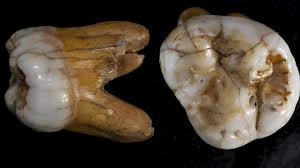
| Our grandfather, T. C. Trumble, a descendant of the Trumble hunter-gatherers of Northern India and the Levant. |
Thanks to the National Geographic Society’s Geno
2.0 Project, I can now dilate further upon the distant origins of us Trumbles. All
such genetic studies begin with the identification of the “marker” for our
oldest male ancestor, and walk forward thence to more recent times, showing at each
step the line of his descendants.
What is a marker? Each of us carries DNA in every cell of our body, a hugely
complex combination of genes passed from both Mum and Dad. This combination endows us with traits
that range from eye color, height, and bone structure (fabulous, if I do say so), to athleticism or otherwise, creativity, intelligence, and even susceptibility
to certain diseases. As part of this process of combination and re-combination, the Y-chromosome is passed
directly from father to son down a
purely male line, in our case the Trumble line, unchanged from generation to generation. Mitochondrial DNA, on the other hand, is passed from mothers
to their children, but only their daughters pass Mitochondrial DNA to the following generations.
In other words it traces a purely maternal line. We have already dealt with this, and, with
it, our exciting dalliance with Neanderthal and Denisovan man.
Now, parts of the DNA are passed on unchanged, unless a
mutation occurs—a random, spontaneous, natural and usually harmless change. The mutation, known as a marker, acts as a beacon; it can be
mapped through generations because it, too, is passed down through the generations for thousands of
years. When geneticists identify such a marker, they try
to determine when it first occurred, and in which region of the
world: in Ethiopia, or Manchuria, or the Yukon, or Borneo, or Tierra del Fuego. Each marker is essentially the beginning of a new lineage on the human family
tree.
Branch M42: ca. 75,000
years ago
The common direct paternal ancestor of all men
alive today was born in Africa around 140,000 years ago. Naturally he was a Trumble. He was neither the
first human male nor the only man alive in his time. He was, however, the only
male whose Y-chromosome lineage has survived until now. All men, including
our direct paternal ancestors, trace their ancestry to one of this man’s
descendants. The oldest Y-chromosome lineages in existence, belonging to the “A”
branch of the tree, are found only in African populations.
Around 75,000 years ago, the “BT” branch of the
Y-chromosome tree was born, defined by many genetic markers, including M42. The
common ancestor of most men living today, some of this proto-Trumble’s descendants began
the journey out of Africa, to India (!) and to the Middle East. Small groups would
eventually reach the Americas. Others would settle in Europe, and some from
this line remained near their ancestral homeland in Africa.
Individuals from this line in Africa often
practice cultural traditions that resemble those of their distant ancestors.
For example, they often live in traditional hunter-gatherer societies. These
include the Mbuti and Biaka Pygmies of central Africa, as well as the
Hadza of Tanzania (formerly Tanganyika), a range of possibilities that I feel quite sure would have tickled my late father, and filled my mother with deep skepticism and, perhaps, a wry or mischievous chuckle. She was modestly proud of her own ancestors.
Now, as M42-bearing populations migrated around the
globe, they picked up additional markers on their Y-chromosomes. Today, there
are no known BT individuals without these additional markers.
Branch M168:
Africa/Asia, ca. 70,000 years ago
As the proto-Trumbles left Africa, they migrated across the
globe in a network of pathways that spread out like the branches of a tree,
each limb of migration identifiable by a marker in our DNA. For male lineages,
the M168 branch was one of the first to leave the African homeland.
Moving outward from Africa and along the
coastline, members of this lineage were some of the earliest settlers in Asia,
Southeast Asia, and, significantly, Australia, the Aboriginal Trumbles. Some from this line
would even travel over the land bridge to reach the Americas.
The Trumble who gave rise to the first genetic marker in our lineage
probably lived in northeast Africa in the region of the Rift Valley, perhaps in
present-day Ethiopia, Kenya, or Tanzania. My preference would be for
Kenya, a distant premonition, as I have already put it, of gins-and-tonic on
the verandahs of suburban Nairobi or in Happy Valley. The descendants of this rather
blasé
Trumble became the only
lineage to survive outside of Africa, making him the common ancestor of every
non-African man living now.
Why did this Trumble and/or his descendants leave Africa?
The first migrants probably ventured across the Bab-al Mandeb strait, a narrow
body of water at the southern end of the Red Sea, crossing into the Arabian
Peninsula soon after M168 originated—perhaps 65,000 years ago. These beachcombing
Trumbles made their way quite rapidly to northern India and Southeast Asia, following the
coastline in a gradual march eastward. One can see it, I think, in the satisfactorily Brahmin Trumble eyebrows. By 50,000 years ago, they had
also reached Australia. These were the ancestors of today’s Australian Aborigines.
It is also likely that a fluctuation in climate
may have contributed to our ancestors’ exodus out of Africa. The African ice
age, as we have already seen, was characterized by drought rather than by cold. Around 50,000 years ago, parts of the inhospitable Sahara briefly became habitable. As the
drought-ridden desert changed to a savanna, the animals hunted by our ancestors
expanded their range and began moving through the newly emerging green corridor
of grasslands. Our nomadic Trumble ancestors therefore followed the good
weather and the animals they hunted, although the exact route they followed
remains to be determined. In addition to a favorable change in climate, around
this same time there was a great leap forward in modern Trumbles’ intellectual
capacity. Many scientists believe that the emergence of language gave we Trumbles a huge
advantage over other early human species. Improved tools and weapons, the
ability to plan ahead and cooperate with one another, and an increased capacity
to exploit resources in ways we hadn’t been able to earlier: all these allowed ancient Trumbles rapidly to migrate into new territories, exploit new resources, and
replace or subsume other hominids such as the Neanderthals.
Branch M89: South Asia
(hmmm) or West Asia, ca. 50,000 years ago
The next male ancestor in our ancestral lineage
is the man who gave rise to M89, a marker found in 90 to 95 percent of all
non-Africans. This Trumble was born around 50,000 years ago in northern Africa
or the Middle East. The first Trumbles to
leave Africa probably followed a coastal route that eventually ended,
satisfactorily, in Australia. Our ancestors followed the expanding grasslands
and plentiful game to the Middle East and beyond, and were part of the second
great wave of migration out of Africa.
Beginning about 40,000 years ago, the climate
shifted once again and became colder and more arid. Drought bore down upon Africa and the
grasslands reverted to desert, and for the next 20,000 years, the Saharan
Gateway was effectively closed. With the desert impassable, our Trumbles
had but two options: to remain in the Middle East, or to press on. Retreat to the
home continent was no longer an option. While many of the descendants of M89 remained in
the Middle East, others continued to follow the great herds of wild game
through what is now modern-day Iran into the vast steppes of Central Asia.
These semi-arid grass-covered plains formed an
ancient “super-highway” stretching from eastern France to Korea. Our Trumbles,
having migrated north out of Africa into the Middle East, then traveled both
east and west along this Central Asian superhighway. A smaller group continued
moving north from the Middle East to Anatolia and the Balkans, trading familiar
grasslands for forests and high country.
Today, geneticists have found the lineage in 1% to
2% of Pakistani and Indian populations. However, it is about 4%
of some Austro-Asiatic-language-family-speaking groups in India. It is about 9% of some Dravidian-language-family-speaking groups in India, and it is 9%
to 10% of male lineages in Sri Lanka. In Borneo, Borneo!, it is about 5%
of the population. In Malaysia, it is about 6% of the population.
Branch P128: South
Asia, ca. 45,000 years ago
The next male ancestor in our ancestral lineage
is the Trumble who gave rise to P128, a marker found in more than half of all
non-Africans alive today. This man was born around 45,000 years ago in the
Middle East or Central Asia. The descendants of P128 migrated to the east and
north, picking up additional markers on their Y-chromosomes. This lineage is
the parent of several major branches on the Y-chromosome tree: O, the most common
lineage in East Asia; R, the major European Y-chromosome lineage; and Q, the
major Y-chromosome lineage in the Americas. These Trumbles went on
to settle the rest of Asia, the Americas, and Europe; many others traveled to
Southeast Asia. Today, P128 individuals lacking these additional
markers are rare in most populations, and are most commonly seen in Oceanian
and Australian Aboriginal populations.
Branch M45: Central
Asia or South Asia, ca. 35,000 years ago
This Trumble traveled with groups in the open
savannas between Central and South Asia during the Paleolithic era. These were big
game hunters, and parents to two of the most widespread male lineages in
modern populations, one that is responsible for the majority of pre-Columbian
lineages in the Americas (haplogroup Q) and many others from Asia and Europe.
Another one that spread farther into Asia produced the highest frequency
lineages in European populations (haplogroup R). Today, Trumbles of this lineage who do not belong to a descendant branch are rare, and
geneticists have found them most often, again, in India. These populations include such
diverse groups as the Saora (23%), the Bhumij (13%), and Muslims
from Manipur (33%).
Branch M207: Central
Asia, ca. 30,000 years ago
Trumble M207 was born in Central Asia around 30,000 years
ago. His descendants went on to settle in Europe, South Asia, and the Middle
East over the following 20,000 years. Today, most western European men belong
to one branch—R–M342—all descended from this glorious Trumble lineage. While it appears to have
been one of the earliest to settle in Europe more than 25,000 years
ago, more recent population expansions associated with the post-glacial re-population
of northern Europe after the end of the last ice age, as well as the spread of
agriculture during the Neolithic, also contributed to its high frequency in
Ireland, Britain, France and Spain. One
descendant lineage—R–L62—is common in Eastern Europe and India (again; are we detecting a pattern?), and was probably
spread in part through the migration of Indo-European steppe nomad Trumbles over the previous 5,000 years.
Branch P231: Central
Asia, ca. 25–30,000 years ago
The Paleolithic Trumble who founded this lineage was
also a nomad. His descendants include two major branches that today account for most
European men and many others from Central Asia, West Asia, and South Asia.
Branch M343: South Asia
or West Asia, 17–22,000 years ago
The first Trumbles of this lineage lived as
hunter-gatherers on the open savannas that stretched from Korea to Central
Europe. They took part in the advances in hunting technology that allowed for
population growth and expansions. When the Earth entered a cooling phase, most Trumbles from
this line sheltered in the southeast of Europe and in West Asia. It was from
these regions that their progeny rapidly expanded when the ice
receded once more. Some of these Trumbles migrated west across Europe. Other Trumbles moved back toward their
distant ancestors’ homelands in Africa, passing through the Levant (!).
Through these movements and the population boom triggered by the Neolithic
Revolution, these Trumbles and their descendants came to dominate Europe.
Today, it has a wide distribution. In Africa, geneticists have found
this lineage in Northern Africa (6%) and central Sahel (23%). Its
frequency in Europe is at times high and at other times moderate. It represents
about 7% of Russian male lineages, about 13% of male lineages in
the Balkans, about 21% of Eastern European male lineages, 55% to 58% of Western European lineages, and about 43% of Central European
male lineages. In Asia, most men of this lineage are found in West Asia (6%) and South Asia (5%). However, trace frequencies of around one half
of a percent from this lineage are present in East Asia, our very distant Han Chinese Trumble cousins.
Branch L278: West Asia,
date yet to be determined
While some Trumbles from this group traveled west
into Central Asia, others moved south toward the Levant. Today, they are
present in trace frequencies of less than 1% in Italy, the Ukraine,
and the region of the Pannonian Basin, pottering about in their characteristically Trumblish way.
Branch P310: West Asia,
date yet to be determined
Trumbles of this lineage strolled into Central
Asia, Europe, and the Levant (!). One such Trumble branch has the highest
frequency of any male line in Western Europe. However, rather than a single
movement across Europe, this lineage’s branches may represent many
simultaneous and successive waves of migration. Today, it is 48% to 52% of male lineages in
Ireland. This comes as no surprise to us, for we already knew that our Irish
great-great-grandfather William Trumble (1828–1908) emigrated to Australia from
Ballymote, Co. Sligo, in 1841, aged fourteen. The family also had connections
to the little town of Castlerock, near Lough Foyle in Co. Londonderry, Northern
Ireland. Their father, John Trumble, was evidently a freeholder, and their
mother’s name was Ann (née Knott). John Trumble survives in the
land records for two parishes in the neighborhood of Ballymote, Co. Sligo. It
seems he paid a church tithe or tax for arable and bottom land, and what is
unsentimentally described as “reclaimed
bog” at Feenaghroe in the parish of
Toomour, to the tune of £1/10/10½.
However, looking at the much farther distant horizon,
we are now sure that Branch P310
also represents 45% of those in France—Les Trumbles. It is about 38% of the male population in Spain—Los Trumbles. It is about 8% of
male lineages in Italy—i Trumble. It is about 5% of male lineages in
Oman. It is 1% to 2% of the male population in Iraq and Lebanon—the Lebanese Trumbles. It is
also 1% to 2% of the male population in Kazakhstan, the sturdy Kazakh Trumbles. Today, members
of this lineage are even more widely distributed across Europe and West Asia. Yet they reached
their highest frequency in Ireland where we and our descendant branches
contribute to between 35% and 38% of the male population. It is between 1%
and 2% of male lineages in Germany—Die Trumbln. It is about 2% of
the male population in Croatia. It is
also present in some paternal lineages from the Ashkenazi population of
eastern Europe. Can this perhaps mean that certain Trumbles were in fact once Jewish, or, at any rate, proto-Jewish—because this almost certainly predated Abraham and Sarah by several millennia? Quite possibly, and, if so, how very wonderful!