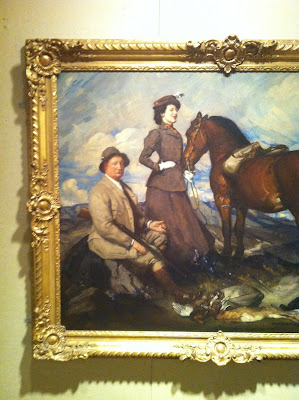
Mr.
John Proctor and Miss Alison Preston have arrived from Perth, Western
Australia, thanks to the generosity of Wesfarmers Limited. This beautifully-painted action
portrait by the Australian expatriate George Washington Lambert, the father of
the composer Constant Lambert, was originally exhibited as Mearbeck Moor, probably to avoid raising indelicate questions as to
the exact character of the relationship between a middle-aged gentleman and a
much younger lady with different surnames posing together in the same portrait. In fact they were
uncle and niece, and the atmosphere of the salubrious outdoor exercise and country sport are
perhaps also misleading. Mr. Proctor was a London barrister, a professional man
whose authoritative pose as a huntsman and maybe squire is therefore strongly aspirational
in tone. I wonder also if the al-fresco cigar, a Cohiba Robustos surely, encodes a hint of metropolitan taste that is slightly at odds with the briskness of a day out riding on the moor, and even slightly vulgar. The brilliant part about getting hold of the objects in an exhibition
and having an opportunity to examine them again at close quarters and for some
considerable time is that you notice many new and intriguing things.

So it was not until last evening that I grasped that Miss
Preston is wearing a pince-nez, or possibly spectacles, which I suppose seems prudent
but rather inconvenient when riding side-saddle. She must have needed them.
Alison Preston is an interesting figure, because the very fact that she is
participating in a hunt at all, and on horseback, implies an independent-mindedness
and a definitely progressive spirit that underlies this particular social gathering, and certainly her own
cheerful participation in it. Edwardian ladies did not usually go out shooting. Indeed, the late
Princess Alice, Duchess of Gloucester, remembered her father-in-law King George
V being genuinely shocked to learn that she firmly intended to accompany the
Duke when he went stalking at Balmoral. And that was in 1935. Given the longstanding
conventions of portraiture, the wearing of spectacles is always noteworthy:
Reynolds made no secret of his, on the contrary. Whistler positively advertised his rimless
monocles. But it is nevertheless most unusual for young women to be portrayed wearing specs.
A tactful artist might have chosen to omit them, and some ladies may also have preferred to be portrayed without. That Miss Preston wears hers
here strongly suggests to me that the detail existed either with her blessing, or possibly at her instigation. I like her choice of hatpin, too: a
jumbo South Sea pearl to go with the riding outfit. Splendid!
.JPG)
We are told that last Friday evening’s blizzard, known as
Nemo, was a once-in-a-century event. Well, yes, but notice how many of these we seem to be getting nowadays. I have never experienced
anything remotely like it. Here in New Haven, a fraction more than thirty-four
inches of snow fell in twenty-four hours, but neighboring Hamden got more than
forty. Certainly the snow that drifted along the front of my house in the Westville neighborhood was much
deeper than three feet, more like six. It is not difficult to describe the
fundamental difference between an ordinary snow storm and a blizzard. Storm has
always struck me as a misnomer. When it merely snows there is a delicious quiet,
a softness, an atmosphere almost of calm not unlike the effect of a blanket—provided
you are safely tucked up in bed, or sitting by the fire with a cup of tea and a
good book. A blizzard, by contrast, has teeth, fangs, claws. The snow starts to behave like
grit against doors and window-panes. It penetrates nooks and crannies. It scrapes and mauls. There is a howl in the wind, and a
sinister air of real danger. Walking in a snow storm can be pleasant, if at
times hard work. Trudging through a blizzard is hazardous. You cannot see.
Your footing is at best uncertain. The cold is especially severe. You
must seek shelter. Nothing better accounts for the practical purpose and
life-saving rationale of the covered bridges of New England than a
fully-fledged blizzard. On Saturday morning the impact of Nemo was almost
overwhelming in its scale. Dozens of snow plows, emergency vehicles and cop cars lay
abandoned in city streets like so many woolly mammoths. The streets were
impassable, even on foot. Plucky citizens began to shovel, but as the city’s
monster digging equipment began to carve single-lane canyons through the middle
of the main arteries their efforts were largely annulled or even reversed because of the
immense walls of snow thrown up on either side. On Monday it began to
rain and, the drains being blocked with snow, the whole concoction began to
settle into deep, frigid puddles, soon to become sullen floes of ice, exceedingly unhelpful.
Still the city chugged ahead. The Governor temporarily lifted a ban on dumping
snow into Long Island Sound because there really was nowhere else to put it.
Now, nearly a week later, a small army of diggers, earth moving equipment and
dump trucks are still loading up with immense quantities of snow, gradually clearing the streets and
parking lots. The university was closed for classes on Monday and Tuesday,
something that through 312 years is almost unheard-of. I must say that the citizens of New Haven exhibited extraordinary patience, forbearance, generosity, and good cheer amid the
most trying circumstances. Frustrating though it is to be holed up for days on
end, and to experience the onset of cabin fever, most people were philosophical—merely
breathing silent prayers lest the snow and ice on the roof formed a destructive
ice dam, or worse. The excellent Tony Maratea managed to carve me out a portion
of my drive in which to park, and also a little path to the back door, but I
have no idea how on earth he will clear the rest of it. Forget the snow-blower, this
requires at least a Bobcat. In the meantime, we continue to install our exhibition, and have really only lost two working days as a consequence of the
blizzard. Only two weeks to go, but I am sure we will get the job done.

Orpen’s
bill from the Café Royal carries a distinctive monogram, the capital letter N
beneath a crown. This haughty gesture recurs throughout the lavish
interior decorations of the café, and, I fancy, embraces a degree of Gallic
mischief. In 1865, Daniel-Nicolas Thévenon, a French wine merchant, established
the Café Royal in extensive premises on the Crown Estate at the bottom of
Regent Street, hard by Piccadilly Circus. He anglicized his name to Daniel
Nicols, and by the end of the century his son and namesake took the Café Royal to
new heights of opulence. Its cellars were famous for their size, distinction,
and rarity. The Café Royal became one of the most fashionable establishments in
the West End, and was frequented by artists and writers such as Oscar Wilde, Aubrey
Beardsley, Arthur Conan Doyle, H. G. Wells, George Bernard Shaw, Rudyard
Kipling, W. B. Yeats, Walter Sickert, Max Beerbohm, James McNeill Whistler, William
Nicholson, Augustus John, and obviously William Orpen too. The character of the
place embraced the dizzyingly high, expressed above all by its
extravagant décor, but also the forthrightly low. Some of the early rules of
boxing were first written down in the building, and contests were regularly
staged there. No doubt this was something that drew Nicholson and John
especially—both were connoisseurs of the boxing ring. From the vantage point of
the 1920s and 1930s, when it was still going strong, the Edwardian Café Royal was
recalled as so many charmed caverns, their gilding and encrusted ornamentation softened
by thick blue cigar smoke, and the buzz of brilliant talk brightened further by
the clack and shuffle of dominoes over marble. Through all of this, not unlike
the flamboyant César Ritz, Daniel Nicols oversaw his palatial establishment
with the flair and instinct for public relations that distinguishes a true
impresario. He was the svengali of catering, a gentleman moreover eagerly
sought after for preferred table reservations, or, in the case of social indiscretions,
tables in quiet corners. His monogram refers unabashedly to that of
Napoleon, but also implies no less imperial authority wielded over a West End
café society that increasingly sought to distinguish itself from the
starchiness of clubland, the inaccessibility of the Court, and from the rough
and tumble of music hall entertainment.

Installation
continues apace. This morning we unpacked, condition-checked, and hung the great self-portrait by Sir
William Orpen entitled Myself and Venus that comes to us from the Carnegie Museum of Art in Pittsburgh, Pennsylvania. At once I realized I
have made an error in the relevant catalogue entry. The picture is very close to the artist’s nearly contemporaneous Self-Portrait (Leading the Life in the West) in the Metropolitan Museum of Art,
which unfortunately cannot travel any more, and it contains the same conceit of the large, framed mirror facing
the window of Orpen’s studio. In the New York painting Orpen showed various
invitations, letters, opened envelopes, and other pieces of colored paper slipped between
the vertical edges of the mirror and the wall, but in the Pittsburgh picture there is only one—which I
took to be a newspaper clipping, perhaps a positive notice in one of the
weeklies, or some such. That would be consistent with his steadily growing self-regard.
Instead I
see now that this large piece of paper is a sizeable bill from The Café Royal, an itemized check, quite a long one, to which Orpen has
added his notional and, I suppose, actual signature at the top, the souvenir of a bibulous evening spent with artist friends in
that glamorous establishment at the bottom of Regent Street, hard by Piccadilly Circus, presumably in the
opulent surroundings of the Domino Room. As it happens, we will have
Charles Ginner’s view of the interior of that very room in the next bay but
one, so this could not be a happier state of affairs. As well, the plaster
cast of Orpen’s Venus is also present in his collegial group portrait from the Manchester City Art Gallery entitled
Homage to Manet, but because in the Pittsburgh picture it is seen by Orpen reflected in the mirror with which he also sees himself it is naturally
reversed. These two paintings will hang side by side, which is a rather neat
curatorial stratagem, if I do say so.

The Anglo-French condominium or joint administration of the New
Hebrides formed between 1904 and 1906 against a sinister backdrop. The southwestern
Pacific islands of Melanesia had for decades attracted the attention of nineteenth-century
Church of England, Methodist, Presbyterian, and Catholic missionaries, whose
motives ranged from the genuinely enlightened to the expedient and nakedly sectarian.
At the enlightened end was a deep concern for indigenous people who were target and victims of the criminal trade in indentured labor for the cane fields of Queensland
and indeed many other places and purposes, a form of illegal serfdom that had existed since the 1860s to which successive colonial governments turned a blind eye. Annexation by Australia or by Britain was
urged upon Whitehall therefore as a way of eradicating this form of modern slavery.
At the same time it was also feared that if annexation did not take place the
islands would be turned into a French penal colony, possibly worse even than
Devil’s Island, and a further concern was obviously that the indigenous
people would inevitably become francophone and therefore Catholic. Ironically
considerable opposition to annexation came from the “White Australia” lobby,
which was sufficiently developed at this date to argue for the abolition of the
traffic in kanak labor not upon humanitarian grounds but rather for the purpose
of racial purification. Beyond this hideous rationale, the White Australia lobby
had already succeeded in persuading inter-colonial legislatures to enact impossibly
high tariffs on maize, coconuts, and other crops from the New Hebrides
so as to discourage trade with the coloured islanders, a state of affairs to which the
French gleefully responded by encouraging and extending the flow of commodities back and forth between Port
Vila and Noumea, the chief port in their thriving nickel and copper colony of New
Caledonia. According to the veteran Scottish missionary Dr. John Gibson Paton, the New
Hebridean islanders used to call themselves Queen Victoria’s children, and by
1904 were calling themselves the children of Queen Victoria’s son. No doubt
they had long been encouraged to do so by British missionaries, but he thought
annexation was in the best interests of the islanders, of the Commonwealth, and
of the Empire, and that the proposed condominium was a thoroughly bad idea. Of
course this view did not prevail in the end, and it is interesting to observe
that the condominium was at first interpreted by the Conservative opposition to the Liberal government of Sir Henry Campbell-Bannerman at
Westminster as a dangerous concession that undermined British imperial
interests everywhere, particularly in the partly French-speaking colony of Newfoundland
(not yet a part of Canada), and by the predominantly white dominions themselves
as a potentially unwelcome threat to “progressive unity” between their interests
and those of the imperial capital. Old debates can be extraordinarily
revealing, and battle-lines over long-forgotten issues not necessarily easily
comprehended. In these circumstances, and balancing these arguments against
current orthodoxies, it is hard to know whether one would have been for or
against the annexation of the New Hebrides, or indeed for or against the Anglo-French condominium.
Fortunately the issue is unlikely to arise again in this particular form, although
the Republic of Vanuatu, as the New Hebrides are now known, is seriously threatened by
the gradual but inexorable rise in sea level, so the fate of its
gentle Melanesian population may again claim the moral attention of the world.
One of the most bizarre consequences of the Entente Cordiale of 1904,
that set of friendly agreements between France and Britain mostly relating to
the two nations’ colonial possessions all over the world, and especially those that
abutted, was the establishment in 1906 of the “condominium” by which France and
Britain jointly administered the New Hebrides. That island group in the South
Pacific achieved independence in 1980 and has since been known as the Republic
of Vanuatu.
The first European encounter with the islands took place in 1605 when a Spanish expedition named them Espiritu Santo. Louis-Antoine de Bougainville “re-discovered” the locality in 1768, and Captain James Cook followed in 1774. Cook named the islands New Hebrides. The French and British showed little interest in the islands before the 1860s, and both laid claim to the New Hebrides in the 1880s, but with distinct lack of enthusiasm. The condominium effectively resolved this competition, and divided the New Hebrides into two separate
but nevertheless intermingled communities—English- and French-speaking. For most of the remainder of the twentieth century
this curious arrangement insured that there were two currencies circulating side-by-side in the same tills,
two sets of immigration procedures for bemused visitors to choose between, two
justice systems, two education systems, effectively two colonial governments, each exactly
mirroring the other, but naturally reflecting the different methods of colonial administration practiced in London and Paris. The British and French each appointed a co-equal “resident” from the Foreign Office in Whitehall and
from the Quai d’Orsay, and their staff on the ground in Port Vila emphasized dualism to the
point of farce. Every European official in one residency had an opposite number
in the other with whom he was required to consult but with whom he rarely
agreed. The condominium thus
shared jurisdiction over the postal service, for example, but
postage stamps were either British or French, and paid for with pounds sterling
or francs issued by the Banque de l’Indochine. Indigenous people could choose whether to be tried under the
British common law or the French civil law. Nationals of one country could
set up corporations under the laws of the other. In addition to these two
legal systems, a third court existed to handle cases involving traditional Melanesian
customs and usage. Further, Britain and France agreed that the judge presiding over this native
court should be appointed by the King of Spain in order that he could also decide
with impartiality certain cases in which the French and British judges’
opinions or even whole branches of law were in conflict. The origin of this otherwise inexplicable arrangement was picturesquely historical. As well, there were
two prison systems to complement the two different “national” courts. The police force was
technically unified but consisted of two co-chiefs and equal numbers of officers
wearing different uniforms. Each half strictly alternated their duties and
assignments. The Union Jack and the
Tricouleur were raised each morning in perfect synchronization, and flew
side-by-side. When one or the other had to fly at
half-mast, the other gallantly followed suit. Language was not the only barrier to
the operation of this crazy system—because all documents had to be translated
once to be understood by one side, and the response translated back again for the other. Bislama creole created further complications, although for those who could speak it Bislama did form an informal bridge
between the British and the French administrations. The condominium was further
strained by the radically different purpose each country had for being in
the New Hebrides in the first place. Britain’s colonization of these and many other islands in the South Pacific was driven
not by the Colonial Office in Whitehall, which consistently resisted their gradual annexation, but
rather by pressure placed on the imperial government through the 1870s and 1880s by Australian and New Zealand
colonists with voracious commercial ambitions, and a corresponding need to prevent them from doing too
much harm. The French, by contrast, took a much more active interest in the
region, largely to protect their much larger commercial interests in New Caledonia, and in turn
their even more profitable strategic presence in French Indo-China. We are still living with the consequences of that. During the post-war period the
rationale for the Anglo-French condominium was somewhat extended by the dirty business of
testing atomic devices in remote atolls, reefs, and islands—the anxious and increasingly paranoid quest for the
H-bomb. However, that it worked for more than seventy years, or even at all, seems
to me utterly remarkable.


.JPG)


